IN Brief:
- The US Army has awarded AeroVironment a $464.8 million Other Transaction Agreement for the E-HEL programme.
- Dozens of 30kW LOCUST X3 systems are planned, including JLTV and palletised configurations, with training and ongoing support.
- A $30 million Albuquerque investment will support the production ramp as the programme moves from prototype activity into multi-year fielding.
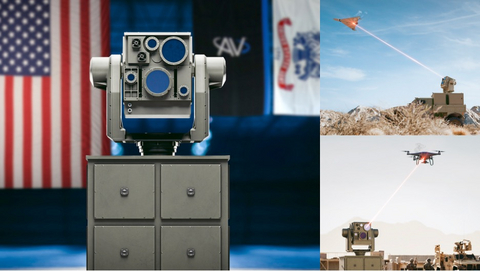
AeroVironment has received a $464.8 million US Army award for the Enduring-High Energy Laser programme, moving its LOCUST X3 counter-UAS system into multi-year production and fielding. Under the Other Transaction Agreement, the company will deliver dozens of laser weapon systems over the next few years together with platform integration, training, and ongoing support.
The award is a significant change of phase for the programme. AeroVironment describes it as the first US production contract for directed-energy systems, but the more immediate industrial point is that the Army is now buying repeated hardware output rather than funding another isolated prototype. LOCUST X3 has to move through manufacturing, acceptance, integration, and sustainment as a fleet.
The 30-kilowatt system is intended to counter Group 1-3 uncrewed aircraft within a layered air-defence architecture. AeroVironment says it will be integrated on platforms including the Joint Light Tactical Vehicle, with palletised configurations also planned and an Infantry Squad Vehicle installation under study. Those options make the laser less dependent on one vehicle, but they also create different integration requirements around power, cooling, weight, shock, space, and crew access.
A high-energy laser is not a single component that can simply be bolted to a vehicle. The complete system depends on sensors, target tracking, beam control, power electronics, thermal management, computing, and software capable of keeping energy on a selected aim point for long enough to produce an effect. Production therefore requires several engineering disciplines to arrive at the factory in matched configurations.
The E-HEL programme builds on the Army Multi-Purpose High Energy Laser prototypes already in use and follows testing at White Sands Missile Range. AeroVironment says that work demonstrated safe counter-drone operation in US airspace and supported coordination between the Department of War and Federal Aviation Administration over domestic laser use. The production award therefore follows an extended prototype and test phase rather than arriving before the system has been exercised.
AeroVironment is backing the manufacturing transition with a $30 million investment in its Albuquerque, New Mexico, facility. That expansion is intended to support higher directed-energy output, giving the contract a defined production base. The company now has to turn the manufacturing process into something repeatable enough for dozens of systems rather than a small number of engineering builds.
Repeatability is a different problem from demonstration performance. Each production unit needs controlled alignment, calibration, and acceptance data, while optical components, power electronics, and thermal hardware have to arrive in sufficient quantities and at consistent quality. Software also needs configuration control so that a fielded fleet can be updated without losing track of which hardware and software combinations have been tested together.
Directed energy offers an attractive counter-UAS cost model because the energy consumed in an engagement can be cheaper than firing a conventional missile at a small drone. That does not make the system free to operate. Electrical generation, cooling, maintenance, optics cleaning, spare parts, and trained operators remain part of lifecycle cost, while weather, dust, obscuration, and atmospheric turbulence can reduce performance.
Those physical limits explain why LOCUST is being fielded within layered air defence rather than as a universal replacement for guns, missiles, or electronic warfare. Different effectors cover different target classes and environmental conditions, and a laser is most useful when its advantages in magazine depth and cost per engagement can be exploited without ignoring line-of-sight or weather constraints.
The platform-agnostic approach introduces another manufacturing consideration. A palletised system can simplify deployment to some sites, while a vehicle-integrated version may improve mobility and protection, but each installation changes cable runs, mechanical interfaces, thermal rejection, and power architecture. The more platform variants the Army adopts, the more disciplined the baseline will need to be to prevent integration work from fragmenting the production programme.
The new contract also includes training and ongoing system support, recognising that fleet readiness depends on more than delivering hardware. Operators have to understand engagement procedures and safety constraints, while maintainers need diagnostic tools, replacement parts, and repair processes. Directed-energy systems introduce specialist optical and electrical maintenance demands that have to be accommodated alongside ordinary vehicle support.
The award confirms the production move anticipated when the Army was evaluating LOCUST for enduring fielding. AeroVironment has now crossed the technical threshold required to secure an enduring programme award. The next threshold is industrial: whether dozens of systems can be manufactured to the same standard, integrated on multiple platforms, and kept available once they are distributed to operational units.