IN Brief:
- The Submarine Delivery Agency has awarded MSubs a £6.68m contract for CETUS trials and evaluation.
- CETUS, formally named XV Excalibur, is a 12m extra-large uncrewed underwater vehicle built for Royal Navy experimentation.
- The next phase will test autonomy, payload integration, support procedures, and future industrial routes for undersea robotic systems.
Britain’s CETUS extra-large uncrewed underwater vehicle is moving into a new trials and evaluation phase, with the Submarine Delivery Agency awarding Plymouth-based MSubs a £6.68m contract covering work through 2028.
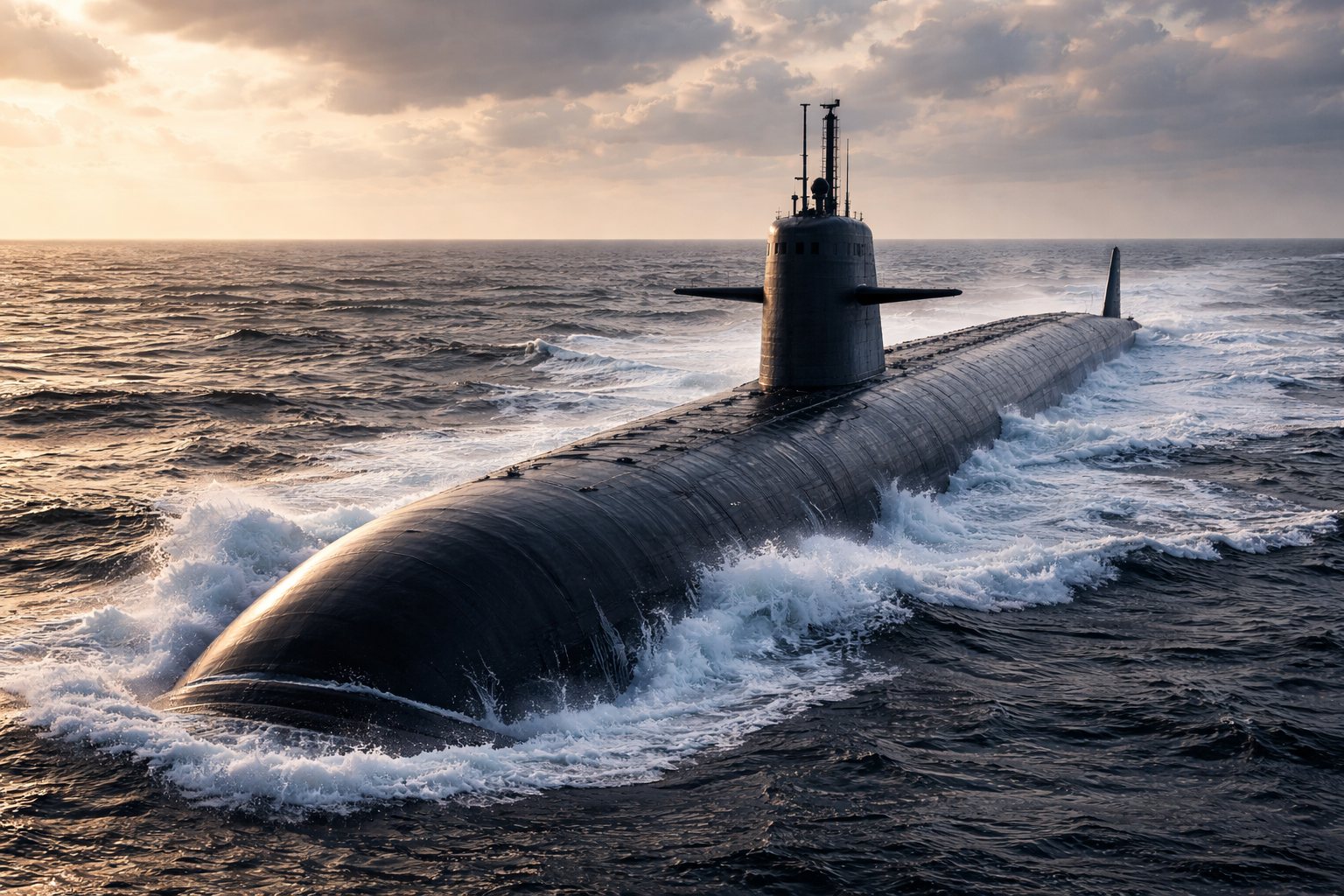
The vehicle, formally named XV Excalibur, is a 12m extra-large uncrewed underwater vessel developed as a Royal Navy testbed for future undersea autonomy. The new contract covers trials, evaluation, payload work, and de-risking of autonomous underwater operations. The programme now shifts from the symbolic value of a large uncrewed submarine into the harder work of proving what the platform can carry, how it behaves, and how industry would support a larger operational family.
Undersea autonomy is moving toward larger and more complex systems. Small UUVs have long supported mine countermeasures, survey work, and specialist tasks, while extra-large systems bring a different production burden. Pressure hull design, energy storage, propulsion, endurance, communications, payload handling, launch and recovery, navigation, safety certification, and long-duration reliability all become defining engineering problems.
MSubs’ role gives the programme useful continuity. The Plymouth company designed and built the CETUS testbed, so the trials contractor understands the vehicle’s architecture from first principles. That continuity can reduce integration risk, although it also highlights how narrow parts of the UK undersea autonomy supply chain remain. Scaling from one experimental platform to an operational class would require wider supplier capacity, standard payload interfaces, maintainable designs, and repeatable production processes.
CETUS’ size gives it the payload and endurance headroom that smaller systems cannot offer. A 12m underwater vehicle can support larger sensors, seabed payloads, communications packages, power modules, and future mission experiments. Size also brings practical handling requirements. Shore facilities, cranes, transport arrangements, battery or energy-management procedures, software loading, test ranges, support tooling, and safe recovery processes become part of the operational concept.
The same undersea-autonomy pressure is visible in BAE Systems’ work to move Herne toward a manufacturable extra-large autonomous underwater vehicle. Herne and CETUS are separate efforts, but both point toward a Royal Navy market in which payload-flexible underwater robots must move beyond bespoke demonstrators. The sector’s next test is manufacturability, not novelty.
Autonomy will be one of the hardest areas to prove. Underwater vehicles cannot rely on continuous high-bandwidth communications. They need robust navigation, fault management, mission logic, obstacle avoidance, health monitoring, and recovery behaviours. A failed surface drone may be visible and recoverable. A failed XLUUV can become expensive, sensitive, and difficult to retrieve. Software testing, simulation, onboard diagnostics, and fail-safe design therefore sit at the centre of the production challenge.
Navigation also remains a demanding technology stack. Submerged vehicles cannot use GPS in the same way as air and surface systems. Inertial navigation, acoustic positioning, terrain-aided methods, precise timing, and emerging quantum technologies all have roles in extending endurance and accuracy below the surface. Earlier quantum-clock work on XV Excalibur shows how navigation, timing, autonomy, and mission data will mature together rather than as isolated subsystems.
Payload integration will decide whether CETUS becomes a useful industrial stepping stone or a one-off demonstrator. A large underwater platform should not be locked to one mission profile. Modular payload bays, standard power and data interfaces, safe handling systems, mission software, and repeatable test procedures will be essential if the Royal Navy wants to experiment without redesigning the vehicle for every new payload.
The hybrid-fleet debate gives the programme a wider naval context. Britain’s shift toward a more mixed fleet of crewed and uncrewed systems will need surface vessels, submarines, underwater vehicles, distributed sensors, and command networks that can work together. Large autonomous underwater systems add a difficult undersea layer to that architecture. Without common interfaces and support models, the future fleet risks becoming a collection of impressive but isolated machines.
For UK industry, the opportunity is substantial, but building one sophisticated underwater demonstrator is not the same as producing and sustaining useful vehicles. Suppliers will need to industrialise pressure structures, propulsion systems, energy modules, autonomy software, payload bays, communications, shore support, and test methods. Designs must be maintainable by naval personnel rather than a small circle of original engineers.
CETUS’ next phase should produce less theatre and more useful evidence. Payload trials, autonomy performance, range work, support burden, and reliability data will show whether the UK has a credible route toward larger undersea robotic systems. The Royal Navy has the experimental vessel. The production question now moves to repeatability.