IN Brief:
- Lockheed Martin is set to expand GMLRS production under a reported $3bn US Army award.
- GMLRS remains the core precision rocket family for HIMARS and M270 launchers.
- Manufacturing pressure will fall across propulsion, energetics, guidance, electronics, actuation, testing, and supplier capacity.
Lockheed Martin’s $3bn US Army award for Guided Multiple Launch Rocket System production reinforces the scale of demand behind HIMARS and M270 launcher fleets, keeping one of the West’s most important precision-fires production lines under sustained pressure.
GMLRS remains the workhorse rocket family for the HIMARS and M270 ecosystem. It sits below longer-range missiles such as PrSM, while offering greater reach, accuracy, and operational effect than traditional tube artillery. Demand has grown as US and allied forces expand launcher fleets, replenish stocks, and adjust to a battlefield where precision munitions are consumed faster than pre-war planning assumptions allowed.
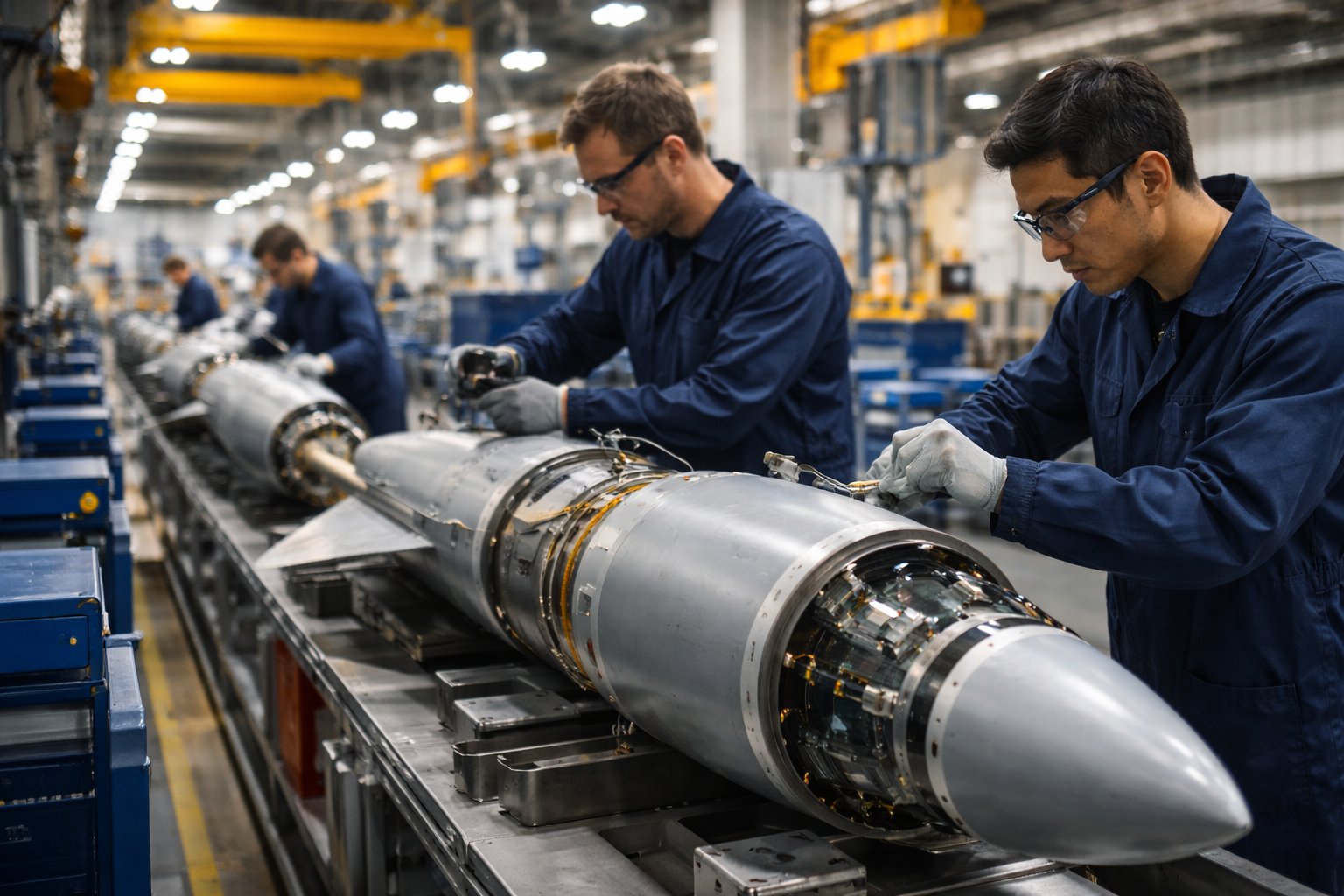
The manufacturing challenge extends well beyond final rocket assembly. GMLRS production draws on rocket motors, propellants, warhead sections, guidance packages, control actuation systems, electronics, structural components, fuzes, launch-pod integration, acceptance testing, packaging, and storage. Each area has qualified suppliers, safety procedures, inspection points, and capacity limits. A large headline contract does not increase output unless sub-tier suppliers can also expand.
Propulsion remains one of the most visible bottlenecks. Solid rocket motor production depends on specialist chemicals, mixing, casting, curing, inspection, energetics safety, and trained labour. Facilities cannot be expanded casually; they require permitting, safety distances, tooling, workforce development, and quality evidence. Warhead and other energetic components face similar constraints. Procurement decisions can move faster than the industrial base behind them.
Guidance and electronics bring a different set of risks. Precision rockets require rugged processors, navigation hardware, control electronics, software, and power components that can survive launch stresses and long storage periods. Semiconductor availability, obsolescence, counterfeit risk, export controls, and component substitution all affect munitions production. A new electronic part cannot simply be swapped into a qualified rocket without testing and configuration-control work.
The award also sits alongside the Army’s shift toward longer-range fires. PrSM is moving into a more prominent deep-strike role, but GMLRS remains the volume layer beneath it. Armies need both: enough GMLRS for routine precision fires and enough longer-range missiles for deeper, higher-value targets. If the lower-cost precision rocket layer becomes scarce, expensive long-range weapons may be pulled into missions that do not justify their use.
Allied procurement is reinforcing that layered-fires model. HIMARS and M270 users need launchers, rockets, training, fire-control updates, vehicles, spares, storage infrastructure, and maintenance capacity. Every new launcher customer adds demand for rocket stocks large enough to support training and wartime use. Precision weapons once treated as scarce strategic assets are now expected to be available at operational volume.
Variant complexity also affects the line. Standard and extended-range GMLRS rockets create overlapping but distinct production and qualification demands. Extending range can affect motor design, airframe loads, guidance behaviour, thermal stress, accuracy, and pod compatibility. A factory network has to manage those changes without slowing output or confusing logistics.
For Lockheed Martin, large awards provide factory loading and supplier confidence, while also exposing any weak link in the chain. Workforce availability, machine capacity, energetics supply, test-range scheduling, quality escapes, transport, and inspection resources all influence delivery. Missile and rocket factories are increasingly judged by rate and resilience, not only by product performance.
The domestic industrial-base challenge is difficult to overstate. US munitions production spent years sized for lower demand, while recent conflicts have exposed the need for larger stocks and faster replenishment. Capacity expansion requires predictable orders, multi-year funding confidence, supplier investment, and attention to unglamorous bottlenecks in castings, chemicals, electronics, test equipment, and quality personnel.
Allied demand can help by giving industry a wider order book, but it also competes for delivery slots. Foreign Military Sales and partner purchases strengthen the business case for investment, while US stockpile requirements remain urgent. The same tension is visible across other missile families, including air-to-air weapons, air-defence interceptors, and next-generation fires.
GMLRS will remain central because it occupies the practical middle of modern land fires: mature, precise, widely integrated, and compatible with launchers that many allies either operate or want. Those advantages make it valuable and expose it to sustained demand pressure.
The award is another marker in the long rebuild of Western munitions capacity. GMLRS is not short of customers or operational relevance. The harder question is whether the factory network behind it can produce enough rockets, across the right variants, with enough resilience to support a force structure that now expects precision fires to be routine.