IN Brief:
- Nearly 60% of the tested TJ150 engine by volume was produced through additive manufacturing.
- More than 50 hot-section components were consolidated into a small number of printed parts.
- The programme targets simpler assembly and faster production for expendable weapons and autonomous systems.
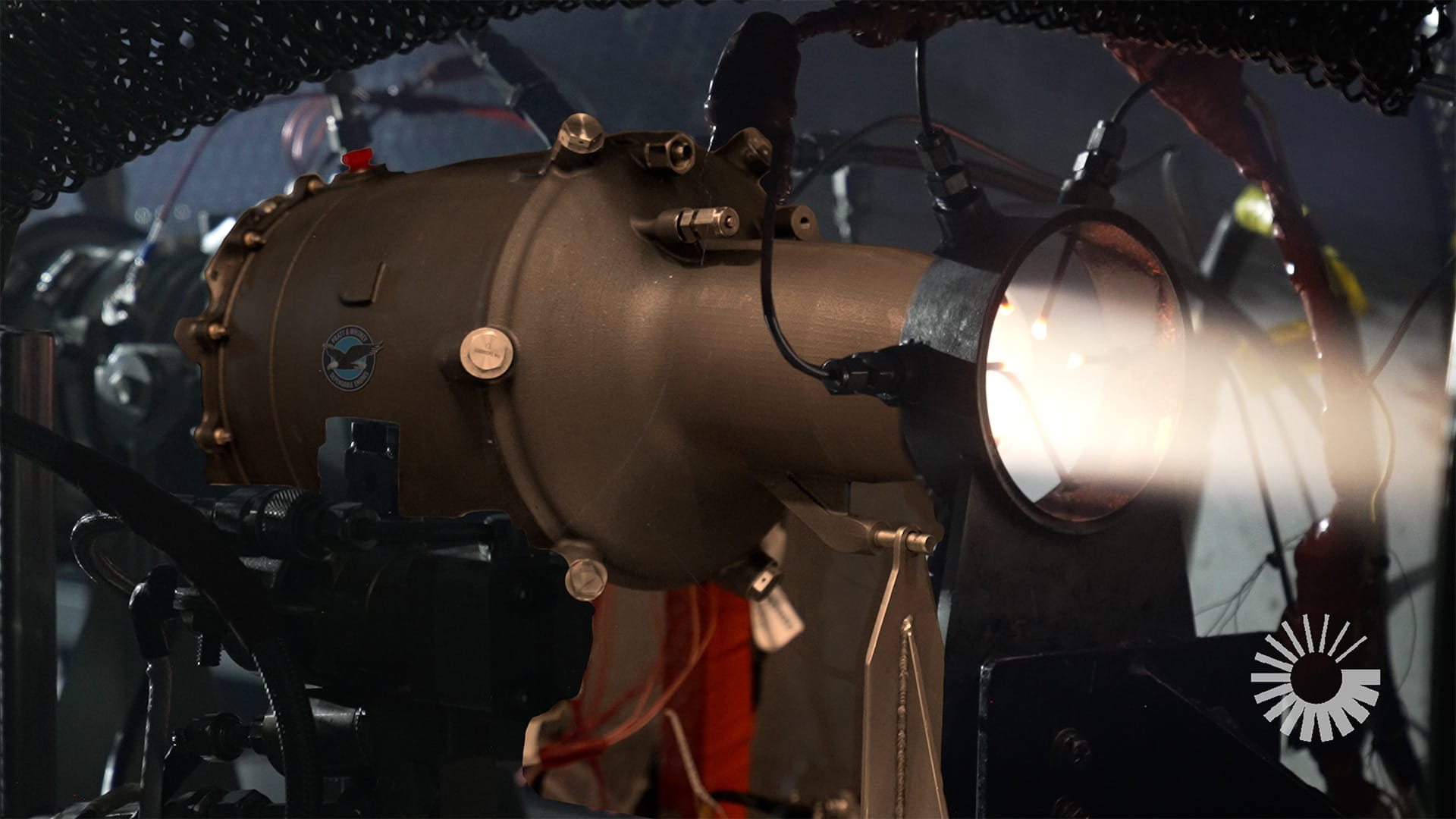
Pratt & Whitney has completed a demonstration test of an additively manufactured TJ150 engine configuration, advancing its effort to simplify production of compact propulsion systems for autonomous aircraft and weapons.
Nearly 60% of the tested engine by volume was produced through additive manufacturing. The printed hardware included major static components and rotating equipment, with an additively manufactured turbine wheel operating under representative conditions.
More than 50 conventional hot-section components were consolidated into a handful of printed parts. Reducing the part count can remove joints, fasteners, welds, brazed connections, separate inspections, work instructions, and supplier transactions from the assembly process.
The TJ150 occupies the 150lb-thrust class and is intended for expendable or short-life applications where customers need dependable performance, predictable cost, and high production output without the service life expected from a reusable aircraft engine.
Such engines still face severe operating requirements. They may remain in storage for extended periods before enduring launch loads, rapid acceleration, temperature extremes, altitude changes, and continuous high-power operation throughout a mission.
Additive manufacturing allows engineers to create internal passages, integrated cooling features, and complex shapes that may be difficult or uneconomic through casting and machining. Digital design changes can also reach test hardware without requiring a complete replacement of dies, patterns, or specialist tooling.
Part consolidation provides a broader production advantage than geometry alone. Fewer components can reduce inventory, assembly time, tolerance stack-up, and the number of interfaces at which leaks or mechanical failures may develop.
Printing shifts rather than removes control
Metal additive manufacturing retains a demanding process chain. Powders require controlled chemistry, particle size, storage, handling, and reuse limits, while build machines depend on calibration, stable parameters, environmental control, and continuous monitoring.
Printed components also need heat treatment, support removal, machining, surface finishing, dimensional inspection, and non-destructive examination. Some operations disappear through consolidation, but others move into post-processing and quality assurance.
A successful engine run validates the basic design and material behaviour, although rate production requires repeatability across machines, operators, powder batches, and facilities. A component that prints successfully during development may still deliver an unacceptable rejection rate when produced in hundreds or thousands.
Machine time can become a constraint because dense metal parts may occupy a build chamber for many hours. Output then depends on the number of qualified machines, build layout, maintenance, powder availability, and capacity across heat treatment, machining, and inspection.
Consolidation also changes the cost of defects. Combining dozens of parts into one structure reduces assembly work, but a flaw in the printed component can scrap more material and machine time. Internal passages may be difficult to inspect, requiring well-defined acceptance criteria and process monitoring.
The turbine-wheel trial carries particular weight because rotating hardware faces high centrifugal, thermal, and fatigue loads. Printed rotating components demand confidence in material consistency and defect control beyond that required for many static brackets or housings.
Experience from the TJ150 will feed Pratt & Whitney’s Valox family of compact engines. A shared technology and manufacturing base could allow several thrust classes or mission configurations to use common powders, machines, controls, inspection methods, and suppliers.
That family approach arrives as demand for lower-cost propulsion grows across missiles, loitering weapons, decoys, and autonomous aircraft. Required quantities may exceed traditional peacetime engine output, while the number of established suppliers remains relatively small.
Conventional production is frequently restricted by castings, specialist alloys, bearings, controls, ignition equipment, and inspection capacity. Efforts to automate persistent casting bottlenecks have demonstrated how lower-tier processes can restrict output even when prime contractors expand final assembly.
Additive manufacturing may reduce reliance on selected castings and tooling, although it creates demand for qualified powders, high-value machines, inert-gas systems, specialist software, and post-processing capacity. Resilience will depend on those inputs being available across more than one facility.
The relevant economic measure is cost per accepted engine rather than the cost of an individual printed part. Powder consumption, machine depreciation, energy, failed builds, inspection, machining, finishing, and labour must be compared with conventional manufacturing at the required production volume.
Printing most of a compact engine by volume represents a broader production experiment than an isolated additive component. The remaining task is to show that the architecture can be reproduced at rate, with stable yield, controlled material properties, and enough qualified capacity to meet demand for expendable propulsion.