IN Brief:
- Fire Point is building a solid rocket propellant plant at Vojens in Denmark, its first production facility outside Ukraine.
- The site will cover more than 120,000m² and is scheduled to begin operations by the end of 2027.
- Planned capacity would allow propellant loading for around 800 to more than 4,000 missiles annually, depending on demand and product mix.
Fire Point is building a solid rocket propellant production facility at Vojens in southern Denmark, creating the Ukrainian defence company’s first manufacturing site outside its home country and adding a new European production node for several of its missile programmes. Operations are now scheduled to begin by the end of 2027.
The plant will cover more than 120,000 square metres and is intended to produce solid propellant for Fire Point missile systems. The company says its planned capacity would allow it to load propellant for between around 800 and more than 4,000 missiles annually, depending on demand and the type of weapon being produced.
Initial output is expected to support the FP-7 and FP-7.x missile families alongside booster requirements for the FP-5 Flamingo cruise missile. Fire Point says production will remain focused on Ukrainian Armed Forces requirements while the war continues, although the scale and location of the investment also give the company an industrial foothold inside the wider European defence market.
Vojens adds an overseas production node
The Danish project has moved beyond a proposed investment. Fire Point says construction work is already under way, including excavation for the main production hall, following development of the project with Danish authorities. The company is working within a regulatory framework created specifically to enable establishment of the Vojens facility while retaining local safety requirements around an inherently sensitive manufacturing process.
The timetable has nevertheless moved to the right. Earlier Danish planning envisaged production activity beginning sooner, while Fire Point’s latest update now places the operational start by the end of 2027. For a solid rocket propellant plant, the delay is a useful reminder that expanding missile capacity is not equivalent to adding another assembly building.
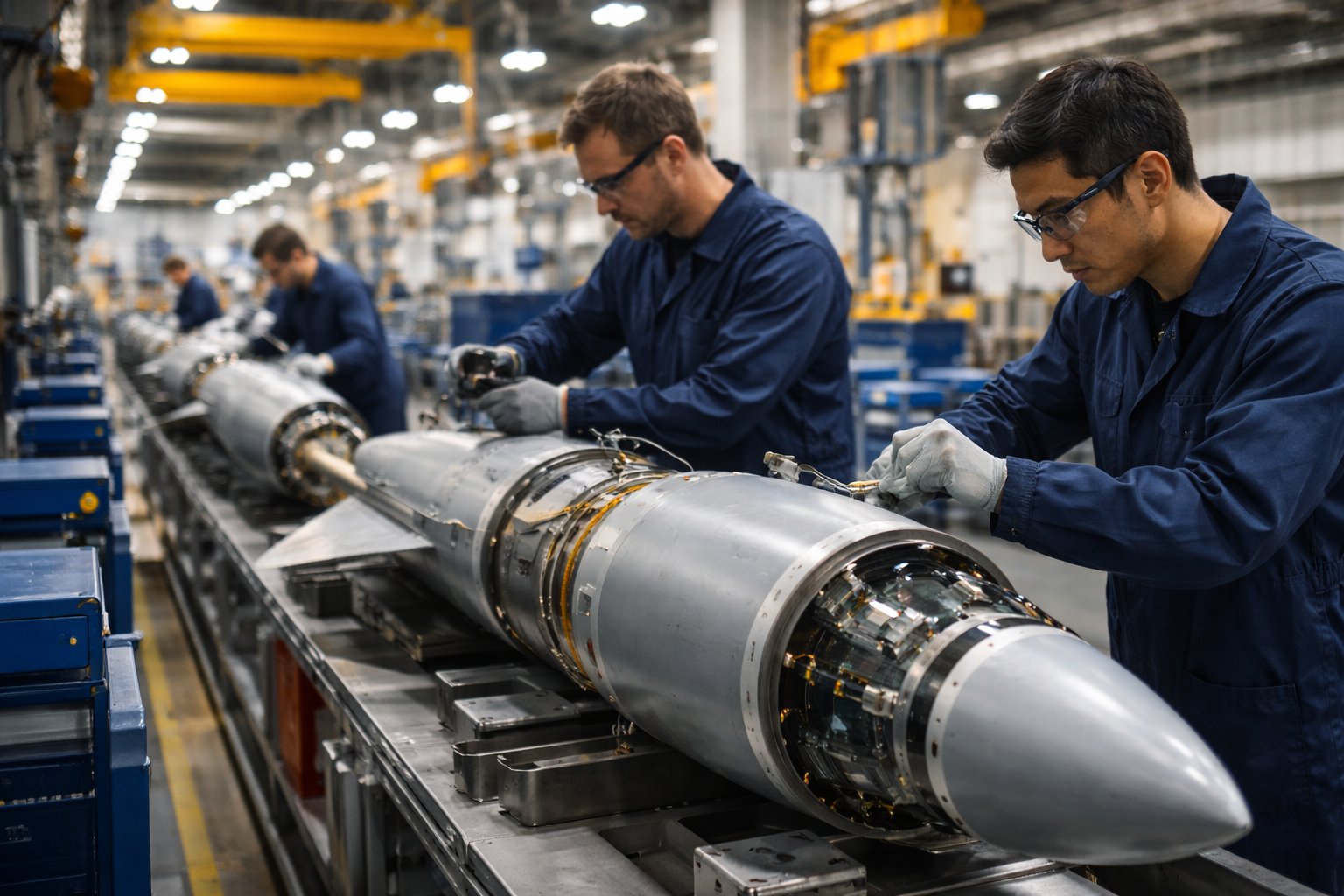
Propellant manufacturing requires specialist process equipment, controlled materials, environmental management, safety systems, trained personnel, quality assurance, and facilities designed around energetic-material hazards. Once installed, those processes also have to demonstrate repeatability before they can become a dependable source for serial missile production.
That makes the Vojens plant an upstream capacity investment. Missile output depends on propulsion, airframes, guidance electronics, control systems, warheads, launch equipment, and test capacity arriving at compatible rates. Increasing final assembly without expanding a constrained propulsion-material supply simply relocates the bottleneck.
Fire Point’s published capacity range reflects that relationship. A plant able to support more than 4,000 smaller missile fills in one production mix will not necessarily support the same number of larger weapons consuming more propellant. The figure is therefore better understood as a manufacturing-capacity envelope than a forecast of annual missile deliveries.
Missile growth increases the propulsion requirement
The company has expanded its missile portfolio rapidly. Fire Point currently presents the FP-5 Flamingo cruise missile alongside its FP-7 and FP-9 ballistic missile families, while the FP-7.x has been developed as an interceptor concept associated with the company’s wider air-defence work.
That interceptor programme has already reached flight testing. IN Defence reported in June that Fire Point had completed a controlled FP-7.x flight test, with the missile intended to contribute to the proposed Freyja air-defence architecture. A controlled flight remains well short of a complete interception demonstration, but it illustrates why Fire Point requires a propulsion supply chain able to support more than one weapon type.
Moving part of that chain outside Ukraine creates an obvious resilience benefit. A production site in Denmark is less exposed to the direct physical risks facing factories inside Ukraine and gives Fire Point access to a different infrastructure, supplier, and workforce environment. It does not remove supply-chain risk altogether: feedstock, specialist equipment, transport, security, workforce availability, and cross-border logistics still have to be managed.
The location also creates additional configuration-control requirements. Propellant manufactured in Denmark has to conform to the same technical standard expected by missile production elsewhere, with material batches, process parameters, inspection results, storage conditions, and transport records controlled closely enough that propulsion performance does not vary unpredictably between production lots.
Solid propulsion is particularly unforgiving of process variation. Grain geometry, material composition, curing, bonding, voids, contamination, and dimensional tolerances can influence burn behaviour and structural performance. Scaling output consequently places pressure on laboratory analysis, non-destructive inspection, process monitoring, and acceptance testing alongside the headline production equipment.
Fire Point has not published a complete capital cost for the Vojens facility, fixed annual production commitments for each missile family, or contracted output volumes. The company’s capacity numbers should therefore not be converted into an assumed order book. They describe what the site is being designed to support if demand and the rest of the manufacturing chain require it.
The Danish investment nevertheless marks a notable transition for a Ukrainian defence company that developed under wartime manufacturing conditions. Establishing a permanent European energetic-materials operation requires a different level of regulatory, industrial, and process maturity from rapidly expanding assembly inside an emergency production environment.
The most useful milestones will now be physical. Completion of the production buildings, installation and qualification of process equipment, regulatory approval, initial batches, and delivery of accepted propellant into Fire Point’s missile manufacturing chain will show whether the planned capacity has become usable output.
Vojens therefore matters less because it carries a potential figure of more than 4,000 missiles than because it tackles one of the manufacturing constraints behind that figure. Missile production cannot scale indefinitely without propulsion capacity. Fire Point is now building that capacity outside Ukraine, with the end of 2027 set as the next major industrial deadline.