IN Brief:
- French DGA teams developed the SMOKERS uncrewed surface demonstrator from concept to sea trials in approximately six months.
- Composite hulls, existing outboard propulsion and DGA-developed software feature in the programme, with low unit cost a stated design objective.
- Three prototypes joined the WildFire naval exercise, but no serial manufacturing contract or production quantity has been disclosed.
France’s Direction générale de l’armement, known as the DGA, has advanced an experimental uncrewed surface vessel programme called SMOKERS from initial concept to naval sea trials in approximately six months. The six-month development cycle has combined hull construction, control software and trials at sea, while operational reliability and serial manufacture remain unresolved.
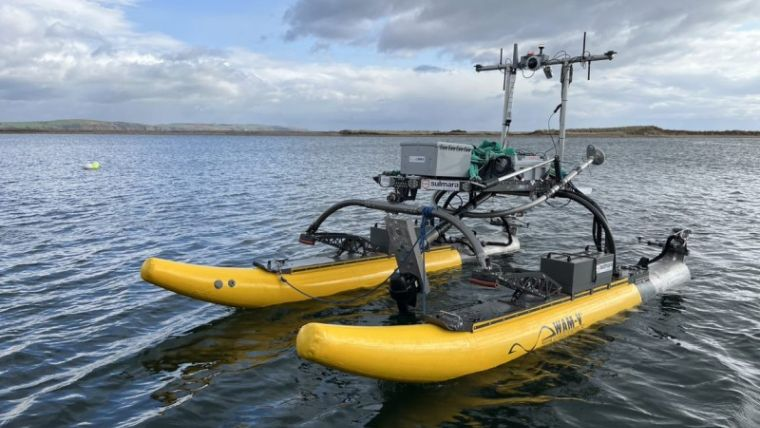
SMOKERS stands for Scalable Maritime Operational Kamikaze System, Developed under Sovereign Control. It is a family of disposable or expendable surface vehicles, rather than a commissioned class of French Navy warship. Trials have examined platform function, navigation, control and detectability, with further reliability work required before any decision to move into wider manufacture.
The demonstrators use composite hulls incorporating resin and fibreglass, with propulsion from commercially available outboard motors. The DGA has described a target price of a few tens of thousands of euros for individual craft and a speed in the region of 40 knots. The cost is a design target rather than an established serial production price; reported speed does not specify a guaranteed performance envelope in every sea state.
Using an existing propulsion product reduces the custom engineering required during early prototype development. A standard motor still has to be mounted, supplied with fuel and integrated with the craft’s steering and control arrangements. The completed system then needs to function reliably under spray, impact loading, hull movement and variations in sea state.
The programme’s engineering was divided between specialist DGA centres. CERDAN, the agency’s naval drone centre of expertise in Toulon, directed the work. DGA Naval Techniques developed the first prototype and the equipment needed to turn a conventional craft architecture into an uncrewed system, including electronic controls, onboard computing and communications with its operators.
The same centre produced the initial software, remote-control interface and integration work. The conversion replaces direct crew input with electronic control and status reporting, allowing a remote operator to command the platform and monitor essential onboard functions. The public account does not specify the validated limits of its autonomy.
DGA Hydrodynamic Techniques contributed the hull and navigation work for an upgraded version designated SMOKERS V1.0. Its teams produced moulds, models and dedicated tooling for a small-scale composite manufacturing capability. Additive manufacturing has also been used during development, including for the pyrotechnic subsystem, although the detailed configuration and qualification of that subsystem have not been disclosed publicly.
Moulded composite construction would allow a common hull design to be reproduced using workshop tooling rather than the heavy steelworking equipment of a large naval yard. Repeatability still depends on material handling, cure control, dimensional checks and the installation of motors, fuel equipment, sensors and electrical systems. Large-scale output would require separate evidence of consistent tooling, inspections and acceptance across successive vessels.
The DGA has completed more than four test campaigns, with activity at Toulon and Cherbourg. Testing has included evaluations of how the vessels appear to naval sensors, an important aspect for a surface drone whose size and construction differ from those of conventional boats. No complete set of detection distances or independently validated engagement outcomes has been released.
Three SMOKERS craft subsequently took part in the French Navy’s WildFire exercise. Crews aboard the destroyer Chevalier Paul, the amphibious ship Tonnerre and the supply vessel Jacques Stosskopf worked with the uncrewed systems, supported by specialist DGA personnel. The trial activity provides experience with launch, control and command arrangements in a fleet setting rather than only in a laboratory or sheltered test area.
One exercise configuration was deliberately adapted for use as a target, with a reduced equipment fit. It lacked some sensors and the payload compartment of the more fully equipped version. The target version lacked the infrared sensors, satellite communications antennas and payload compartment present in the more fully equipped design. Its participation in the exercise establishes a fleet trial, not completed qualification of that fuller configuration.
The agency says reliability improvements and discussions about industrialisation remain ongoing. Its stated approach is to retain control of the design information so that manufacturing specifications could eventually be distributed to a range of French shipyards, including comparatively small yards experienced in leisure craft. Such an approach might broaden production capacity, but common drawings and tooling standards would still need to be matched by inspections and acceptance criteria.
A distributed manufacturing model would require the integrator to manage configuration differences among individual vessels. Composite dimensions, motor variants, electrical connections and software versions must correspond with the approved baseline, particularly if craft are assembled in separate workshops. No production rate, standardised industrial acceptance regime or delivered unit cost has been reported.
Funding so far has come from resources available within participating DGA centres. A French Navy acquisition would require a separate equipment-budget decision, and neither a production quantity nor a signed manufacturing contract has been disclosed. The next stages concern reliability improvements and whether the French Navy funds procurement, followed by any decision on industrial partners and production quantities.