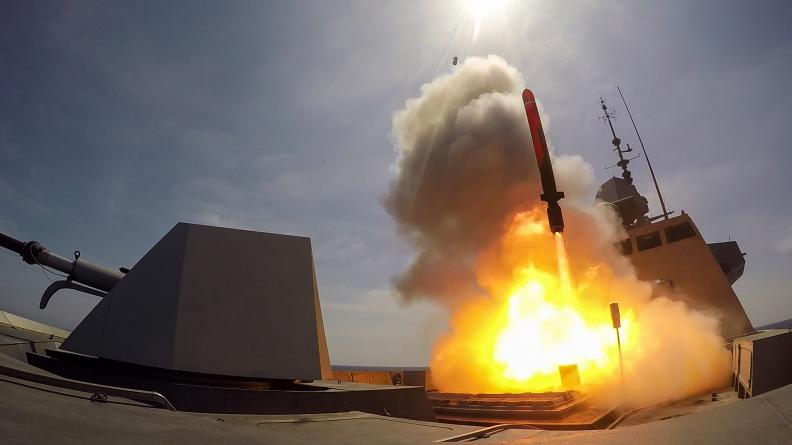
IN Brief:
- France's Directorate General of Armaments plans to sign a contract with MBDA for the MdCN Mk2 naval cruise missile.
- The upgraded weapon is intended to improve range, penetration of air defences, resistance to satellite navigation interference, and mission preparation.
- Deliveries are expected from 2030, with the missile family designed for FREMM frigates and Suffren-class nuclear-powered attack submarines.
France's Directorate General of Armaments (DGA) intends to sign a contract with MBDA for an upgraded MdCN naval cruise missile, introducing changes to range, survivability, and mission preparation across the country's long-range maritime strike capability.
The proposed MdCN Mk2 standard was disclosed on 6 November during the Euronaval exhibition near Paris. Deliveries are expected to begin in 2030, although the DGA has not published the intended procurement quantity, contract value, or precise signature date.
Development priorities include greater range, improved ability to penetrate air defences, increased lethality, and reduced detectability. The DGA has also identified stronger resistance to global navigation satellite system interference and changes to mission preparation using artificial intelligence components developed by MBDA.
The agreement remains prospective. No completed procurement contract has been confirmed, and the announcement does not establish that the upgraded missile has completed qualification or entered production.
MdCN, the French naval cruise missile, provides a long-range land-attack capability from maritime platforms. It is designed for operation from FREMM multi-mission frigates and Suffren-class nuclear-powered attack submarines, allowing the French Navy to employ the missile family from surface and submerged vessels.
The two launch environments introduce different integration requirements. Surface ships accommodate the missile within their vertical-launch equipment, while submarines use an arrangement compatible with underwater launch through torpedo tubes. Associated control systems, launch procedures, and platform interfaces must therefore reflect the equipment fitted to each vessel type.
The Mk2 is intended to improve the existing missile rather than introduce an entirely separate operational role. Its stated purpose remains long-range engagement of land targets, with the new configuration designed to strengthen performance against more demanding defensive environments.
The French defence ministry describes the Mk2 as having a range exceeding 1,000 kilometres and incorporating an increase over the existing missile's performance. It has not disclosed a revised maximum range or the engineering changes responsible for the improvement.
Missile range is influenced by several factors, including propulsion performance, aerodynamic characteristics, carried mass, and flight conditions. The DGA has not identified which elements of the Mk2 design have been altered, preventing a more detailed assessment of the claimed range increase.
Improved penetration of air defences is another stated requirement. The effectiveness of a long-range missile depends on its characteristics and operating conditions as well as the sensors, communications, and defensive weapons that may be encountered.
The ministry has identified reduced detectability as part of the Mk2 development, but has not published figures or technical details concerning the change. Specific assumptions about materials, surface treatment, flight profiles, or other undisclosed design features would therefore be premature.
Resistance to satellite navigation interference forms a separate part of the announced upgrade. Global navigation satellite systems provide position and timing information, but their signals can be affected by deliberate interference or other operating conditions.
Navigation equipment intended for demanding military environments must maintain appropriate performance when individual sources of information are unavailable or degraded. The Mk2 announcement confirms an intention to improve resilience against satellite navigation jamming without identifying the system architecture or the performance achieved under particular conditions.
The missile's complete guidance and navigation arrangement has not been disclosed. Consequently, the announcement does not establish the use of any particular additional sensor, processing component, or navigation technique beyond the capabilities identified by the DGA.
Artificial intelligence is also being incorporated into mission preparation. The ministry attributes the relevant technology to MBDA's development teams and identifies improved preparation of the missile's mission as an intended benefit.
Mission preparation is distinct from the operation of a weapon after launch. It can involve assembling and validating information required by the system, but the ministry has not specified precisely which activities will use the newly developed AI components.
No public information establishes that the MdCN Mk2 will independently select targets, change its rules of engagement, or make autonomous decisions about weapon employment. The confirmed application is the preparation of missions, and the precise capabilities of the software remain undisclosed.
Introducing changes to a missile already designed for naval service also requires the manufacturer to address compatibility with existing launch platforms. The new configuration must satisfy the relevant mechanical, electrical, software, and operating requirements, or be accompanied by separately defined modifications to the launch installations.
Those requirements differ between a frigate and a submarine. Equipment used in a surface-ship launcher operates within a different physical environment from a system prepared for launch from a submerged vessel, with separate demands on the interfaces and launch arrangements.
The DGA has not disclosed whether existing French naval launchers will require modifications for the Mk2. Nor has it identified the development tests, qualification milestones, or installation programme that will precede the expected deliveries.
Manufacturing the upgraded missile will require MBDA and its suppliers to establish the production processes applicable to the final configuration. Changes to components or materials can require new production controls, inspection procedures, and qualification evidence before equipment is accepted for military service.
The scale of those industrial changes remains unknown. The procurement announcement does not identify new factories, additional production lines, a specific manufacturing location, or confirmed subcontract awards associated with the Mk2.
France's existing MdCN capability entered service aboard FREMM frigates in 2017 and subsequently became available through its submarine force. The naval missile provides a different launch option from the air-launched SCALP family, allowing long-range strike missions to be conducted from maritime platforms.
The Mk2 programme will continue that naval role while addressing the DGA's identified requirements for range, survivability, and mission preparation. Its technical development will need to be coordinated with the equipment and operational arrangements maintained by the French Navy.
The announcement follows other French naval missile procurement activity during Euronaval, including the separate Exocet MM40 Block 3C programme. Exocet is primarily an anti-ship weapon, while MdCN is designed for long-range land attack, making the two developments distinct procurement activities.
France has identified 2030 as the beginning of MdCN Mk2 deliveries. The contract signature, detailed qualification programme, and eventual production arrangements will establish how the upgraded missile progresses from the announced technical objectives to equipment accepted for naval service.