IN Brief:
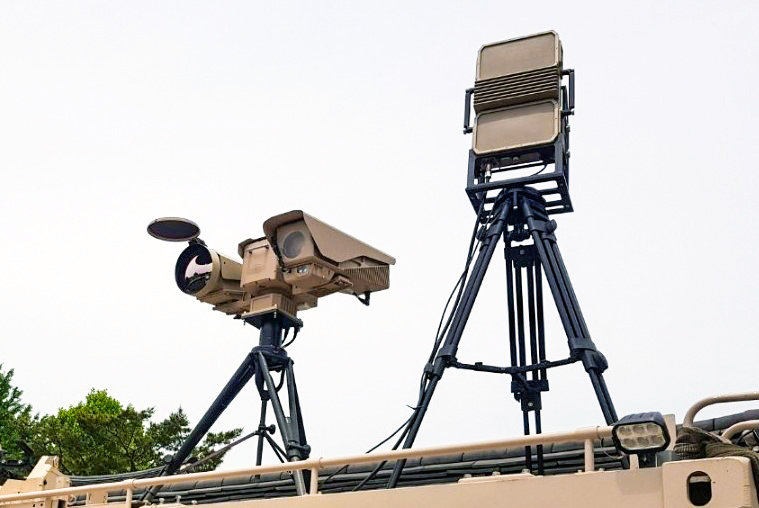
- Hanwha Systems has signed a pilot contract to supply short-range AESA radar to Rebellion Industries.
- The 10km-class system is intended for low-altitude surveillance, with smaller-range variants in development.
- Deliveries are planned by early 2027, alongside preparations to expand manufacturing capacity in South Korea.
Hanwha Systems has secured its first US export contract for short-range active electronically scanned array radar, agreeing to supply equipment to defence technology company Rebellion Industries. The pilot agreement covers compact surveillance systems intended to detect and track low-altitude aerial threats, with initial deliveries planned for completion by early 2027.
The South Korean manufacturer disclosed the agreement on 18 November 2026 but has not published the contract value or number of radar units ordered. Rebellion Industries intends to integrate the equipment with its Sensor OS software to develop surveillance capabilities for military and civilian applications. Initial opportunities include protection of oil refineries, data centres, logistics facilities, and stadiums.
Although the agreement establishes a route into the American radar market, it remains a pilot supply arrangement. Hanwha and Rebellion are discussing the possibility of larger follow-on business, but those discussions have not resulted in a publicly confirmed production order. Deployment and integration of the initial equipment will provide an opportunity to establish its suitability for prospective customers.
The radar is based on active electronically scanned array technology, which uses multiple transmitting and receiving elements to generate and steer radar beams electronically. Compared with an antenna dependent on mechanical rotation for scanning, this arrangement can support rapid changes in surveillance direction and the management of different tracking tasks through the radar’s electronic controls.
Hanwha describes its export product as a 10km-class short-range radar designed to identify and track nearby aerial threats. The company has concentrated development on low-altitude targets, including drones, helicopters, and other aircraft. Its published range classification should not be interpreted as a universal detection distance, because radar performance depends on the characteristics of the target and its surroundings.
Small unmanned aircraft can present difficult surveillance conditions. Their physical dimensions and materials may produce relatively weak radar returns, while low-altitude flight places them against a background containing buildings, vegetation, vehicles, and other sources of reflected signals. Radar processing must distinguish useful target information from that surrounding clutter.
Tracking also requires continuity between successive observations. A radar may detect an object at one moment but have to associate later returns with the same target while accounting for movement, interference, and measurement uncertainty. Electronic beam steering provides flexibility in how observations are collected, although the resulting performance depends on the antenna, processing algorithms, and operating environment.
Hanwha’s work combines radar hardware with processing functions intended to identify relevant aerial activity. The company has described its product as incorporating AI-supported capabilities, but has not disclosed the detailed algorithms, training data, classification accuracy, or testing conditions associated with those functions. No specific probability of detection or false-alarm performance has been independently established for the proposed US installations.
Rebellion Industries’ Sensor OS will provide a supporting software environment for integrating the radar information. The proposed arrangement involves taking measurements from Hanwha’s equipment and making them available within a wider airspace monitoring system. Successful integration will depend on compatible data interfaces, track management, reliable communications, and the way information is presented to operators.
The distinction between surveillance and counter-drone engagement remains important. Radar can provide observations used to locate and track an aerial object, but detection alone does not establish its identity or confer an ability to stop it. A complete defensive installation may require additional sensing, command functions, and separately authorised response equipment, depending on its intended operating role.
Neither company has announced an interceptor or electronic attack capability as part of the pilot radar supply contract. The agreement is therefore best understood as an initial surveillance technology integration rather than a confirmed operational system for physically defeating unmanned aircraft.
The equipment’s potential infrastructure applications present different installation requirements. A refinery or data centre may need surveillance concentrated around sensitive operating areas, while a large logistics site may require several monitoring positions to account for buildings and terrain. Coverage is influenced by sensor placement, antenna geometry, available power, communications infrastructure, and restrictions associated with the surrounding environment.
Hanwha began developing lightweight, compact short-range AESA radar technology in 2024 and has since completed an export-oriented configuration. The company plans to extend the family with products described as five-kilometre and one-kilometre variants by early 2027, creating options for customers whose surveillance requirements do not justify the same coverage area.
Different range classes can involve changes to the antenna, transmission and reception arrangements, processing equipment, or overall system packaging. Hanwha has not released a comparative technical specification for the planned variants, so their relative size, power consumption, cost, and detection performance cannot yet be assessed. The announced development plan establishes intended product coverage rather than finished, qualified configurations.
Manufacturing expansion forms another part of the company’s strategy. Hanwha is preparing automated production lines at its Gumi operations in South Korea to support additional radar output. Manufacturing active-array equipment consistently requires control over radio-frequency components, antenna assembly, electronic integration, calibration, and final system testing.
Increasing assembly capacity does not eliminate the need for component qualification and inspection. Individual radar modules must perform within their required electrical and thermal conditions, while completed systems need verification of their transmitting, receiving, processing, and interface functions. Automated processes can support repeatability, but the eventual manufacturing rate will depend on the availability of qualified components and the configuration of the production line.
The American contract extends Hanwha’s established defence electronics business. The company already supplies multifunction radar equipment associated with South Korean air-defence systems and other military platforms. Its short-range product serves a different surveillance role from the larger systems designed to detect and track distant aircraft and missile threats.
Hanwha has also participated in US aerospace electronics supply programmes, including equipment associated with Boeing aircraft. The latest agreement should therefore be described as the company’s first American radar export rather than its first transaction with the US defence industry.
The pilot agreement creates an initial commercial opportunity in a market where military installations and civilian infrastructure operators face overlapping requirements for low-altitude airspace surveillance. Technical integration, installation requirements, and operational suitability will determine whether the initial deliveries develop into repeat orders.
Hanwha expects to complete the first deliveries by early 2027, while work continues on additional radar variants and manufacturing capacity. Subsequent announcements of deployed installations, accepted systems, and signed follow-on quantities will establish whether the pilot develops into a larger export programme.