IN Brief:
- HD Hyundai is discussing potential auxiliary vessel work with the US Navy and Maritime Administration, not announcing firm orders.
- Its new venture with Kiewit aims to establish an American manufacturing footprint, with investment details expected by year-end.
- The group is prioritising naval logistics ships while combat-vessel production remains at an earlier exploratory stage.
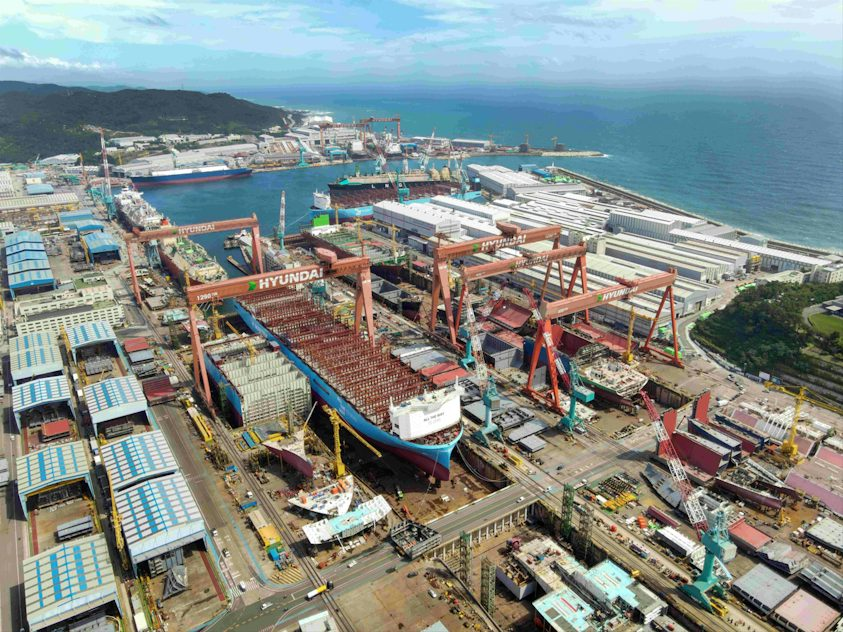
HD Hyundai is discussing potential US Navy orders for auxiliary vessels as it develops plans for a new American shipbuilding base with construction group Kiewit. The South Korean manufacturer says the volume of work it can secure will influence both the amount of capital committed and the eventual ownership structure of the venture. No US Navy shipbuilding award or final investment figure has been announced.
HD Hyundai Heavy Industries is prioritising naval logistics ships in its discussions with the US Navy. Potential vessels include tankers designed to transfer fuel and other stores, and roll-on, roll-off ships that carry vehicles through ramps onto internal decks. Combat ships remain a more distant possibility, with no defined warship programme for the proposed American yard.
HD Hyundai and Kiewit agreed on 22 October to establish HD Kiewit Shipbuilding, a proposed venture to develop a purpose-built shipyard on an existing industrial site on the US Gulf Coast. Construction is targeted to begin in 2027, with full-scale operations planned for 2029. Neither milestone represents a commissioned facility or a delivery schedule for naval vessels, and the partners have not committed to a final project budget.
Negotiations over potential US naval work volumes will influence HD Hyundai’s decision on the scale and ownership structure of its investment by the end of 2026. The equity split remains open, and the proposed yard has no confirmed US Navy order or contracted production rate. Decisions on capacity and capital expenditure therefore depend on the outcome of prospective customer negotiations.
Naval replenishment tankers depend on cargo tanks, pipework, pumps and transfer stations that can handle fuel safely alongside other ships, while vehicle transport vessels require reinforced decks, loading ramps and stability arrangements for heavy rolling cargo. Both designs need propulsion, power distribution, watertight subdivision and maintainable auxiliary machinery. They generally differ from frigates and destroyers in the scale and configuration of weapons, combat sensors and mission-system integration rather than in the need for rigorous shipbuilding and safety controls.
Producing ships in the United States would provide HD Hyundai with a domestic industrial base from which to pursue US naval work. It would not remove the need to compete for contracts or satisfy the procurement, security, sourcing and technical requirements of each programme. The proposed joint venture is therefore an industrial investment decision, whereas an order for an individual support vessel would be a separate customer commitment.
Kiewit brings experience in large engineering and construction projects, including offshore infrastructure, while HD Hyundai contributes ship design, production engineering and vessel manufacturing. The partners would need to translate those capabilities into a complete yard operation, with suitable waterfront access, heavy fabrication and lifting capacity, outfitting space, logistics, suppliers and a trained workforce. No final industrial layout or capacity figure has been made public.
Investment decisions will also depend on whether the yard is configured to build and outfit complete vessels or to supply fabricated blocks and modules to established US builders. These approaches place different demands on dry docks, waterfront access, steel-handling areas, logistics and outfitting facilities. Hyundai has discussed possible block production with Huntington Ingalls Industries, but no resulting workshare or supply order has been announced.
Jeong Woo-man, an executive at HD Hyundai Heavy Industries, indicated that an initial two vessels might be built in South Korea while the American operation develops. He did not identify a firm contract, authorised hull programme or construction timetable for those ships. Any overseas build proposal for a US government customer would also be subject to the applicable procurement and sourcing conditions, so the potential Korean phase remains a management scenario rather than a confirmed production arrangement.
The partners say the new yard could eventually support up to 3,000 US jobs and use HD Hyundai’s Future of Shipyard methods, including digital twins, automated manufacturing and robotic welding. These capabilities would have to be adapted to the chosen site and vessel mix, alongside recruitment, supplier qualification and fabrication controls. The workforce figure is a projection for a fully operating facility, not employment already created by the proposed venture; operational responsibilities between HD Hyundai and Kiewit have yet to be finalised.
Fuel-transfer pumps, vehicle-handling equipment and their control systems need maintenance, spare parts and technical documentation throughout a vessel’s service life. Those requirements can affect supplier qualification and yard capacity as much as initial construction, especially if repairs and overhauls are spread across several ports. HD Hyundai has not secured a through-life support contract or identified where future maintenance for any proposed US Navy vessels would take place.
A decision on the scale and ownership of the American investment is expected by the end of 2026 as discussions over naval logistics work develop. The planned shipyard currently has no confirmed US Navy building award, final capital budget or delivery programme. Work on auxiliary vessels remains its nearest-term defence target, while any move into combat ship construction would require further customer and industrial decisions.