IN Brief:
- Wescom Defence has expanded POMBS manufacturing capacity following a reported tenfold rise in demand over two years.
- Heavy and Light POMBS use rocket-deployed explosive lines, with different cleared-lane arrangements.
- An H-POMBS module has been integrated with Milrem’s THeMIS uncrewed vehicle in cooperation with KNDS Deutschland.
Wescom Defence has expanded manufacturing facilities for its Portable Obstacle Minefield Breaching System (POMBS) following a tenfold rise in demand over two years. The UK-based company supplies portable explosive line-charge equipment designed to open passages through minefields and other obstacles. Alongside its manufacturing expansion, Wescom has worked with KNDS Deutschland and Milrem Robotics on a version of Heavy POMBS carried by an uncrewed ground vehicle, creating a separate route for deploying the technology.
Wescom attributes the expansion to increased requirements from customers, but has not quantified the starting and current annual output of POMBS units or the value of the resulting order book. The tenfold figure describes demand, so it should not be treated as a verified count of completed systems or deliveries. Expanding explosive-equipment manufacture involves consistent component quality, controlled handling and documented production checks, although the company has not broken down the investment by process or individual factory.
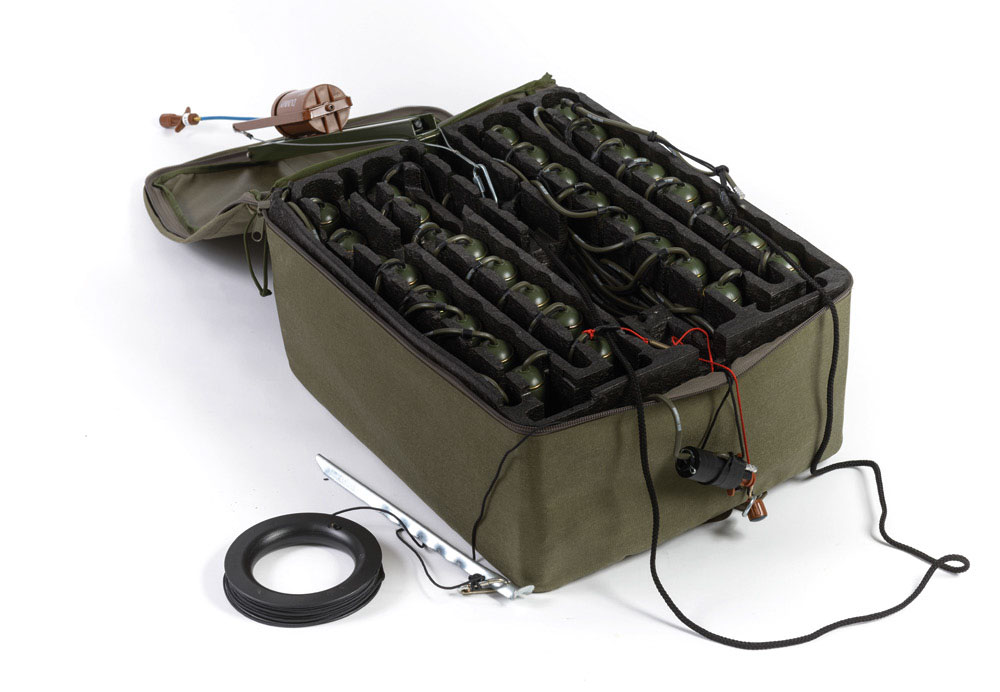
POMBS uses a rocket-deployed explosive line charge intended to create a passage through minefields or similar obstacles. The equipment is carried in portable packs, offering an alternative where larger armoured engineering vehicles cannot reach the required location. A breached passage is not equivalent to comprehensive clearance of the surrounding area; its intended dimensions, obstacle conditions and any residual hazards remain important limits. Wescom markets both light and heavy portable configurations for this task.
Wescom specifies Heavy POMBS as a two-backpack system designed to open a passage about 55 metres long and half a metre wide. Its Light POMBS variant occupies one backpack and is described as producing a 74-metre route with cleared stepping zones at one-metre intervals. These dimensions are manufacturer specifications for the intended effect, not a guarantee that every object or explosive hazard within a field will be neutralised. The company also supplies inert training variants for familiarisation with the equipment.
Portability changes the demands placed on a breaching team. A compact system can be transported without a dedicated heavy engineering vehicle, but its intended use still has to account for the terrain, type of obstruction and safety procedures required for explosive operations. The light and heavy variants offer different passage characteristics and carrying arrangements. Increasing production therefore involves supplying more of an established product family, rather than announcing a newly designed mine-clearing vehicle or an entirely different clearance method.
Wescom Group operates production and testing facilities in the UK, Germany, Australia and Spain. Across its energetic-materials activities, the group reports more than 293,000 square metres of manufacturing space and work involving several pyrotechnic hazard classifications. That figure refers to the wider group and cannot be assigned exclusively to POMBS. The company has not specified which sites accounted for the additional POMBS capacity or disclosed the value of the manufacturing expansion.
A heavy POMBS module has also been integrated onto Milrem Robotics’ tracked THeMIS uncrewed ground vehicle in cooperation with KNDS Deutschland and Wescom Group. The configuration allows the breaching payload to be carried on a remotely operated platform rather than solely in packs. It has been demonstrated in Germany, including during a military exercise at Munster. The partners have not identified a customer procurement order for the integrated vehicle, which remains a distinct development from the established portable product lines.
Vehicle integration changes the engineering environment of the module. Its mounting and control systems must accommodate the payload, vehicle movement and the safety arrangements applied to hazardous equipment, while the carrier adds its own communication and support requirements. Those are integration considerations, not evidence that every aspect of the robotic configuration has been qualified. Wescom has confirmed the demonstrated integration but has not stated a final military acceptance status or delivery quantity for that version.
Wescom describes its established Light and Heavy POMBS products as operationally proven and at technology readiness level nine. That supplier assessment concerns the backpack systems; it does not automatically extend to the newer THeMIS installation. Inert training versions are also part of the product family, allowing personnel to become familiar with the equipment without a live explosive charge. The manufacturing programme and vehicle integration therefore sit at different points in their development and supply arrangements.
David Griffiths, Wescom Defence’s vice-president of defence sales, linked the production expansion to increased customer demand and the company’s engineering and manufacturing capability. The confirmed developments are higher manufacturing capacity and a demonstrated integration with an uncrewed ground vehicle. Unit output, deliveries and any future order for the THeMIS-mounted version have not been quantified, so the programme’s eventual production scale will depend on further contract and delivery evidence.