
IN Brief:
- Several US government contracts total approximately $12 million across space and non-space defence programmes.
- The work covers satellite long-lead materials, vibration-insensitive oscillators, missile PNT subsystems and resilient GPS timing receivers.
- The awards have no disclosed customer-by-customer allocation, equipment quantities or delivery timetable.
Frequency Electronics has secured approximately $12 million of new US government space and defence orders covering satellite supply chains, naval radio hardware, missile timing and ground communications. The New York manufacturer will provide precision frequency references and positioning, navigation and timing (PNT) equipment under several contracts rather than a single platform acquisition. Their individual values, quantities and delivery schedules remain undisclosed, while the named applications span equipment with different operating and qualification requirements.
The space work includes procurement of long-lead materials and continuing support for proliferated satellite architectures. Components with extended manufacturing or qualification times must often be ordered ahead of final satellite assembly, especially when payloads are being produced in repeated batches. Frequency references are used to synchronise communications equipment, payload electronics and the generation of stable radio frequencies. However, the material orders are an upstream procurement commitment; they do not establish that the associated spacecraft have been assembled, launched or placed into service.
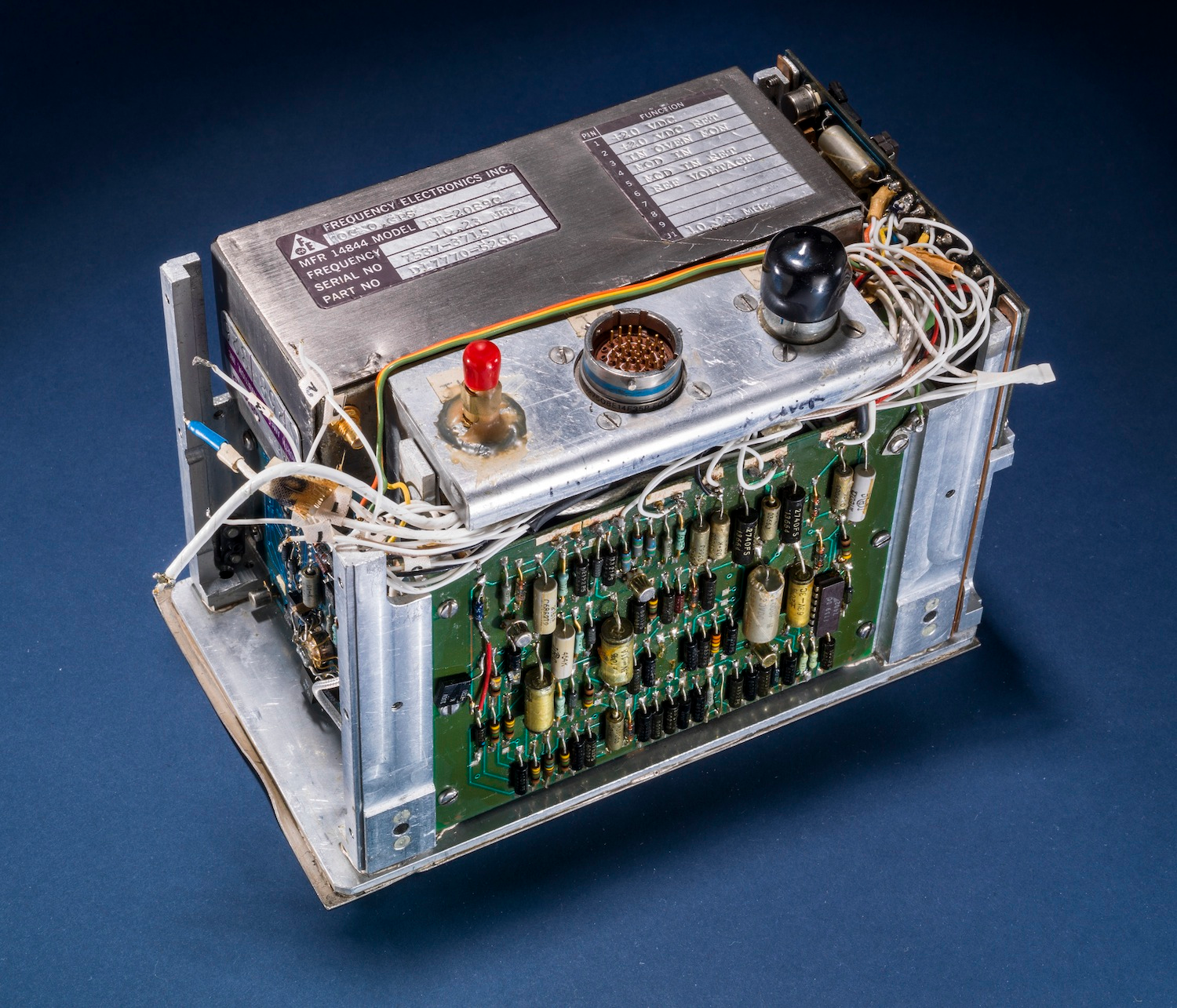
Vibration-insensitive oscillators account for part of the non-space work, with naval systems and software-defined radios identified as applications. An oscillator provides an electrical reference whose frequency is used to drive or control other circuits. Mechanical motion can disturb a quartz resonator, causing short-term frequency fluctuations and raising phase noise around the intended signal. Limiting sensitivity to acceleration and vibration helps maintain stable frequency generation aboard moving vessels and within other equipment exposed to mechanical loading. The manufacturer has not assigned model numbers or measured performance limits to the new orders.
Software-defined radios still depend on analogue radio-frequency circuitry even when waveform selection, modulation and processing functions are implemented in software. Local oscillators provide references for frequency conversion and synthesiser circuits; drift can move a signal away from its intended channel, while excessive phase noise can make weaker signals harder to distinguish near stronger ones. Low-noise frequency references are therefore part of the hardware supporting adaptable radio architectures. FEI’s broader oscillator range includes vibration-compensated designs, but the contracted configuration has not been identified.
A further group of awards covers secure timing and PNT subsystems supporting major missile programmes. Navigation and control electronics require timing relationships between processing, measurement and communications functions, while frequency references support the stability of those functions. A subsystem order of this kind does not establish responsibility for an entire guidance package. The relevant missile types, installations and programme phases have not been identified, and no flight-test or qualification milestone forms part of the newly specified work. The specified scope concerns timing and PNT subsystems, without identifying a complete missile guidance assembly or a named platform.
Ground communications networks are another application, with Frequency Electronics supplying resilient GPS receivers to a major defence contractor. GPS signals can furnish a common time reference to equipment distributed across a network, helping maintain synchronisation between sites and links. Interference or loss of satellite reception can disrupt that reference, which is why resilient timing systems may use local oscillators and holdover arrangements to sustain timekeeping between valid external updates. FEI also supplies secure timing products through its FEI-Zyfer business. The new orders do not establish a specific anti-jamming specification, holdover duration or customer network architecture.
The company’s production portfolio includes quartz oscillators, atomic frequency standards, timing distribution systems and radio-frequency subsystems. FEI-Elcom Tech serves electronic warfare and microwave applications, while its New York operation manufactures precision frequency-control equipment. FEI also produces quartz resonators in-house, allowing its engineering and manufacturing teams to control a critical element of oscillator behaviour. The technology is not interchangeable across every customer: electrical interfaces, enclosure dimensions, power consumption, frequency stability and environmental limits must be matched to the host equipment before a reference can be integrated.
Qualification places different demands on maritime and space hardware. A naval oscillator may need to retain performance under vibration, temperature changes and shock, whereas satellite components can require screening for radiation exposure, thermal cycling and long service life without physical servicing. Electronics must also maintain stability after ageing and under variation in supply voltage. FEI’s standard oscillator portfolio includes military-grade and space-qualified product families, but those catalogue specifications should not be treated as the acceptance criteria for the newly ordered hardware. The order values alone provide no measure of units completed or factory capacity committed.
These awards extend an established series of government contracts. FEI reported approximately $16 million of separate space and non-space timing orders in May and another $18 million in July, including satellite frequency-generation equipment and follow-on oscillator production. In September, the company reported first-quarter fiscal 2027 revenue of $23.5 million and funded backlog of $129 million at 31 July 2026. Those figures describe different contract periods and accounting measures. The new $12 million cannot simply be added to the July backlog to produce an updated figure because the timing of order entry, deliveries and revenue recognition has not been specified.
Chief executive Tom McClelland anticipates follow-on work from some of the new contracts, although further orders will depend on customer decisions. The present awards cover several specialist functions across satellites, naval communications, missile programmes and terrestrial timing networks. Each application depends on reliable frequency generation or synchronisation, yet carries its own integration and qualification requirements. FEI has secured the stated combined order value; the eventual mix of hardware, production runs and additional purchases will be determined by the individual programmes.