IN Brief:
- Astroscale Ltd has been appointed prime contractor for the Ministry of Defence’s £15m LEDA programme.
- BAE Systems and Open Cosmos are supporting partners; the new mission will address rendezvous and proximity operations.
- UK Space Command describes spacecraft manufacture, launch and operation as part of the programme, without disclosing a launch date.
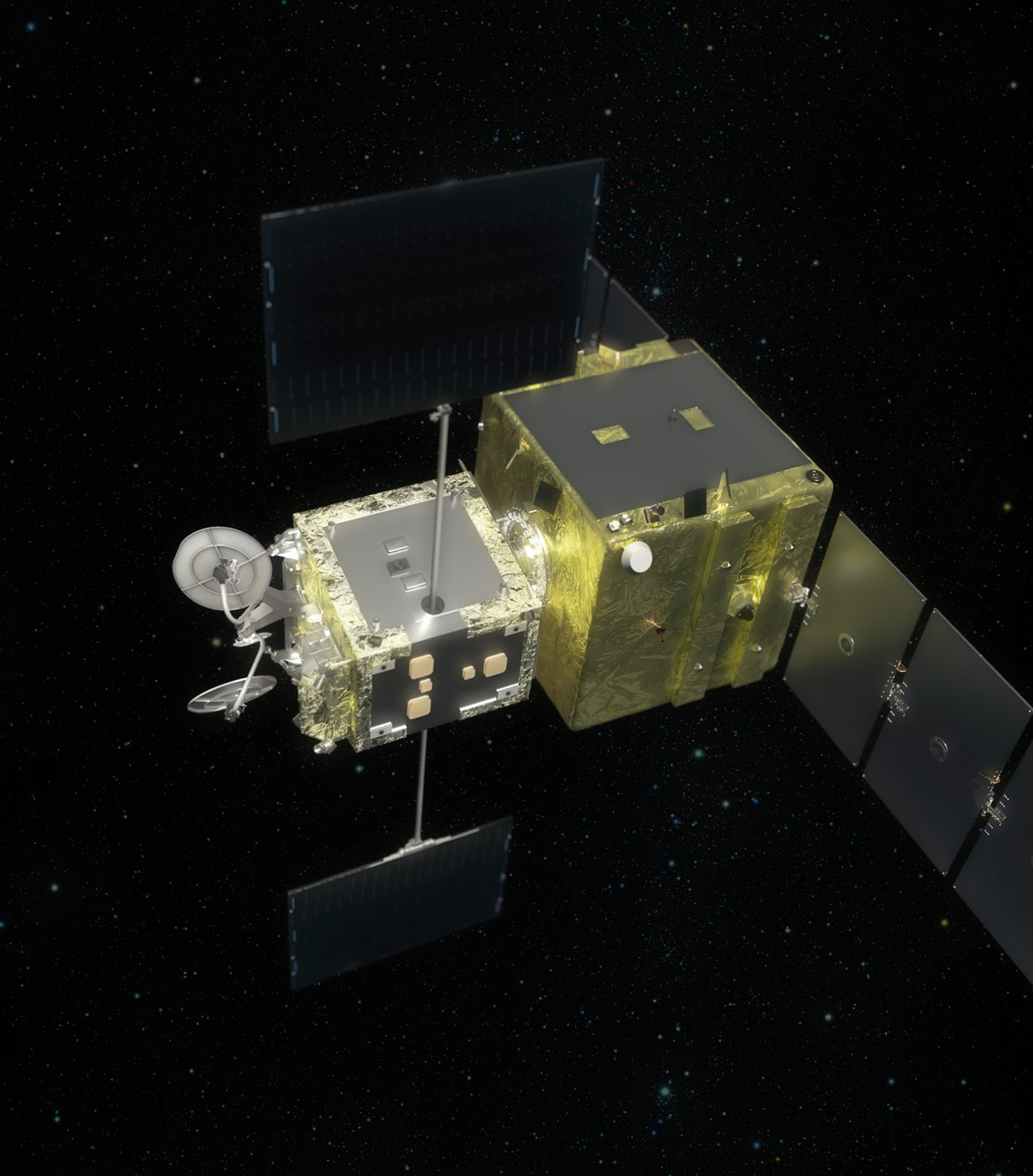
Astroscale UK has secured a £15 million Ministry of Defence contract to lead LEDA, a programme intended to develop British capabilities for operating spacecraft close to other objects in orbit. BAE Systems and Open Cosmos will support the Harwell-based prime contractor. UK Space Command envisages spacecraft manufacture, launch and operation as part of LEDA. A launch date, spacecraft configuration and sensor specification have not been confirmed, leaving the contract as a development commitment rather than an operational deployment.
LEDA addresses rendezvous and proximity operations (RPO), in which a spacecraft must determine the position and relative motion of another object, plan its approach and maintain safe separation. The orbital geometry changes continuously, making navigation, guidance and collision avoidance integral to the mission. These techniques can support inspection or servicing, while also helping defence organisations characterise potentially threatening activity near satellites. LEDA is intended to extend Britain’s understanding of such operations, without establishing that a defensive spacecraft has already entered service.
Astroscale will be responsible for delivering the programme as prime contractor, with BAE Systems and Open Cosmos identified as supporting partners. Their respective hardware and software work shares have not been defined publicly. Close-proximity missions involve spacecraft platforms, flight control software, ground communications and safety procedures that must operate as one system. Developing that integration is different from tracking distant objects with ground-based sensors: engineers must also manage the behaviour of a spacecraft manoeuvring close to a target.
Astroscale has conducted two distinct missions that provide relevant flight heritage. ELSA-d demonstrated rendezvous and magnetic capture with a cooperative client spacecraft, while ADRAS-J approached an unprepared rocket body to less than 15 metres in 2024 and collected inspection data. Neither mission was part of LEDA. Their achievements concern rendezvous, inspection and control techniques, rather than proving which sensors, proximity distances or defensive functions will be incorporated into the new British spacecraft.
For ADRAS-J, Astroscale’s UK team developed the ground segment and led flight dynamics operations, including manoeuvre planning and collision-risk monitoring. A controller assessing a close approach needs orbit estimates for both spacecraft and must account for uncertainty in each trajectory. The closer the vehicles become, the more important it is to recognise deviations and retain the ability to interrupt or modify the manoeuvre. This ground-to-space operating discipline provides relevant experience for LEDA, although the new mission’s flight rules and control architecture remain to be specified.
A separate Defence Science and Technology Laboratory programme, Orpheus, already involves Astroscale UK and Open Cosmos. Awarded at £5.15 million in 2025, Orpheus comprises two near-identical small satellites designed and built by Open Cosmos and operated by Astroscale. They are intended to fly in formation and take measurements relevant to space weather and the ionosphere. The 2025 contract anticipated a 2027 launch. That timetable applies to Orpheus, not LEDA, whose launch schedule has not been set out.
Tony Williams, UK Space Command’s head of space capability, connected LEDA with the military requirement to understand orbital warfare and possible responses to RPO threats. The capability under development is not equivalent to a declared anti-satellite weapon: no payload, countermeasure or engagement concept has been identified for the new mission. Developing a vehicle that can safely inspect and manoeuvre near another object would nevertheless provide practical knowledge of both the possibilities and limitations of close-proximity systems.
The industrial partnership combines a spacecraft operations specialist, a defence systems manufacturer and a British satellite builder. Their integration work will have to join onboard control, spacecraft hardware, ground operations and test procedures into a coherent mission. The award specifies £15 million for LEDA but does not allocate contract values between the partners or define a production quantity. The government’s wider space-investment commitments are separate funding decisions and should not be added to the LEDA contract value.
Military satellite systems support communications, navigation, sensing and intelligence, making their continued operation dependent on reliable knowledge of the orbital environment. An unexpected approach can indicate a collision hazard or potential surveillance activity, but orbital movement by itself cannot establish hostile intent. Ground-based tracking, close inspection and manoeuvre analysis answer different questions. LEDA is intended to strengthen the UK’s understanding of the latter two, rather than substitute for the existing space domain awareness network.
Nick Shave, Astroscale’s UK managing director, confirmed the company’s leadership of the work alongside BAE Systems and Open Cosmos. Delivery will involve turning the contracted mission into tested spacecraft and ground operations, followed by launch and flight activity when the design and timetable are settled. Astroscale’s existing experience establishes the capabilities from which the team can draw; it does not predetermine the new mission’s configuration or its eventual use by UK Space Command.