IN Brief:
- Bharat Dynamics will manufacture 160 Satellite Smart Anti Airfield Weapons and associated equipment for the Indian Air Force.
- The ₹810.79 crore contract specifies 60% indigenous content under India’s Buy Indian-IDDM procurement route.
- Deliveries across 2027–28 and 2028–29 move the DRDO-developed weapon into a defined production programme.
Bharat Dynamics Limited has secured a ₹810.79 crore contract to manufacture and supply 160 Satellite Smart Anti Airfield Weapons, or SAT-SAAW, and associated equipment for the Indian Air Force, moving the indigenous precision weapon into a defined production and delivery programme.
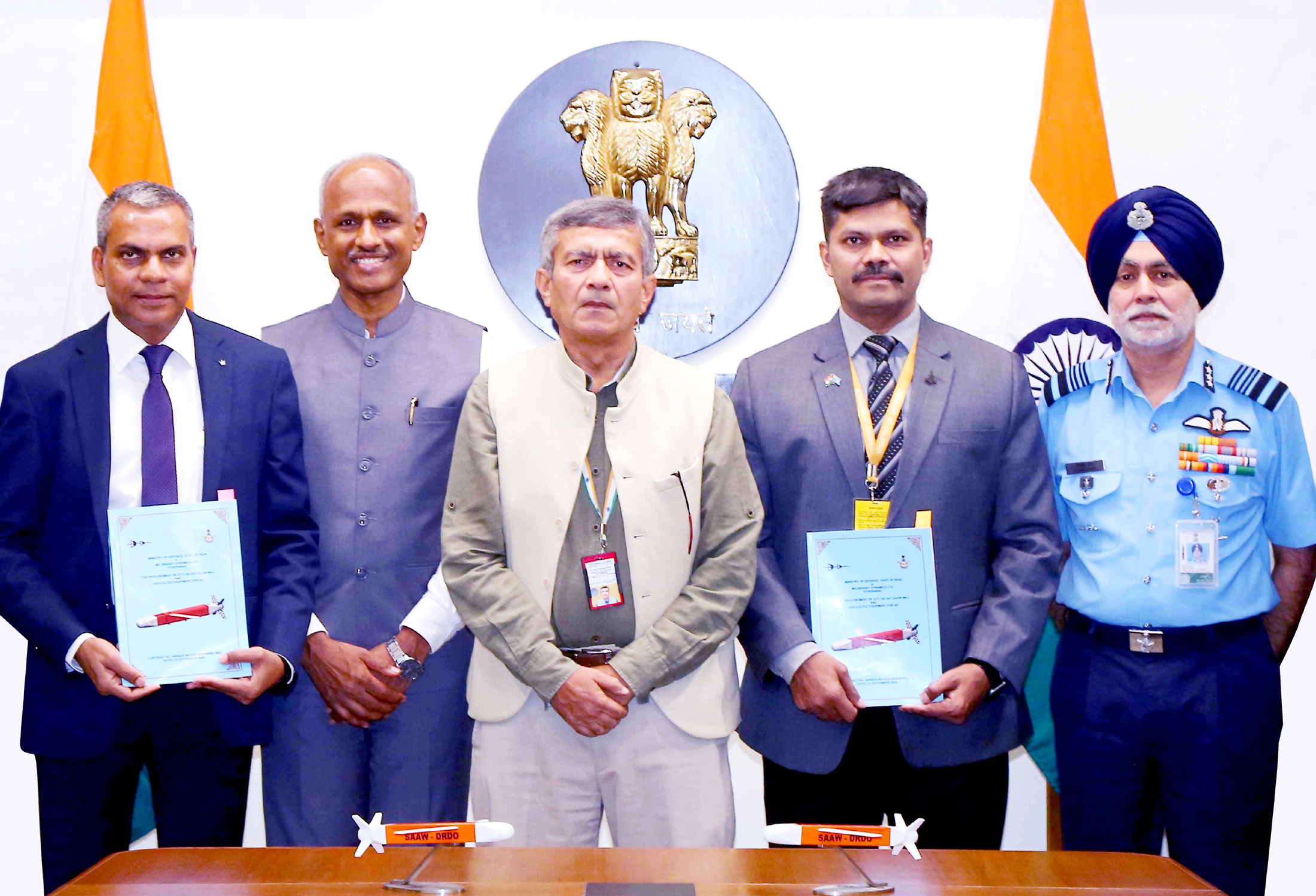
The contract was signed in New Delhi on 23 September in the presence of India’s Defence Secretary Rajesh Kumar Singh. It has been placed under the Buy Indian — Indigenously Designed, Developed and Manufactured category, with the Ministry of Defence specifying indigenous content of 60%. Deliveries are scheduled across the 2027–28 and 2028–29 financial years.
SAT-SAAW is an air-launched precision guided glide weapon developed by India’s Defence Research and Development Organisation. The Ministry says it can be launched from Jaguar, Hawk, and Su-30MKI aircraft and employed against airfield infrastructure from stand-off distance. DRDO has previously described the SAAW family as a roughly 125kg weapon with a range of around 100km, intended for targets including runways, hardened structures, hangars, and radar installations.
The award moves the programme from development and trials into production engineering, qualification, supply, and integration at scale. Bharat Dynamics was established as a manufacturing base for guided weapons and associated equipment and has worked extensively with DRDO to transfer domestically developed missile and weapon technologies into series manufacture. SAT-SAAW adds another programme in which that relationship must convert a development baseline into repeatable hardware for an operational customer.
The 60% indigenous-content requirement extends below final assembly. The Ministry identified navigation, fuzing, and twin-store carrier equipment among the areas being brought into the domestic industrial base. Precision weapons depend on those supporting systems operating as a controlled configuration: guidance, safe arming, aircraft carriage, environmental qualification, and reliable interfaces all have to perform consistently across production lots.
India has increasingly directed major acquisition programmes towards domestic industry. Earlier in September, the Defence Acquisition Council approved requirements estimated at ₹1.10 lakh crore across land, naval, aerospace, and electronic-warfare capabilities, with most of the proposed procurement intended for Indian suppliers. The SAT-SAAW contract goes beyond an acquisition approval by fixing the supplier, quantity, value, localisation level, and delivery period.
Aircraft integration remains central to the production programme. A stand-off weapon carried by several aircraft types has to satisfy separate mechanical, electrical, software, separation, and mission-planning requirements for each authorised platform. Jaguar and Su-30MKI are established Indian Air Force combat aircraft, while Hawk has also been used during SAAW development. Maintaining those interfaces consistently is essential if production weapons are to remain interchangeable within the approved configuration.
The twin-store carrier adds another integration requirement. Carriage hardware affects aerodynamic loads, clearances, weapon separation, electrical interfaces, and the number of weapons available on a sortie. Localising that equipment alongside the weapon reduces dependence on externally controlled interfaces, while placing configuration control and production assurance more firmly inside the Indian programme.
Series manufacture will also test the depth of the supporting supplier network. Guidance components, structures, fuzing equipment, electronics, carriage hardware, test systems, and documentation must arrive to controlled specifications and remain traceable through manufacture and acceptance. A localisation figure has limited value if bottlenecks in a small number of critical components prevent production from meeting the planned schedule.
Bharat Dynamics must now move from contract award through supplier preparation, production, acceptance, and delivery while maintaining the specified indigenous-content level. The first useful indicators will be production milestones and delivery performance against the 2027–29 schedule, when the SAT-SAAW programme begins to demonstrate whether its domestic industrial base can support repeatable manufacture rather than development quantities alone.