IN Brief:
- Advanced Navigation has secured a €16 million agreement to supply hundreds of Boreas inertial navigation systems to KONGSBERG.
- The systems provide position and orientation data when satellite navigation is jammed, spoofed, or unavailable.
- The equipment feeds into PROTECTOR platforms supporting Poland’s 18-battery SAN counter-UAS programme.
Advanced Navigation has secured a €16 million agreement to supply hundreds of Boreas fibre-optic gyroscope inertial navigation systems to KONGSBERG for integration into PROTECTOR counter-UAS platforms, adding an independent navigation reference for operations where satellite positioning is jammed, spoofed, or unavailable.
The Australian navigation specialist’s equipment will provide positioning, orientation, and heading data for the weapon platforms. KONGSBERG’s systems are being supplied into Poland as part of the wider SAN counter-UAS programme, tying Australian-manufactured navigation technology into a European air-defence architecture built around distributed sensors, weapons, and command-and-control equipment.
Inertial navigation provides a reference that does not depend continuously on external satellite signals. A counter-UAS weapon station may combine radar, electro-optical sensors, tracking software, and effectors, but those systems still need an accurate understanding of the platform’s own position and orientation. That requirement becomes harder when GNSS signals are unreliable or deliberately manipulated.
Advanced Navigation’s Boreas family uses fibre-optic gyroscopes together with inertial sensors and processing algorithms. Under the agreement, the company says its equipment will allow PROTECTOR stations to maintain sensor alignment and targeting functions in electronically contested environments. The work follows an earlier supply arrangement under which Boreas D90 systems were integrated with KONGSBERG’s PROTECTOR RS4 platform.
“Precision is no longer determined by arsenals or sensors alone,” said David Leniewski, Managing Director of Advanced Navigation EMEA. Stable position and attitude data sit underneath the rest of the fire-control chain, particularly when a weapon station is mounted on a vehicle or operating in an area affected by electronic attack.
The supply agreement forms part of a considerably larger Polish programme. KONGSBERG and Polska Grupa Zbrojeniowa signed a contract with the Polish Armaments Agency in January covering 18 SAN counter-UAS batteries, with KONGSBERG’s portion valued at around NOK 16 billion. The programme combines several classes of guns, missiles, interceptor drones, sensors, and command-and-control equipment rather than relying on one effector for every drone threat.
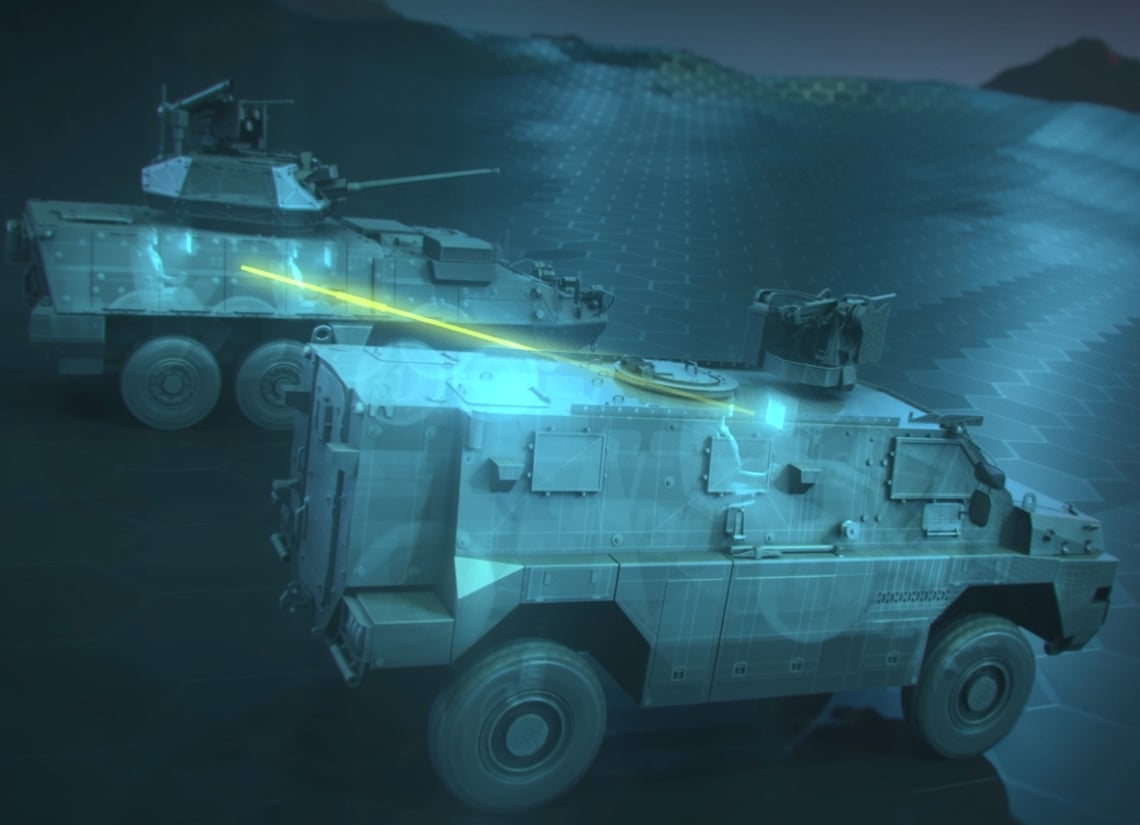
PROTECTOR provides one of the integration points within that architecture. KONGSBERG’s remote weapon-station family accepts different weapons and sensors and has increasingly been adapted for the counter-UAS role. The company has also integrated Echodyne MESA radar technology with PROTECTOR RS4 and RS6 stations, providing precision radar tracking data for optical cueing and fire-control calculations.
Boreas addresses a different part of the same system chain. Radar can detect and track an aerial target, optical equipment can refine identification, and an effector can provide the physical response. If the weapon station’s own orientation or position reference degrades, however, data shared between those elements can lose accuracy. Fibre-optic gyroscope technology supplies an internal reference independent of satellite reception.
The counter-UAS environment makes that independence increasingly valuable. Small drones can be used alongside electronic attack, while military forces themselves may restrict or alter their use of satellite navigation to reduce vulnerability. A system intended to operate under those conditions cannot allow the loss of GNSS alone to undermine the alignment between sensor and weapon.
The contract also moves Advanced Navigation further into an international defence production network. The company manufactures navigation equipment in Australia and says the agreement has been supported by the Australian Department of Defence’s Global Supply Chain Program. KONGSBERG is preparing additional manufacturing capability in Poland as SAN deliveries increase, giving the project a supply base spanning Australia, Norway, and Poland.
Production volume changes the industrial requirement. SAN covers 18 batteries, while Advanced Navigation’s agreement calls for hundreds of Boreas units. That converts a technology usually described through accuracy and navigation resilience into a manufacturing task involving repeatable calibration, environmental testing, configuration control, and delivery across a large fleet of systems.
Integration into PROTECTOR has already been demonstrated through the earlier Boreas D90 work. The €16 million agreement moves the relationship onto a larger production footing, where navigation performance has to be reproduced consistently across hundreds of units and sustained through Poland’s wider deployment of the counter-UAS architecture.