IN Brief:
- DroneShield has opened an Adelaide R&D facility providing software-development and dry-laboratory space for defence engineers.
- Work at the site spans embedded systems, sensing, communications, software, electronic warfare, and counter-UAS technologies.
- The new operation expands DroneShield’s Australian engineering capacity alongside its existing Sydney research activity.
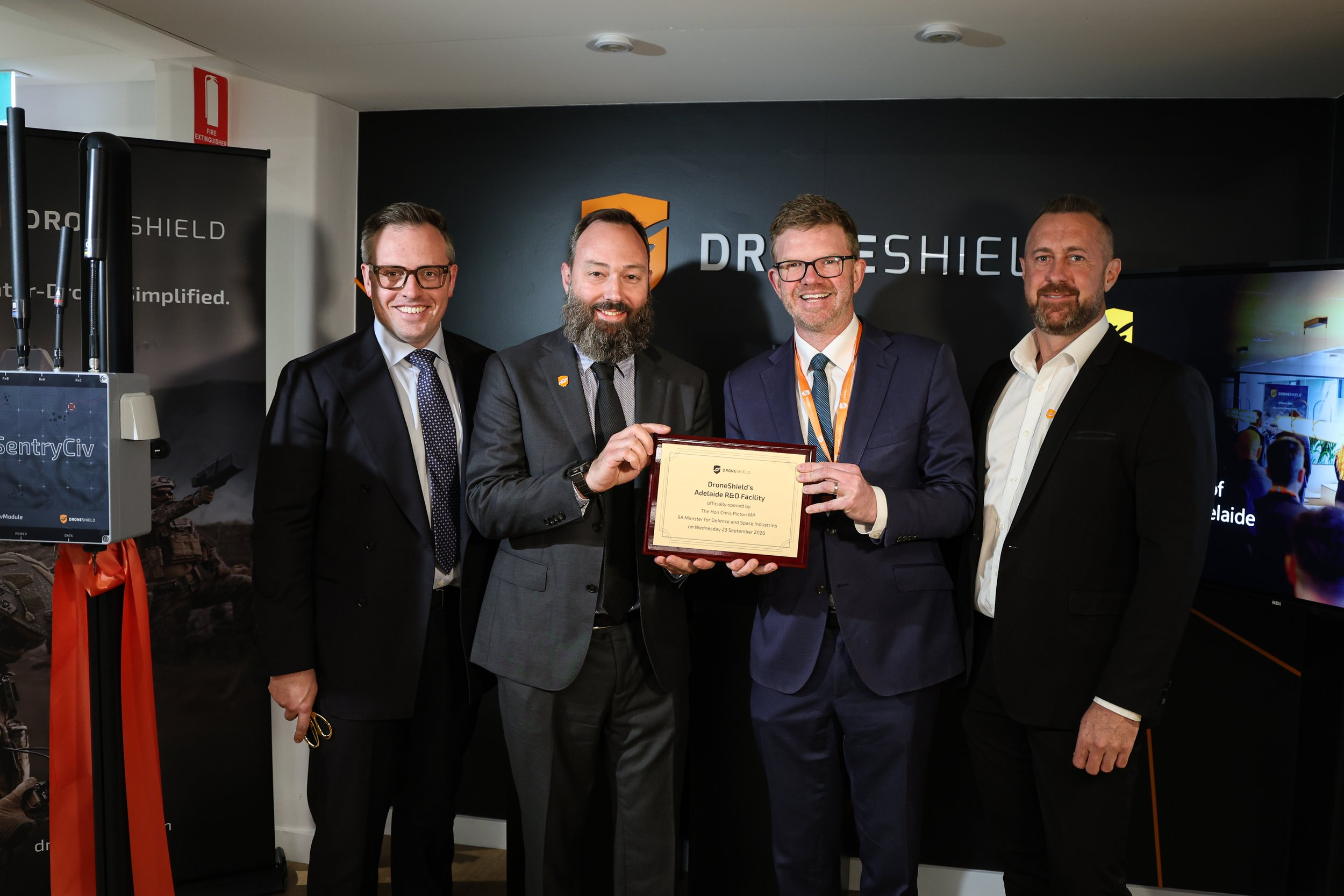
DroneShield has opened a research and development facility in Adelaide, expanding its Australian engineering footprint with dedicated software-development and dry-laboratory capacity for counter-UAS and electronic-warfare technology.
The site will support engineers working across embedded systems, advanced sensing, communications, software, and electronic warfare. It complements DroneShield’s existing research activity in Sydney and adds another engineering team within South Australia’s defence and advanced-technology cluster rather than creating a new production plant.
Counter-UAS systems increasingly depend on rapid software and sensor development alongside the physical radar, antenna, processor, or effector hardware deployed in the field. A dry laboratory allows engineers to develop, integrate, and test portions of that system architecture without requiring every software or electronics iteration to begin on a live operational range.
DroneShield says the Adelaide team will contribute to future generations of its counter-drone and electronic-warfare technologies. The company’s current architecture combines radio-frequency sensing, artificial intelligence, sensor fusion, software, and electronic countermeasures across fixed, mobile, and dismounted applications. Additional engineering capacity therefore supports several layers of the product range rather than one individual system.
“Opening our Adelaide office strengthens our ability to access exceptional engineering talent and further expand our Australian research and development capabilities,” said Angus Bean, Chief Executive of DroneShield. South Australian Minister for Defence and Space Industries Chris Picton formally marked the opening, placing the facility within the state’s wider push to expand its defence technology workforce.
The investment follows a series of integration and deployment milestones for the company’s equipment. DroneSentry-X Mk2 systems recently reached initial operational capability on US military Infantry Squad Vehicles after installation, live-UAS acceptance testing, and operator training. DroneShield has also been developing interoperability between its DroneSentry architecture and directed-energy effectors.
Those programmes place a different engineering burden on the company from stand-alone counter-drone equipment. Vehicle-mounted and layered systems have to exchange information with host-platform power, data, command-and-control, and sensor systems while continuing to classify changing drone signatures. Software releases and electronic-warfare updates also require controlled testing because a change intended to improve detection or disruption can affect interoperability elsewhere in the system.
The Adelaide operation adds capacity for that integration work. Its emphasis on embedded systems and communications is closely aligned with counter-UAS equipment that has to process sensor data locally and pass tracks or classifications between distributed components. Electronic-warfare development introduces further requirements around emissions, frequency management, hardware compatibility, and verification against changing signal environments.
Small uncrewed aircraft are also evolving faster than conventional military platform cycles. New control links, navigation techniques, autonomy functions, airframes, and operating frequencies can change the threat characteristics seen by detection and electronic countermeasure systems. Counter-UAS suppliers therefore need an engineering process capable of updating software and signal libraries without forcing a complete hardware redesign for every change.
DroneShield has not disclosed a capital investment figure, floor area, or recruitment target for the Adelaide site. The facility should therefore be measured as an expansion of engineering capability rather than a quantified increase in manufacturing output. Evidence of its scale will emerge through workforce growth and the programmes, software releases, and hardware integrations developed there.
The location also places DroneShield within a region hosting substantial defence, space, naval, and electronics activity. Access to engineers with adjacent experience in communications, embedded systems, software, and electronic warfare can be as important as physical laboratory space when specialist recruitment becomes a constraint on development programmes.
Counter-UAS development cycles are continuing to shorten as new drone platforms and control methods reach the market. Adelaide gives DroneShield another site from which to run that work alongside Sydney, increasing the engineering capacity available for system updates, integration, and testing. Its contribution will become clearer as those resources feed into deployable products and customer programmes.