IN Brief:
- India has commissioned nuclear-powered ballistic missile submarine INS Aridhaman and stealth frigate INS Taragiri.
- Taragiri enters service as a Project 17A ship with more than 75% indigenous content and support from a broad domestic supplier base.
- The paired induction highlights two strands of maritime industry at once: strategic undersea manufacturing and serial surface-combatant production.
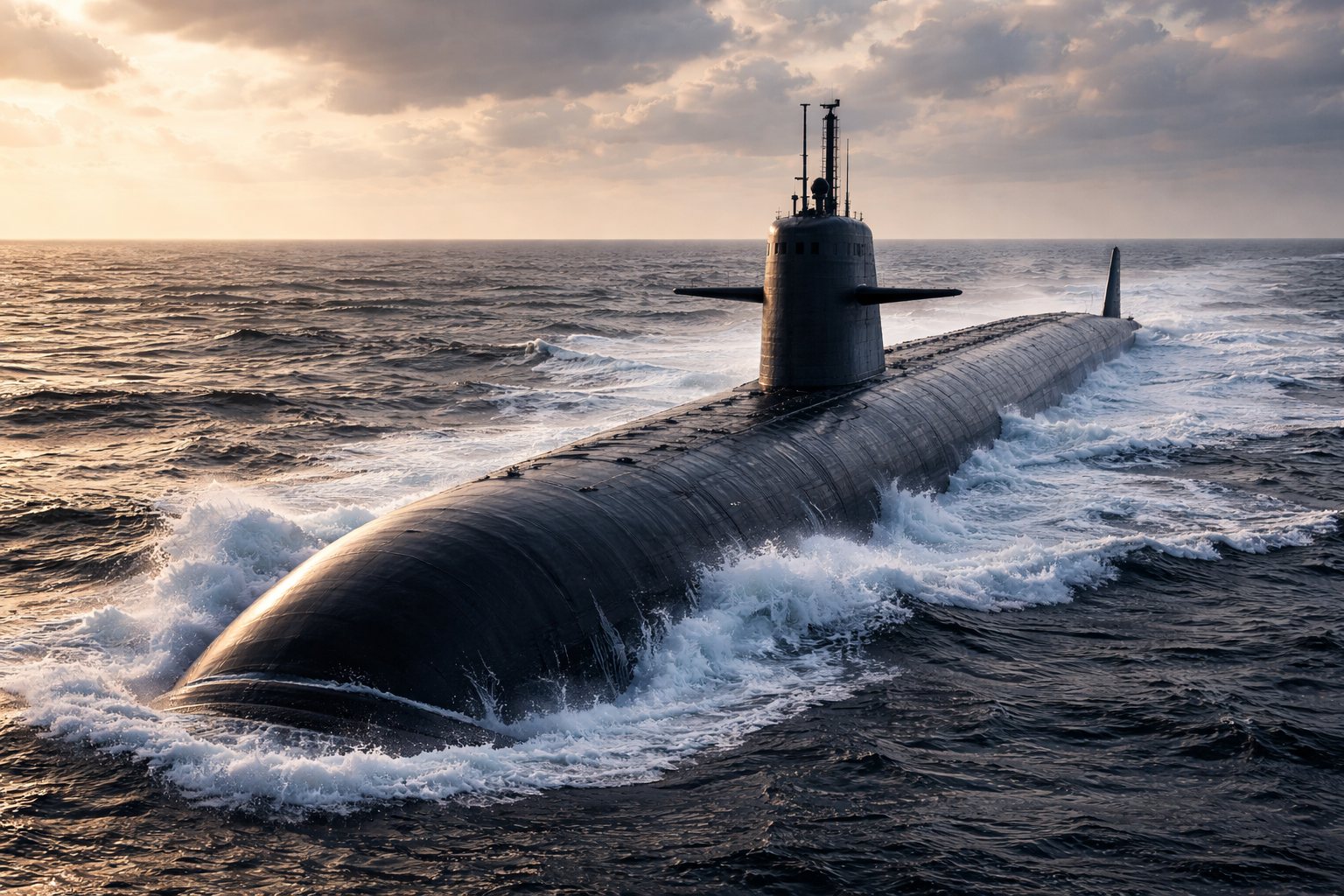
India has added two significant warships to its naval inventory with the commissioning of ballistic missile submarine INS Aridhaman and stealth frigate INS Taragiri at Visakhapatnam. The two platforms sit at opposite ends of the fleet structure, one tied to strategic deterrence and the other to frontline multi-role surface combat, yet together they say something more important about the country’s shipbuilding direction.
Taragiri is the easier platform to read in public. The fourth ship of the Project 17A class, it has been designed by the Warship Design Bureau and built by Mazagon Dock Shipbuilders Limited for multi-role operations, with more than 75% indigenous content. Indian officials have also stressed the contribution of domestic MSMEs, while a separate update from the Ministry of Steel says the ship used roughly 4,000 tonnes of special-grade steel supplied by SAIL.
Aridhaman is a different kind of signal. Strategic submarine programmes are necessarily more opaque, but commissioning another nuclear-powered ballistic missile submarine points to a maturing industrial ecosystem in reactor integration, submarine construction, acoustic management, and the tightly controlled supply chains that underwrite an SSBN fleet.
Surface-combatant output at scale
Taragiri matters because it shows India is trying to turn indigenous warship construction into a repeatable production model rather than a one-off national project. Repeatability is the real test. Once a shipyard begins moving through a class in sequence, schedule reduction, supplier learning, and configuration discipline start to matter as much as headline capability.
That is also where domestic materials and subsystem production become strategically useful. A frigate programme with high local content is not only a sovereignty argument. It is a resilience argument.
Strategic manufacturing is a different discipline
Aridhaman points to a parallel challenge. Strategic submarine production operates on longer timescales, tighter secrecy, and narrower margins for error. Industrial throughput is lower, but technical complexity is much higher. Design maturity, specialist fabrication, propulsion integration, and lifecycle support all carry strategic rather than merely programme consequences.
Taken together, the two inductions show India trying to broaden its naval-industrial base both horizontally and vertically — across serial frigate construction and into the deeper engineering demands of a sovereign undersea deterrent.