IN Brief:
- Leonardo Rheinmetall Military Vehicles has displayed a new Italian main battle tank concept demonstrator.
- The demonstrator combines a new turret with a Leopard 2A4 hull while pointing towards a more developed production configuration.
- The programme will test Europe’s ability to rebuild heavy-armour capacity around mobility, protection, electronics, and workshare.
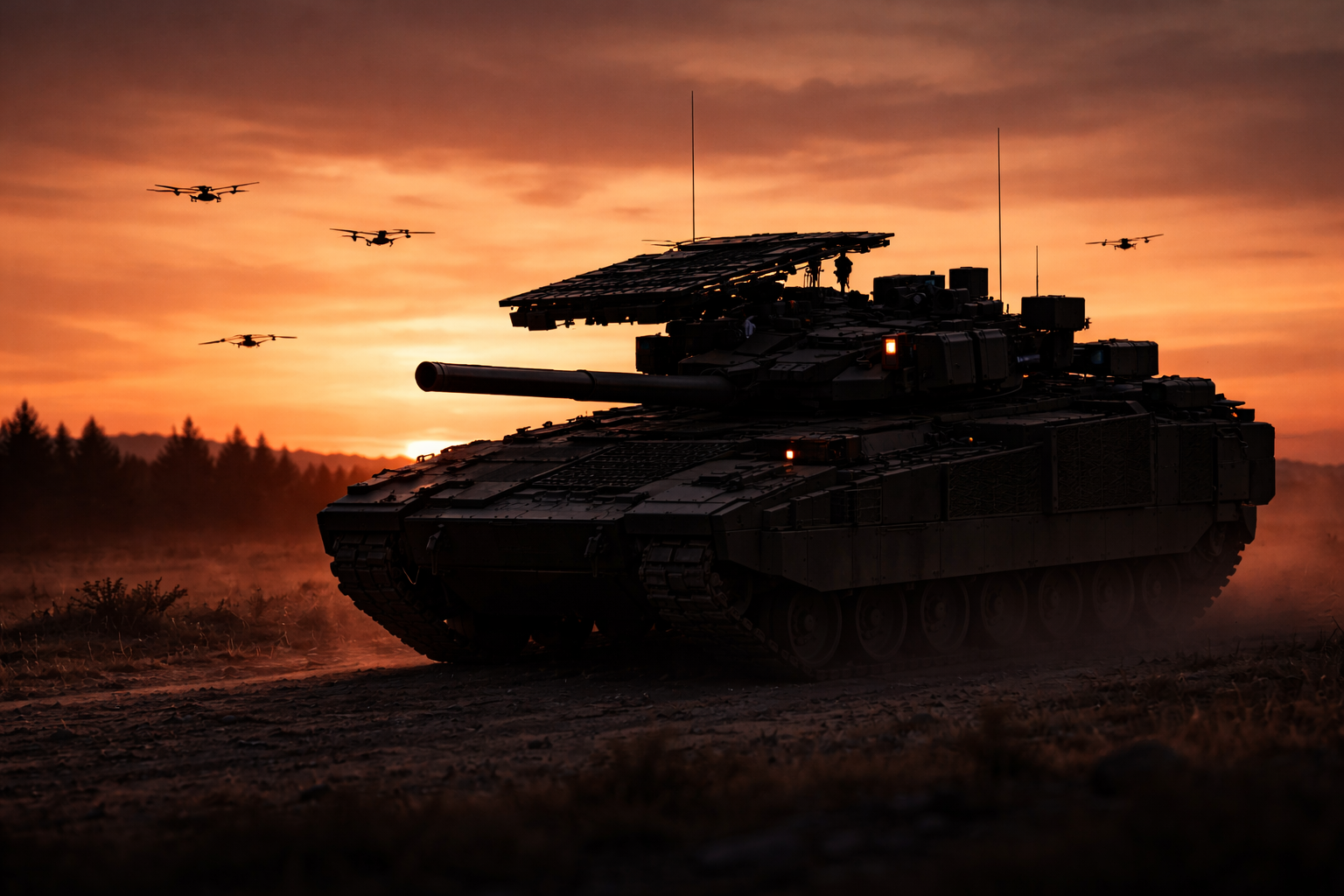
Leonardo Rheinmetall Military Vehicles has displayed a new main battle tank concept demonstrator for Italy, giving Europe’s heavy-armour rebuild a visible industrial marker.
The demonstrator combines a Leopard 2A4 hull with a new turret design integrating subsystems from Leonardo and Rheinmetall. It is not the final production configuration, but it shows the intended direction for Italy’s future main battle tank requirement.
The joint venture brings together Rheinmetall’s land-platform and armour expertise with Leonardo’s electronics, sensors, weapon systems, command systems, and Italian industrial base. That structure gives Italy a stronger domestic role than a straightforward foreign platform purchase, while giving Rheinmetall a deeper position in one of Europe’s largest land modernisation programmes.
Using a Leopard 2A4 hull gives the demonstrator a known platform base, yet a production vehicle will need more than legacy hull adaptation. Modern requirements around mobility, underbelly protection, electronic architecture, active protection, cooling, and growth capacity place pressure on every part of the design. A future production vehicle is expected to require a new hull solution rather than simple refurbishment.
The manufacturing workload is broad. A modern MBT programme brings heavy structures, welding, machining, armour modules, powerpacks, transmissions, suspension, tracks, cooling, vetronics, fire-control systems, sights, communications, active protection, remote weapon stations, ammunition handling, and test infrastructure into one programme. Any weakness in that chain slows the whole vehicle.
Europe is rebuilding heavy-armour capacity after years of limited procurement and fragmented national requirements. Similar pressures are visible beyond Europe, where Rheinmetall’s US manufacturing expansion has centred on hulls, turrets, machining, automation, and inspection capacity. The same basic issue applies on both sides of the Atlantic: armoured-vehicle production cannot be regenerated instantly once skilled labour, qualified suppliers, and tooling have thinned out.
The Italian programme also has a strong workshare dimension. Rome needs to replace ageing Ariete capability while retaining meaningful national participation in design, production, support, and future upgrades. Managing that balance will require careful allocation of turret work, electronics integration, hull production, final assembly, testing, and sustainment.
Battlefield lessons are changing the vehicle’s design priorities. Mobility is no longer only speed and range; it includes recovery, bridge classification, power reserve, thermal management, and the ability to carry heavier protection and electronics. Survivability now reaches beyond passive armour into active protection, top-attack resistance, electronic-warfare resilience, signature management, and repairability.
Electrical architecture may become one of the most important production choices. Future MBTs will carry more sensors, counter-drone systems, defensive aids, datalinks, displays, and software-controlled subsystems. Without power and cooling margins, upgrade paths quickly become expensive redesigns.
The demonstrator still leaves major questions open, including final hull design, production allocation, export potential, fleet size, and integration schedule. Even so, it moves Italy’s MBT plan from industrial agreement into physical architecture. The next phase will show whether the joint venture can translate that architecture into a controlled production programme that strengthens Italy’s land-systems base while adding capacity to Europe’s wider armour rebuild.