IN Brief:
- Leonardo will integrate Shield's Hivemind development environment with its Proteus autonomous rotorcraft programme.
- The software development kit will support Leonardo's own mission autonomy applications and subsequent updates.
- Proposed mission areas include anti-submarine warfare, surveillance, and contested logistics, with integration and evaluation still ahead.
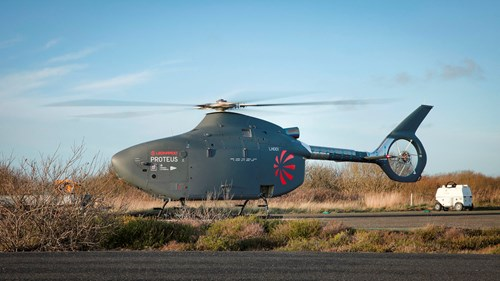
Leonardo has selected Shield’s Hivemind software development environment to extend the autonomous capabilities of Proteus, its uncrewed rotorcraft demonstrator developed with the Royal Navy and UK Defence Innovation.
The agreement will allow Leonardo engineers to develop mission autonomy applications using the Hivemind Software Development Kit (SDK). Proposed applications include anti-submarine warfare, intelligence, surveillance, and reconnaissance (ISR), and helicopter logistics operations in contested environments.
Proteus already incorporates autonomy developed by Leonardo and completed its maiden flight in early 2026. The new collaboration introduces additional development tools for expanding those capabilities, rather than establishing the aircraft’s first autonomous flight capability.
The rotorcraft was developed under the Rotary Wing Uncrewed Air System Capability Concept Demonstrator Phase 3B programme. It supports the Royal Navy’s Maritime Aviation Transformation strategy, which considers how uncrewed and crewed aircraft capabilities could develop through 2040.
Proteus has a modular payload bay intended to accommodate approximately one tonne of equipment or two standard NATO 463L pallets. The arrangement allows different payloads to be incorporated for particular missions, subject to the aircraft’s operating limitations and the engineering requirements of the selected equipment.
These configurations place different demands on mission software. A surveillance sortie may require the aircraft to conduct a planned search while managing sensor information, whereas a logistics task involves navigation to assigned locations while accounting for the carriage and delivery of its payload.
Anti-submarine warfare introduces further requirements because the aircraft may need to operate as part of a wider maritime sensing arrangement. Mission planning, aircraft positioning, and the handling of information received from sensors or other naval assets must be coordinated, although no particular Hivemind-enabled anti-submarine payload has been confirmed for Proteus.
The distinction between aircraft flight control and mission autonomy is central to the integration. Flight control maintains the aircraft’s basic flying characteristics and executes control commands, while mission autonomy determines how the platform performs assigned tasks within its approved operating limits.
Information must pass reliably between these functions. The mission software needs access to relevant aircraft state and navigation data, while its instructions must remain compatible with the control system’s constraints. Changes to payloads or sensors can alter the information available to the autonomy software and require additional integration work.
Shield’s Hivemind environment provides software tools through which engineering teams can create and refine their own autonomous behaviours. The SDK is intended to support development, integration, testing, deployment, and subsequent modification without requiring the platform manufacturer to depend on Shield for every change to its mission applications.
Leonardo will retain responsibility for the autonomy software it creates with those tools. Its engineers can tailor applications to the requirements of Proteus and undertake further development as mission definitions, sensors, or operating environments change.
That responsibility also extends to evaluating the modified software. Autonomous behaviour can be assessed in simulation before engineers introduce it into representative hardware and subsequently test its interaction with an aircraft. Each stage provides opportunities to examine whether the software responds correctly to relevant inputs and system constraints.
Proteus previously completed synthetic demonstrations before its first flight, allowing aspects of its existing autonomy capability to be examined in simulated operational scenarios. That experience provides an established development foundation for further work, although the integration and testing schedule for Hivemind has not been disclosed.
Sensor information introduces particular engineering challenges. The mission system may receive data from navigation instruments, aircraft systems, and installed mission equipment, with differing update rates and levels of uncertainty. Its decisions must remain consistent with the information available and the operational rules established for the aircraft.
Where communication links are restricted or disrupted, an autonomous platform may need to continue carrying out an approved activity using onboard information. The extent to which it can do so depends on its software architecture, sensor configuration, and defined operating authority. Shield and Leonardo have not specified the degraded-communications performance intended for the Proteus integration.
The aircraft’s modular design also makes configuration management important. A change in payload mass, electrical consumption, sensor interfaces, or mission equipment can alter the conditions that software must accommodate, requiring corresponding updates to engineering documentation and test evidence.
Maintaining software applications within Leonardo’s own engineering organisation could support repeated development across configurations while preserving the company’s control over its platform-specific mission functions. The agreement provides the tools and collaboration needed to pursue that work, with completed capabilities dependent on subsequent integration and testing.
Leonardo’s Adam Wardrope, Vice President Market Development Helicopters UK, identified the potential to extend the collaboration beyond Proteus into other rotary-wing programmes. Any further application would require engineering work appropriate to the control systems, payload arrangements, and operating characteristics of the aircraft concerned.
Shield has previously integrated Hivemind with a range of aircraft and other autonomous platforms, providing experience in developing mission software for different operating environments. The present agreement applies that development approach to Leonardo’s rotorcraft programme, with Proteus serving as the immediate platform for the planned work.
Leonardo and Shield will now develop and integrate the additional autonomy functions. Proteus provides an existing flying demonstrator for evaluation, while further flight testing and technical assessment will determine which new mission capabilities can be demonstrated on the aircraft.