IN Brief:
- Anthony Reeves will lead National Armaments Innovation, overseeing a combined £3.7bn four-year portfolio.
- The organisation encompasses Dstl, UK Defence Innovation, the Defence Investment Unit, and the Defence Uncrewed Systems Centre.
- Its responsibilities connect defence research, technology evaluation, industrial collaboration, and progression towards military adoption.
The Ministry of Defence has appointed Anthony Reeves as its first Director General Innovation, bringing approximately 4,800 scientists, engineers, and technology specialists within a new senior leadership portfolio responsible for defence research and innovation.
Reeves will lead National Armaments Innovation as a three-star senior civil servant, joining the National Armaments executive committee under National Armaments Director Rupert Pearce. He will oversee a combined science, technology, and innovation portfolio worth £3.7bn over four years, covering established research functions and the development of emerging military capabilities.
The financial commitment comprises a ringfenced £1.6bn defence innovation budget and £2.1bn supporting core science and technology. Both amounts form part of the portfolio brought under the new leadership arrangement, rather than representing £3.7bn of additional funding created by the appointment.
National Armaments Innovation encompasses the Defence Science and Technology Laboratory (Dstl), UK Defence Innovation (UKDI), the Defence Uncrewed Systems Centre, and the Defence Investment Unit. Their work spans scientific research, technology assessment, industry engagement, and the development of equipment intended to meet military requirements.
The structure connects organisations performing different functions within defence technology development. Dstl undertakes scientific and technical work that informs equipment design and capability decisions, while UKDI engages with industry and academia to identify technologies that could be developed for military applications.
UKDI’s priority areas include autonomy, decision advantage, logistics and support, effects, and protection. These encompass technologies used in communications, sensing, data processing, uncrewed systems, and protective equipment, with development requirements shaped by the capabilities sought by the Armed Forces.
Promising technologies must progress through several engineering stages before they can become deployable equipment. Laboratory results establish initial technical performance, but subsequent work may require prototype integration, representative testing, manufacturing development, and assessment against the operating conditions expected in military service.
Dstl provides expertise that can support these assessments, including experimental research, modelling, materials science, sensing, and operational analysis. Scientific evaluation helps establish whether the proposed technology performs as intended and which limitations need resolving before a programme moves into more extensive development.
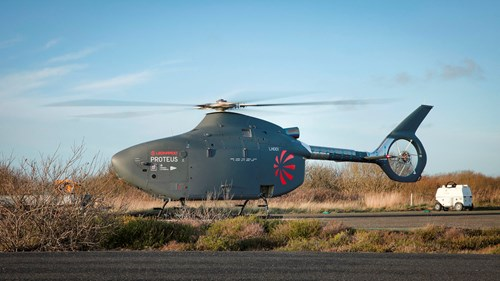
Uncrewed systems present particular integration demands because the vehicle, sensors, navigation equipment, control software, and communications arrangements must operate together. Performance depends on the interaction between those elements, including the information available to onboard systems and the conditions in which the equipment is expected to operate.
The Defence Uncrewed Systems Centre provides a dedicated organisational focus for this area. Its inclusion within National Armaments Innovation places specialist uncrewed capability development alongside the scientific research and industrial engagement functions needed to support subsequent engineering work.
Recent defence experimentation has demonstrated the range of activities involved. In a Dstl-led Army project, an eight-aircraft test bed was used to examine coordinated uncrewed operations under the Software Defined Swarms Concept Demonstrator programme. The work combined software development, systems integration, and experimentation with military users.
Such projects require more than the development of autonomous software. Aircraft or ground platforms must exchange the required information, onboard control systems must remain compatible with mission functions, and test arrangements must establish how equipment behaves under defined conditions.
The MOD has also been expanding access to specialist testing infrastructure. Its Project Safari arrangement with QinetiQ is intended to help smaller technology businesses use facilities that can support evaluation and development work, connecting industrial innovation with the evidence required for defence capability decisions.
The Defence Investment Unit adds a further function within Reeves’s portfolio. Bringing investment and innovation activity under common senior leadership creates a route for coordinating the identification and development of emerging technologies with the broader resources and partnerships available to defence organisations.
Responsibility for procuring and supporting equipment remains distributed across the wider National Armaments structure. Research and innovation organisations can help mature a technology, but acquisition, production, integration, training, and sustainment involve additional technical and commercial decisions.
Those stages can be particularly demanding when a promising technology is developed outside the traditional defence supply chain. A commercial product may need revised mechanical or electrical interfaces, environmental qualification, cybersecurity assessment, or changes to its manufacturing arrangements before it can be incorporated into military equipment.
Reeves joins the MOD from Deloitte, where he led its UK and NATO Digital Defence practice and held senior responsibilities covering National Armaments and artificial intelligence for defence and security. His earlier career included technology and transformation roles at Microsoft, PA Consulting, and Detica.
He also served as a British Army infantry officer, with operational deployments in Northern Ireland, Bosnia, Kosovo, and Sierra Leone. His professional experience spans military communications, digital technology, defence programmes, and the introduction of new information systems.
That background combines operational experience with the technical and organisational work involved in developing military capabilities. Communications and digital systems often depend on equipment and software supplied by multiple organisations, requiring common interfaces, assurance processes, and arrangements for supporting systems after deployment.
National Armaments itself brings together functions concerned with innovation, equipment acquisition, digital systems, commercial activity, logistics, and international cooperation. Reeves’s directorate will operate within that structure, linking research organisations to the wider processes responsible for developing and sustaining defence capabilities.
The MOD intends the new leadership arrangement to strengthen cooperation with industry, academic institutions, and international partners. Technologies emerging from those relationships will still require appropriate technical evaluation, development funding, and procurement decisions before they can enter military service.
Reeves takes up the position during autumn 2026. His initial responsibilities will encompass the four constituent organisations and their existing programmes, with the combined four-year portfolio establishing the financial scope of National Armaments Innovation’s work.