IN Brief:
- DEFTECH and UMPSA have presented TUAH as a modular autonomous UGV for resupply, reconnaissance, and future combat support tasks.
- The vehicle is built around a compact 4×4 architecture with configurable sensors, payload space, and low-signature propulsion.
- Its industrial value lies in local control over autonomy, integration, and mission-system growth rather than a one-off show prototype.
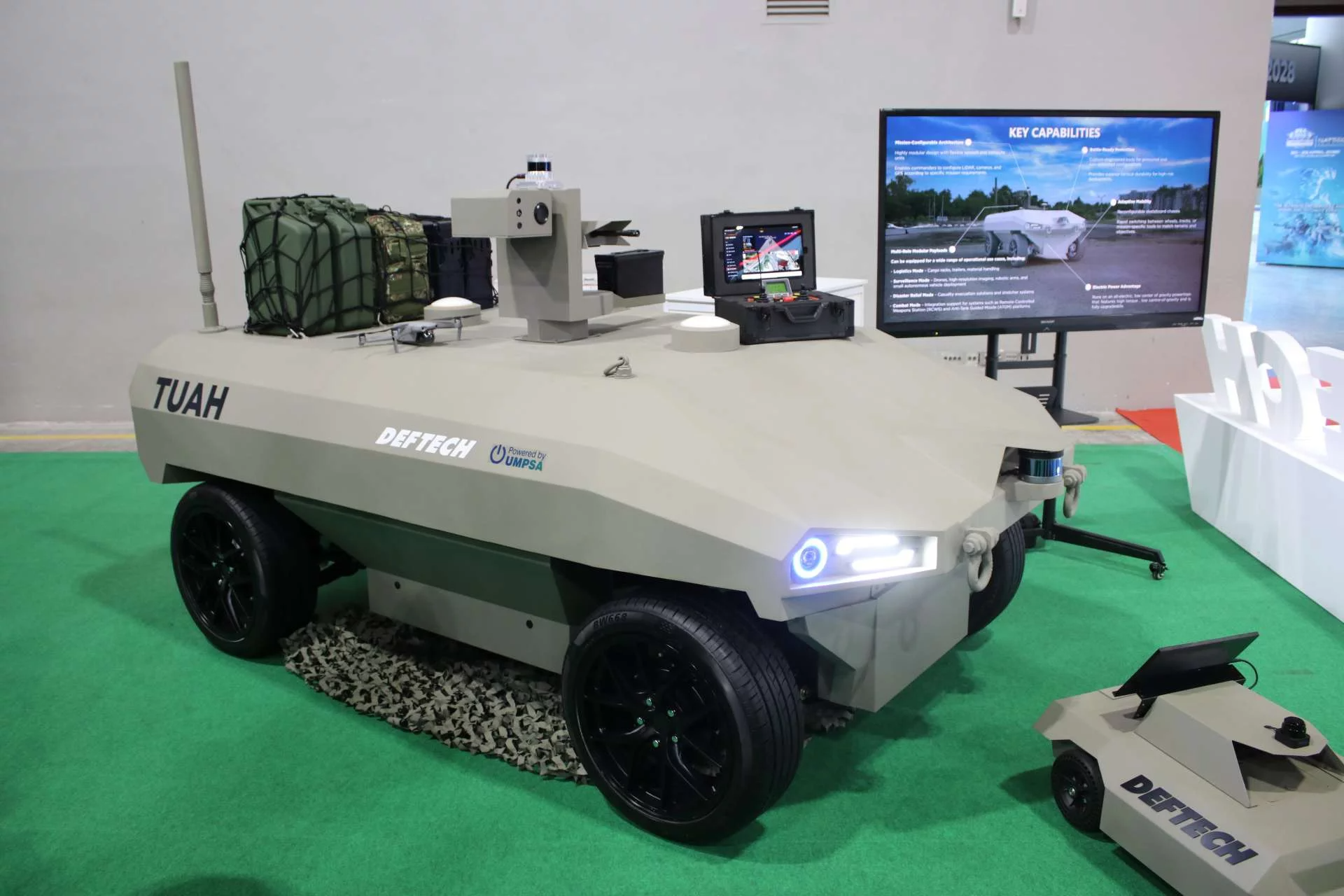
Malaysia has used DSA 2026 to put a new indigenous unmanned ground vehicle into view, with DEFTECH and Universiti Malaysia Pahang Al-Sultan Abdullah presenting TUAH as a tactical platform for moving supplies, carrying sensors, and supporting future combat roles.
The vehicle arrives at a point when armies are shifting from concept robotics to practical systems that can remove crews from exposed routes, reduce the burden on light vehicles, and keep sensors or payloads forward for longer. TUAH sits in that space. As displayed in Kuala Lumpur, it combines a low-profile 4×4 layout with a mast-mounted sensor package and a flat, adaptable upper structure for mission kits.
The design emphasis is modularity. The platform has been shown with provision for cameras, LiDAR, GPS, and different payload packages, while the wider concept leaves room for surveillance, protected logistics, and more heavily equipped variants. That matches a market increasingly looking for one chassis that can be adapted for multiple mission sets rather than a string of single-purpose robots.
Building a vehicle family
No operator has yet been identified, but the strongest signal from TUAH is not immediate procurement. It is the attempt to create a locally owned architecture that can evolve. A UGV programme becomes more credible once its autonomy stack, drive architecture, mission interfaces, and payload integration pathways are designed for iteration rather than exhibition use.
TUAH has been associated with edge intelligence, centralised control, and a reconfigurable structure intended to accept different sensor and equipment packages. That opens a route to follow-on variants for border security, resupply, reconnaissance, or armed overwatch without redesigning the entire base vehicle.
The production challenge sits below the surface
The harder part is not styling the platform. It is turning a demonstrator into a supportable system. That means ruggedising electronics for tropical heat and rain, validating autonomy in cluttered terrain, qualifying payload power distribution, and proving that the vehicle can keep moving when communications degrade.
It also means standing up a supplier base that can support local manufacture, spares, software maintenance, and future subsystem swaps. For Malaysia, that sovereign control may prove as important as the platform itself. If TUAH can move from stand model to tested fleet asset, it would give the country a more meaningful position in the regional unmanned land-systems market.