IN Brief:
- NIOA has renewed its L3Harris partnership to explore Australian production of rocket motors and warheads.
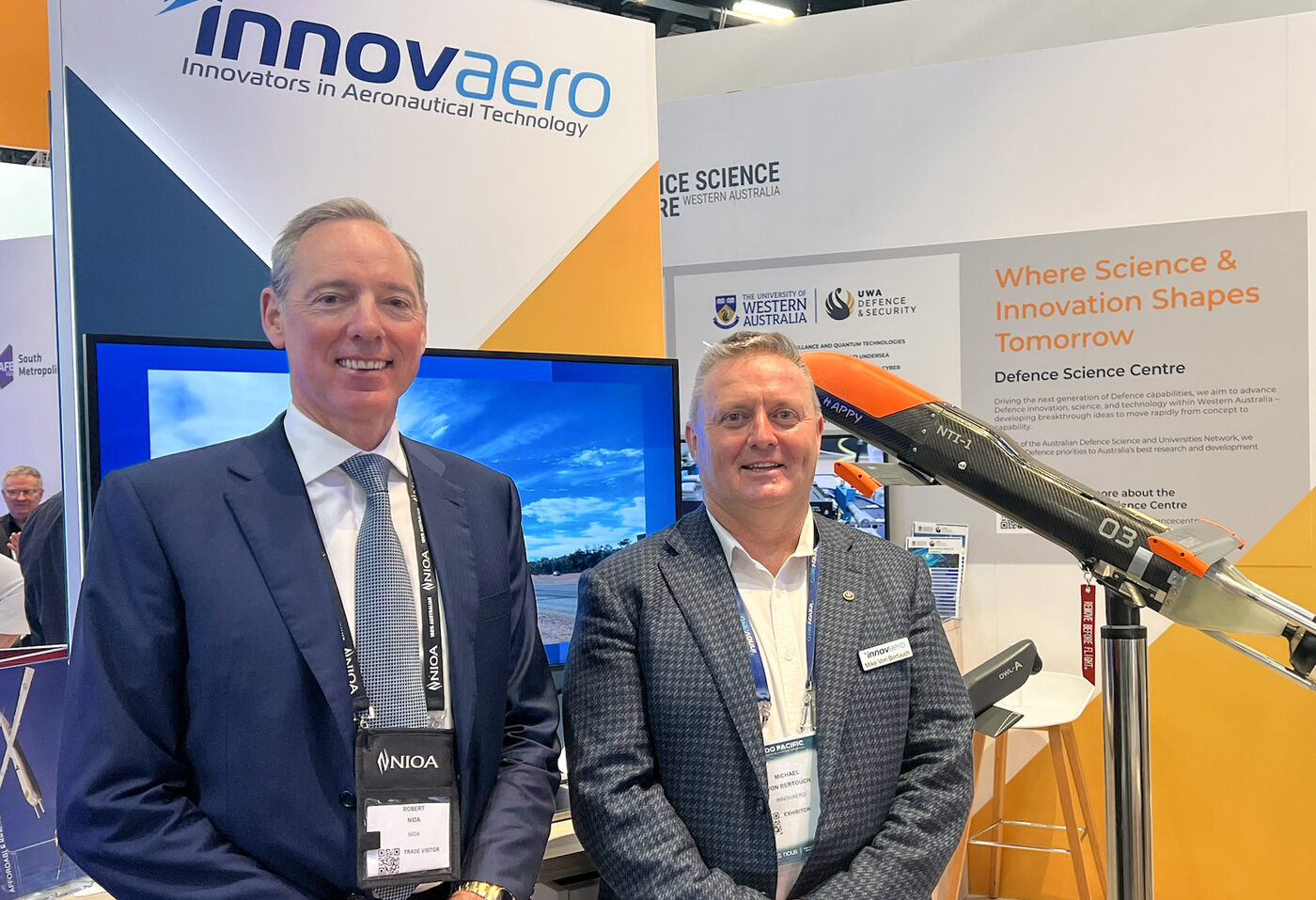
- A second agreement with Innovaero adds loitering-munition warheads, launch boosters, and tube-launched systems.
- Together, the deals widen Australia’s guided-weapons manufacturing base beyond assembly into deeper subsystem production.
Australia’s sovereign-guided-weapons effort has moved another step up the manufacturing chain, with NIOA securing two linked partnerships aimed at rocket motors, warheads, and loitering-munition subsystems.
The first agreement renews NIOA’s collaboration with L3Harris to explore production of critical guided-weapons components in Australia, extending work first announced in 2023. The focus is on establishing local capability for rocket motors and warheads, two of the hardest parts of the missile supply chain to scale quickly once demand accelerates. The second, announced a day later, brings Innovaero into a new all-Australian partnership with NIOA to develop and manufacture modular warheads, launch systems, launch boosters, and tube-launched architectures for loitering munitions.
Together, the agreements carry more industrial weight than a single teaming arrangement. One strand is aimed at propulsion and energetic content for established missile families. The other is centred on a strike segment built around lower-cost, mass-producible autonomous weapons. Both sit squarely inside Canberra’s wider push to build a sovereign Guided Weapons and Explosive Ordnance enterprise over the rest of the decade.
Rocket motors and warheads move closer to shore
Rocket motors and warheads are among the hardest parts of the weapons-industrial equation to localise. Casings, propellant, energetic filling, fuzing, and safe handling all require specialised facilities, certification, and workforce depth. When those lines are absent domestically, even well-funded procurement plans can end up waiting on allied production slots.
The renewed L3Harris agreement points to Australian participation deeper in the missile build than final integration alone, and aligns with NIOA’s existing manufacturing footprint at Benalla and Maryborough. For the supply chain, the opportunity reaches well beyond one prime and one partner. Motor cases, energetics, machining, test equipment, storage, transport, and quality assurance all bring their own industrial workload.
Loitering munitions add a faster-production lane
The Innovaero partnership adds a different production rhythm. Loitering munitions compress strike, reconnaissance, and affordability into a format that can be built in larger numbers than traditional cruise-missile classes, provided the industrial base can support repeatable manufacture of airframes, launch tubes, warheads, and control systems.
The plan moves through design, qualification, and production-readiness phases under Australian control. That points to a programme built for safety approval, export control, and controlled-rate manufacture rather than a short-lived demonstration line. For Australian defence manufacturing, it is another sign that sovereign capability is being pushed into production engineering rather than left at policy level.