IN Brief:
- Saab has delivered Giraffe 1X radars to the RAF in response to an urgent counter-UAS operational requirement.
- The lightweight 3D radar supports surveillance, target acquisition, counter-UAS detection, and wider air-defence functions.
- Recent UK orders and production investment have expanded Giraffe 1X manufacturing, integration, and verification capacity.
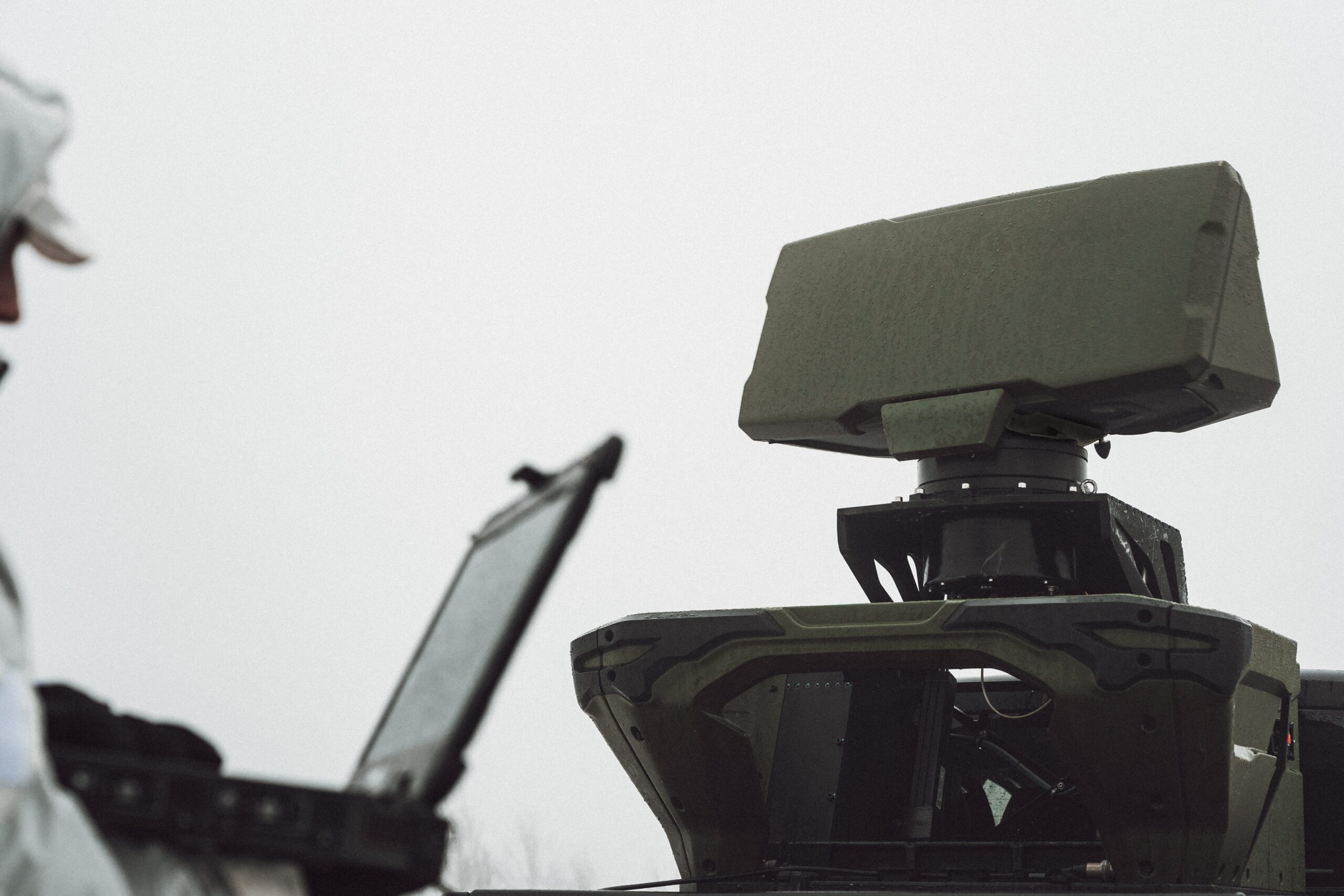
Saab has delivered Giraffe 1X radar systems to the Royal Air Force against an urgent operational requirement, adding the compact three-dimensional sensor to the RAF’s wider counter-uncrewed-aircraft architecture.
No quantity or contract value was disclosed in the 2 September announcement. Saab said the delivery was accelerated by combining its global production capacity with UK manufacturing and support operations, and that the radars are now part of the RAF counter-drone architecture used to support detection, tracking, and engagement of airborne threats.
Giraffe 1X is designed as a lightweight, multi-mission radar that can operate as a fixed sensor, be mounted on vehicles, or form part of wider ground-based air-defence networks. Saab lists the total system weight at less than 150kg and says the radar searches its full volume every second. Roles include air surveillance, ground-based air-defence target acquisition, counter-rocket, artillery and mortar warning, and detection of small uncrewed aircraft.
The radar is a sensor rather than a complete counter-UAS solution. Its operational value depends on how quickly reliable tracks can be passed into command-and-control systems for identification, prioritisation, and engagement, particularly when several types of sensor and effector are working together.
The RAF delivery follows increased Giraffe 1X activity in the UK. In April, Saab announced a separate Ministry of Defence order worth about £24 million for systems manufactured at its Centre of Radar Excellence in Fareham. That order used funding from the UK-administered NATO Security Assistance and Training Ukraine Trust Fund and covered weapon locating, air surveillance, and counter-UAS applications.
Fareham completed its 100th Giraffe 1X in May and opened a dedicated integration and verification facility for system testing, software integration, and customer acceptance. Saab said the site supports Giraffe 1X, Giraffe AMB, and TAIPAN radar production and sustainment, alongside the company’s wider UK radar engineering activity.
Urgent operational requirements put particular pressure on manufacturing and configuration control because the delivery timetable compresses activities normally spread across longer acquisition cycles. Component availability, software baselines, integration, acceptance testing, and support arrangements still have to be controlled even when equipment is required quickly.
Saab’s UK production base gives the Ministry of Defence a domestic route for a radar family supported by the company’s wider international manufacturing network. That combination becomes more useful when customers need additional units or modified configurations without establishing an entirely new support chain.
The sensor has also been used in UK experimentation beyond conventional point deployment. An August trial paired separate Giraffe 1X radars with independent AQlock quantum timing sources under simulated GNSS spoofing and denial conditions. The work examined whether distributed sensors could maintain a coherent air picture when satellite-derived timing became unreliable.
Distributed radar networks depend on accurate timing because measurements from separate sensors have to be correlated into a common track picture. That requirement becomes increasingly relevant to counter-UAS operations, where small targets can appear in numbers, fly at low altitude, and move through cluttered environments while defensive systems are expected to classify and engage them quickly.
Giraffe 1X is also entering additional European configurations. Saab and Scania France received a contract in May covering 17 systems, including one for test and evaluation and 16 intended for installation on tactical vehicles. Deliveries are planned across 2026 and 2027.
The ability to install the same core radar in fixed, deployable, and vehicle-mounted configurations allows development and support costs to be spread across a broader customer base while national users retain control over their own command, communications, and engagement architectures.
The RAF delivery adds another operational customer configuration to that installed base. Saab’s challenge is now less about demonstrating that Giraffe 1X can detect small airborne targets than about manufacturing, configuring, and supporting enough sensors to match the rate at which counter-UAS requirements are being turned into deployable systems.