IN Brief:
- Raytheon has received a $1.1bn US Navy contract to produce AIM-9X Block II missiles.
- The award covers missiles, hardware, and software for US and Foreign Military Sales customers.
- Raytheon is increasing AIM-9X production capacity to 2,500 missiles per year as domestic and allied demand grows.
Raytheon has received a $1.1bn US Navy contract to produce AIM-9X Block II missiles, extending one of the most widely used Western short-range missile families at a time of heavy domestic and allied demand.
The award covers AIM-9X missiles, associated hardware, and software for US and Foreign Military Sales customers. Raytheon is increasing production capacity to 2,500 missiles per year, reflecting demand from US forces and more than 35 allied and partner nations. The missile is used as an infrared-guided short-range air-to-air weapon and as a surface-to-air option in ground-launched systems such as NASAMS.
The contract places short-range missile production back in the foreground. AIM-9X is no longer only an air-combat weapon carried by fighters. Its wider use in layered air defence means demand can come from aircraft fleets, ground launchers, naval integration routes, training stocks, and foreign customers at the same time. One production line is therefore serving multiple operational communities.
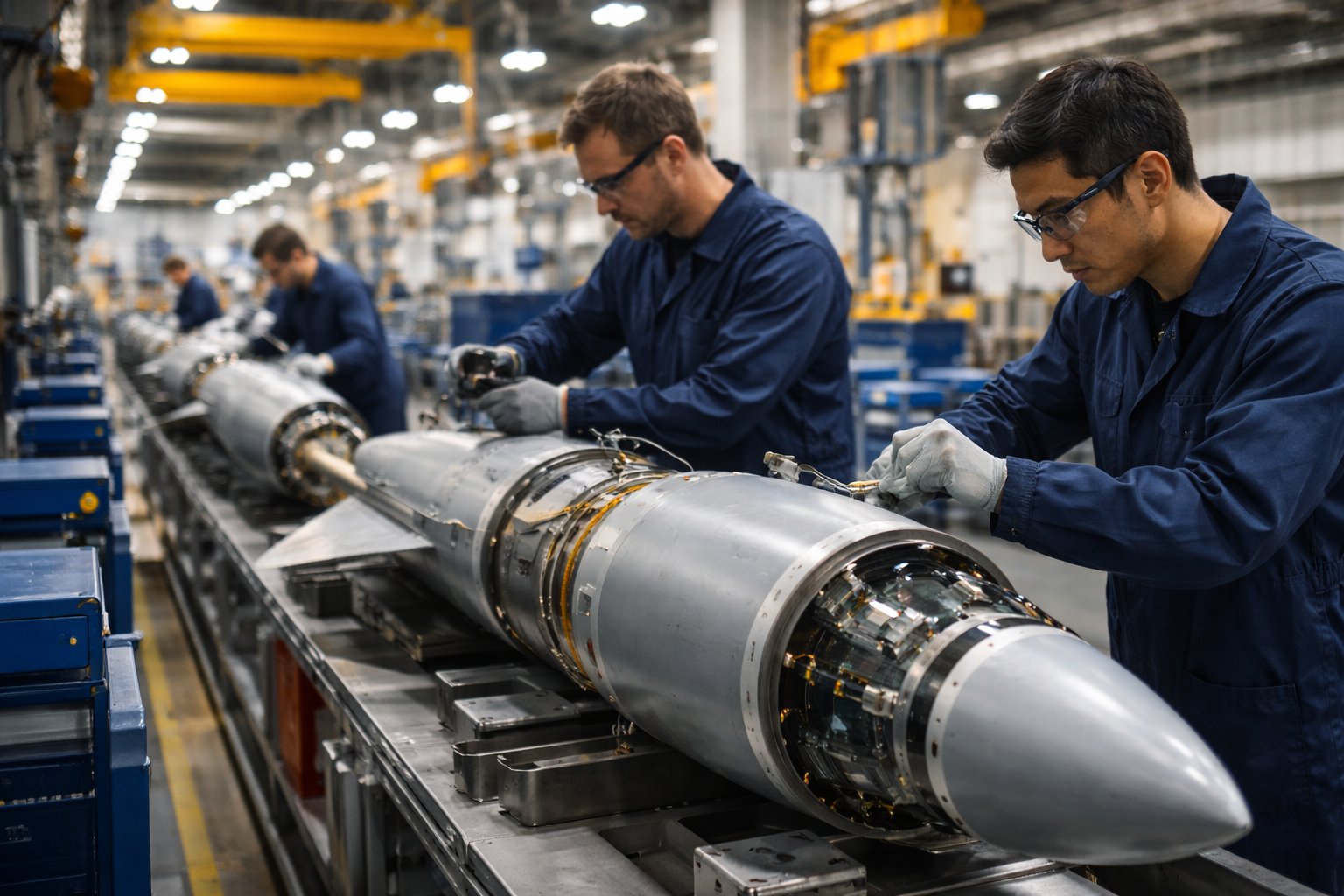
A modern missile is a dense manufacturing object. AIM-9X production draws together an imaging infrared seeker, guidance electronics, control surfaces, rocket motor, warhead, fuze, thermal battery, software, launch interfaces, structural components, storage containers, test equipment, and technical documentation. Expanding annual output requires more than additional final assembly stations. Critical suppliers have to increase throughput in step.
Seekers are among the hardest components to scale. Infrared tracking relies on optics, detectors, signal processing, calibration, environmental testing, and highly controlled assembly. These parts sit in a market where defence, space, and advanced sensing demand can overlap. A bottleneck in seekers can slow the entire missile line, even when airframes and final assembly capacity appear available.
Energetics create another constraint. Rocket motors, warheads, and fuzes require specialist facilities, trained staff, safety controls, qualified materials, and long certification routes. Western defence industries have repeatedly found that propellant, explosive filling, motor casings, and test capacity can limit output as much as prime-contractor assembly. Missile production cannot surge cleanly if the energetic supply chain lags behind.
Software and configuration control add further complexity. AIM-9X serves multiple platforms and customers, which means production must manage aircraft integration, ground-launch requirements, export configurations, test equipment, and documentation. A missile family gains value from its broad installed base, but each hardware or software change has to be qualified carefully across that base.
The new order sits alongside wider Western missile production pressure. AMRAAM’s next variants and allied participation in missile development are increasing demand for advanced air-to-air capability, while small-engine production for affordable strike systems shows how lower-cost weapons can create their own bottlenecks. High-end missiles, short-range interceptors, and attritable strike systems are all competing for skilled labour, electronics, energetics, test capacity, and supplier attention.
Foreign Military Sales demand complicates allocation. Allied customers depend on US production decisions, while US services need their own inventories for deterrence, training, and operational planning. When demand rises across Europe, the Indo-Pacific, and the Middle East at the same time, production slots and delivery priorities become strategic choices. Missile lines are now treated as elements of national and alliance readiness.
Ground-launched use broadens the demand profile further. Systems such as NASAMS have increased the value of adaptable air-to-air missile families in air-defence roles. That approach can make sense because it uses mature weapons, but it also increases consumption. A missile originally acquired for fighter operations may be drawn into base defence, cruise-missile interception, critical infrastructure protection, and counter-air missions.
The cost-exchange problem will not disappear. AIM-9X is a capable weapon, but it is not a cheap answer to every drone. Militaries will need guns, electronic warfare, directed energy, lower-cost interceptors, passive measures, and better sensing to avoid using premium missiles against low-end threats. Even with those layers, advanced short-range missile inventories need more depth than many pre-war stockpile assumptions allowed.
Raytheon’s planned production capacity of 2,500 missiles per year will test workforce, tooling, inspection, suppliers, test cells, and quality systems. A faster line that produces higher rework or reliability problems would not strengthen readiness. The useful output is accepted missiles delivered with consistent performance, storage life, documentation, and integration support.
Tucson remains a major centre of gravity for US missile production, but resilience depends on the wider supplier network. Electronics manufacturers, energetic-materials providers, propulsion suppliers, machining specialists, software teams, and test facilities all have to keep pace with final assembly. Concentrated expertise can improve efficiency, yet it also exposes the line to capacity limits if second-tier suppliers cannot expand.
The AIM-9X award is part of the wider effort to rebuild Western weapons depth after years of lean procurement. Air forces and air-defence operators increasingly need missiles that can be produced, upgraded, stored, and delivered at scale. The Sidewinder family has long been an operational standard. Its next test is industrial: sustaining the output needed for a much more demanding inventory environment.