IN Brief:
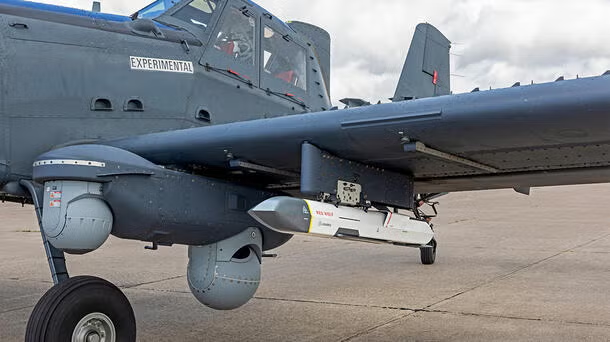
- L3Harris has demonstrated a Red Wolf fit on the Skyraider II family, extending the platform’s offensive-growth path.
- The pairing links a rugged austere-runway aircraft with a long-range precision effect built for flexible employment.
- The industrial test now shifts toward repeatable integration, modular missionisation, and affordable missile-scale production.
L3Harris has moved the Skyraider II family further into the offensive-technology conversation by demonstrating a Red Wolf fit on the aircraft line, tying a low-footprint strike platform to a long-range precision effect built for distributed operations. The significance is not that a pylon can carry another store. It is that the company is showing how a rugged aircraft designed for rough-field use can sit inside a wider strike architecture rather than operating only as a close-support or surveillance platform.
That positioning is consistent with where the market is heading. Operators increasingly want aircraft that can launch effects from outside the immediate threat ring, stay overhead, and reconfigure quickly for changing missions. The Skyraider II design is well suited to that argument: it uses the Air Tractor-derived airframe, is intended for austere operations, and carries a modular mission-system approach that lets payload and mission packages evolve without demanding a clean-sheet aircraft every time the requirement shifts.
Red Wolf adds the harder edge. The system is positioned as a kinetic launched effect for long-range precision strikes, with ranges above 200 nautical miles in relevant employment concepts. When paired with a low-cost missionised aircraft, that creates a different cost and basing logic from the fast-jet model, particularly for special operations, border missions, and dispersed campaigning.
Integration, not concept art, is the industrial test
The engineering task is larger than the outward simplicity of the pairing suggests. A useful launched-effect integration package needs more than a hardpoint. It needs clean mechanical fit, electrical and software interface stability, weapon-management logic, mission-planning tools, safe-release validation, and support procedures that can be handled away from major air bases.
That is where the programme becomes interesting for aerospace manufacturing. A modular aircraft is only commercially persuasive if new payloads can be certified, supported, and fielded without dragging the operator into a long and expensive integration cycle.
Affordable mass still has to be built properly
L3Harris is clearly leaning into the argument that lower-cost aircraft and lower-cost precision effects can restore mass without accepting disposable performance. That claim will be tested on production cadence, mission-system maturity, and sustainment discipline as much as on range or payload.
For the wider market, the message is straightforward. The Skyraider II family is being positioned not as a lesser strike aircraft, but as a different one — shaped around austere basing, modular payloads, and the industrial logic of quicker integration at lower cost.