IN Brief:
- Saronic’s Marauder medium autonomous surface vessel has entered on-water trials.
- The vessel combines long range, containerised payload capacity, and autonomous software architecture.
- The programme tests whether unmanned naval production can scale at a faster industrial tempo.
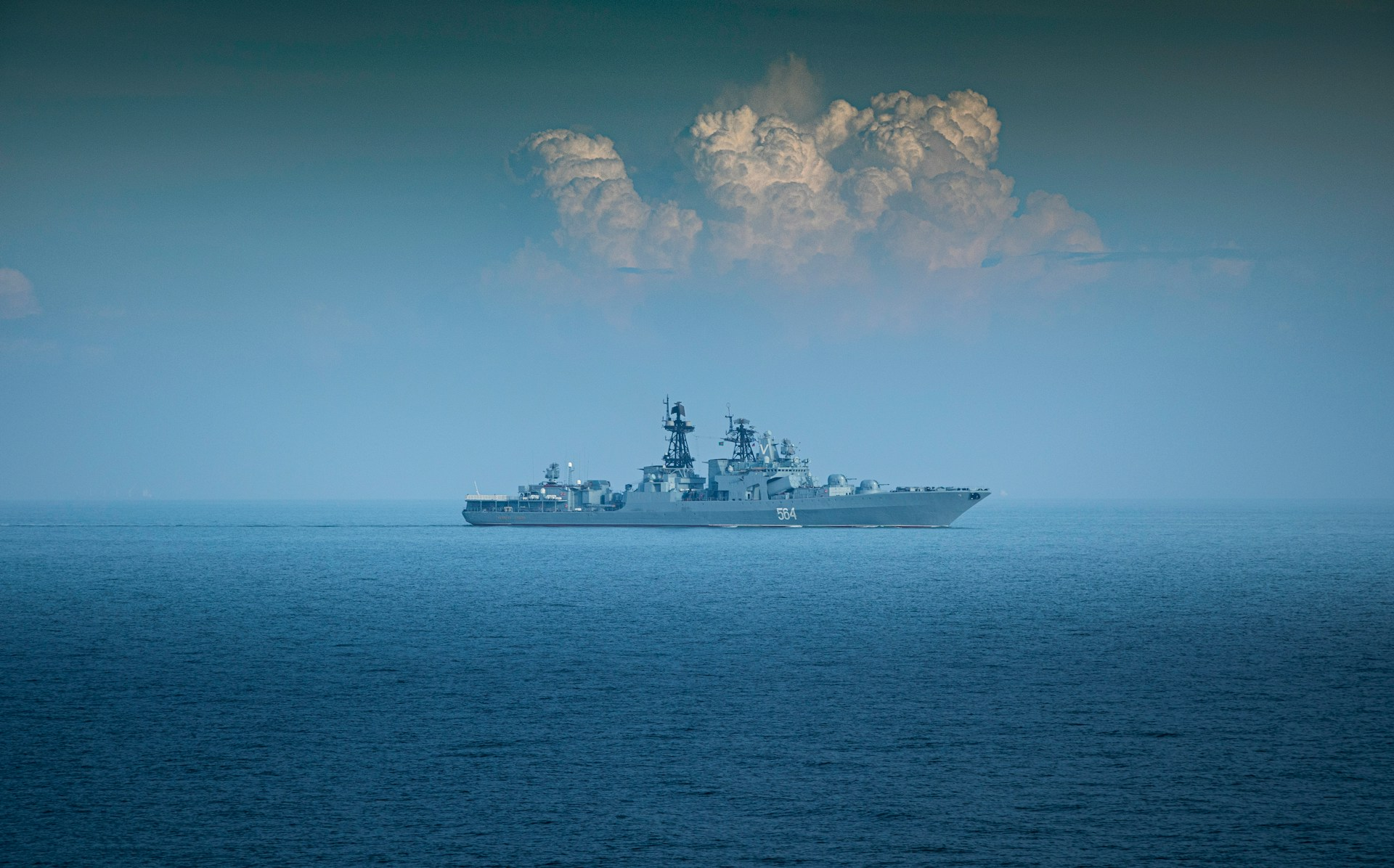
Saronic’s Marauder medium autonomous surface vessel has entered on-water trials, giving the US Navy and its industrial partners a new test case for rapid unmanned naval production.
The 180ft vessel was designed, built, and launched in under a year, with Saronic positioning it as a modular autonomous platform able to carry mission payloads in standard container formats. That architecture is central to the appeal of uncrewed naval systems: payload flexibility, production speed, and distributed capability at a lower cost than traditional crewed combatants.
Marauder is larger and more substantial than the small drone boats that have dominated much of the public debate around maritime autonomy. Its size allows greater payload capacity, endurance, and mission flexibility, while also introducing the harder engineering problems associated with operating beyond sheltered waters and limited test ranges. A vessel in this class must handle weather, navigation, command links, maintenance, software assurance, and payload integration at a standard closer to naval operations than technology demonstration.
The production model is as significant as the vessel. Saronic has emphasised integrated design, manufacturing, and software development, with modular aluminium shipbuilding methods and rapid build sequencing. Its Franklin shipyard is expected to reach capacity for up to 20 Marauder vessels per year by the end of 2026. If that rate is achieved, it would represent a markedly different rhythm from conventional naval shipbuilding, where major combatants often move through long acquisition and construction cycles.
The US Navy’s interest in medium unmanned surface vessels is rooted in a strategic capacity problem. It needs more distributed maritime presence, sensing, communications, and payload capacity than traditional shipbuilding can deliver quickly. Large crewed warships remain essential, but they are expensive, slow to build, and difficult to risk in dense threat environments. Autonomous vessels offer a route to push sensors, decoys, electronic warfare, logistics payloads, and potentially weapons into contested areas without tying every mission to a crewed hull.
The US Navy’s MUSV downselect has already shown how autonomy is moving from experimentation into programme structure. Marauder now shifts attention toward physical production, shipyard throughput, sea trials, and supportability. The critical question is whether vessels built at speed can deliver the reliability, seaworthiness, maintainability, autonomy, and command integration that naval operations demand.
Autonomy is not a bolt-on layer. A vessel operating at range requires route planning, collision avoidance, health monitoring, resilient communications, cybersecurity, remote intervention pathways, and fleet-level telemetry. These capabilities depend on software pipelines, data infrastructure, onboard processing, and test regimes that must keep pace with hull production. If the software maturity lags the shipbuilding tempo, the vessel risks becoming available in hardware before it is usable in operations.
Containerised payloads create a parallel opportunity. If interfaces can be standardised, Marauder becomes a platform for multiple mission packages rather than a single-purpose craft. That could open work for sensor suppliers, electronic warfare companies, communications specialists, logistics payload designers, and weapons integrators. It could also reduce the time needed to adapt the vessel to new missions, provided power, cooling, weight, stability, and software interfaces are controlled properly.
The risks remain substantial. Naval autonomy at this scale must survive harsh sea states, degraded communications, cyber threats, ambiguous maritime traffic, and adversary electronic activity. Maintenance also becomes central. A fast-built autonomous vessel still needs spare parts, diagnostics, depot support, software updates, and trained maintainers. If production outruns sustainment planning, fleet availability will suffer.
The wider allied movement toward uncrewed naval production is already visible below the surface. The AUKUS UUV project shows undersea autonomy moving into a production phase, with many of the same questions around modularity, industrial scale, software assurance, and support. Marauder applies those pressures to the surface fleet, where payload flexibility and visible mass may be easier to demonstrate but harder to protect.
For the US, Marauder’s attraction is not limited to endurance or payload. It is the possibility of an industrial model able to deliver useful naval mass faster than conventional shipbuilding. Autonomous vessels will not replace destroyers, frigates, submarines, or logistics ships, but they may supplement an overstretched fleet and complicate adversary planning. That only works if industry can build, maintain, update, and integrate them at scale.
The on-water trials will therefore be judged across more than speed and range. Marauder has to prove that its production model, autonomy stack, payload architecture, and support system can mature together. Distributed maritime operations depend on distributed industrial capacity, and autonomous shipbuilding will be tested as much in factories, software labs, and maintenance depots as at sea.