IN Brief:
- Hanwha Ocean launched ROKS Pyeongtaek, the fifth Ulsan Batch-III frigate, at Geoje on 18 November.
- The 129-metre vessel combines multifunction radar, infrared tracking, hull-mounted and towed sonar, and hybrid propulsion.
- Sea trials and systems integration will precede the planned December 2027 naval delivery.
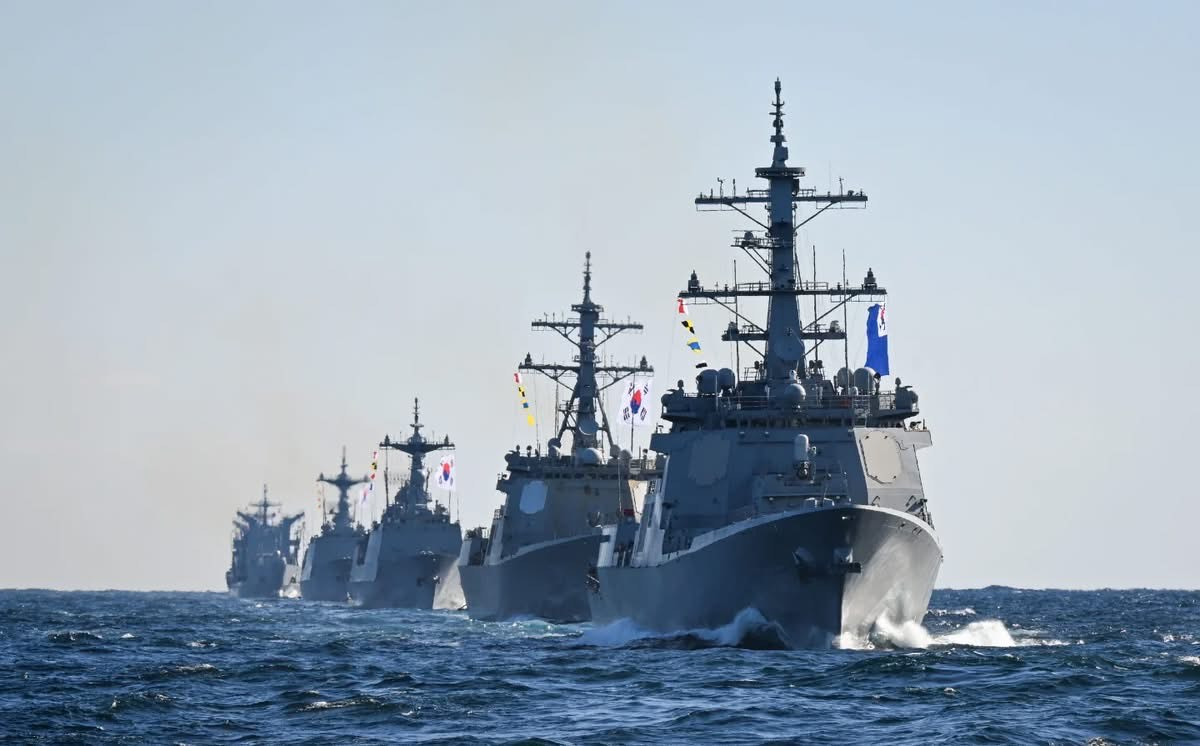
South Korea has launched its fifth Ulsan Batch-III frigate, with Hanwha Ocean placing ROKS Pyeongtaek into the water at the company’s Okpo shipyard in Geoje on 18 November. The 3,600-tonne warship combines domestically developed surveillance and combat systems with hybrid propulsion intended to improve its anti-submarine warfare capabilities.
The vessel, designated FFG-833, is the fifth ship in a six-frigate construction programme intended to replace older South Korean Navy frigates and patrol combat corvettes. It follows Chungnam, Gyeongbuk, Jeonnam, and Jeju, extending a class designed around improved air defence, surface warfare, and submarine surveillance capabilities.
Hanwha Ocean received the construction contract in November 2023, with steel cutting following in 2025 and keel laying during 2026. The ship’s launch establishes that the hull has progressed through its principal construction phase, although installation, integration, harbour testing, and sea trials remain necessary before the Navy can accept the completed vessel.
Pyeongtaek measures 129 metres in length, 14.8 metres in beam, and 38.9 metres in overall height. The frigate’s dimensions accommodate a substantial collection of sensors, weapons, propulsion equipment, and supporting systems within a platform considerably smaller than a major destroyer. Their integration requires careful management of weight, electrical capacity, space, cooling, and maintenance access.
A prominent feature of the Batch-III design is its integrated sensor mast, which incorporates a domestically developed four-face multifunction phased-array radar. Unlike a conventional rotating search antenna, the fixed arrays can steer their beams electronically to observe different sectors around the ship. The arrangement supports surveillance and target tracking without requiring the main radar antenna to rotate mechanically.
Electronic beam steering allows a radar to direct energy towards selected areas, supporting the management of multiple surveillance and tracking tasks. Its effectiveness nevertheless depends on the antenna, signal processing, available power, target characteristics, and surrounding conditions. The Korean authorities have not published verified detection ranges or simultaneous tracking figures for Pyeongtaek’s installed equipment.
The mast also integrates infrared search and tracking technology, providing a complementary means of observing airborne or surface contacts. Infrared sensors respond to thermal radiation rather than transmitting radar signals. Their contribution depends on target contrast, atmospheric conditions, sensor geometry, and processing performance, making their information different from, but potentially complementary to, radar measurements.
Combining these sensors into one mast reduces the need for several separately mounted major surveillance assemblies. It also imposes demanding installation requirements because radar electronics, infrared equipment, supporting processors, and environmental control systems must operate within a relatively concentrated structure. The arrangement has been designed with reduced radar signature characteristics, although no measured signature reduction has been disclosed.
The combat system must process information from the ship’s sensors and provide a coherent basis for employing its weapons. This involves managing track information, presenting the tactical situation, and exchanging data with launch and fire-control equipment. The precise software architecture and interface specifications remain proprietary, but the requirements extend across several interconnected subsystems rather than individual pieces of hardware.
Pyeongtaek’s announced armament includes a five-inch naval gun, the Korean Vertical Launching System, anti-ship missiles, ship-to-land attack missiles, anti-ship missile defence weapons, and long-range anti-submarine torpedoes. The combination supports several distinct engagement roles. Its presence aboard the launched ship does not establish that the complete weapons installation has passed operational acceptance trials.
Anti-submarine warfare places additional demands on the platform because its own acoustic emissions can interfere with the detection of underwater targets. Machinery vibration, propulsion noise, and water flow around the hull all contribute to the acoustic environment surrounding a vessel. Reducing those emissions can improve the operating conditions available to passive acoustic sensors.
The frigate incorporates a hybrid propulsion arrangement intended to limit underwater radiated noise. Hybrid systems can support different operating configurations according to propulsion demand, but the Navy has not published the detailed machinery layout, electric drive characteristics, or acoustic performance of Pyeongtaek. Those specifications cannot be inferred from the description of the propulsion system alone.
Underwater detection is supported by a domestically developed hull-mounted sonar and a towed-array sonar system. The hull-mounted equipment provides an acoustic sensor installation integrated into the ship, while the towed array operates behind the vessel and can offer a different sensing geometry. Conditions such as water temperature, ambient noise, operating speed, and target behaviour affect the performance of both arrangements.
The ability to use several sensor types creates additional opportunities for analysing underwater contacts, although it also increases the integration workload. Acoustic information must be processed, displayed, and associated with other available observations while accounting for uncertainty. Testing the relationship between the ship’s propulsion machinery and acoustic equipment will be part of establishing the completed platform’s operating characteristics.
Domestic systems development is a substantial element of the Batch-III programme. South Korea has invested in local combat-management, radar, sonar, missile, and shipbuilding capabilities, allowing manufacturers to combine equipment produced by different parts of the national defence industry. This requires common technical requirements and controlled interfaces between shipyard, electronics, propulsion, and weapons suppliers.
The fifth vessel also benefits from experience accumulated during construction of the earlier frigates, although each ship must still meet its own acceptance requirements. Production consistency becomes particularly important when multiple hulls are assembled over several years, during which electronic equipment, software versions, and manufacturing processes can change.
Hanwha Ocean’s construction activities now move towards completing the ship’s equipment installation and demonstrating its functionality. Harbour testing can establish the operation of machinery, electrical systems, and onboard equipment before more demanding assessments at sea. Subsequent trials examine how the vessel performs as an integrated platform under operating conditions.
The Navy plans to receive Pyeongtaek in December 2027, after which the ship will undergo the process required for operational introduction. That distinction separates delivery from immediate front-line availability. Final commissioning arrangements and deployment will depend on completion of the remaining acceptance and readiness activities.
The launch therefore adds another hull to South Korea’s naval construction and testing pipeline, with its principal industrial milestone completed at Geoje. The next measure of programme progress will be successful integration of the ship’s propulsion, sensors, weapons, and supporting systems before the scheduled December 2027 handover.