
IN Brief:
- Airbus Helicopters and the Spanish Navy have completed a maritime crewed-uncrewed teaming trial at Rota.
- The exercise connected an H135 helicopter, Flexrotor UAV, A900 drone, Rayo patrol vessel, NAIAD, and SCOMBA.
- Naval autonomy is moving toward integrated command, sensor-sharing, and shipboard launch-and-recovery architectures.
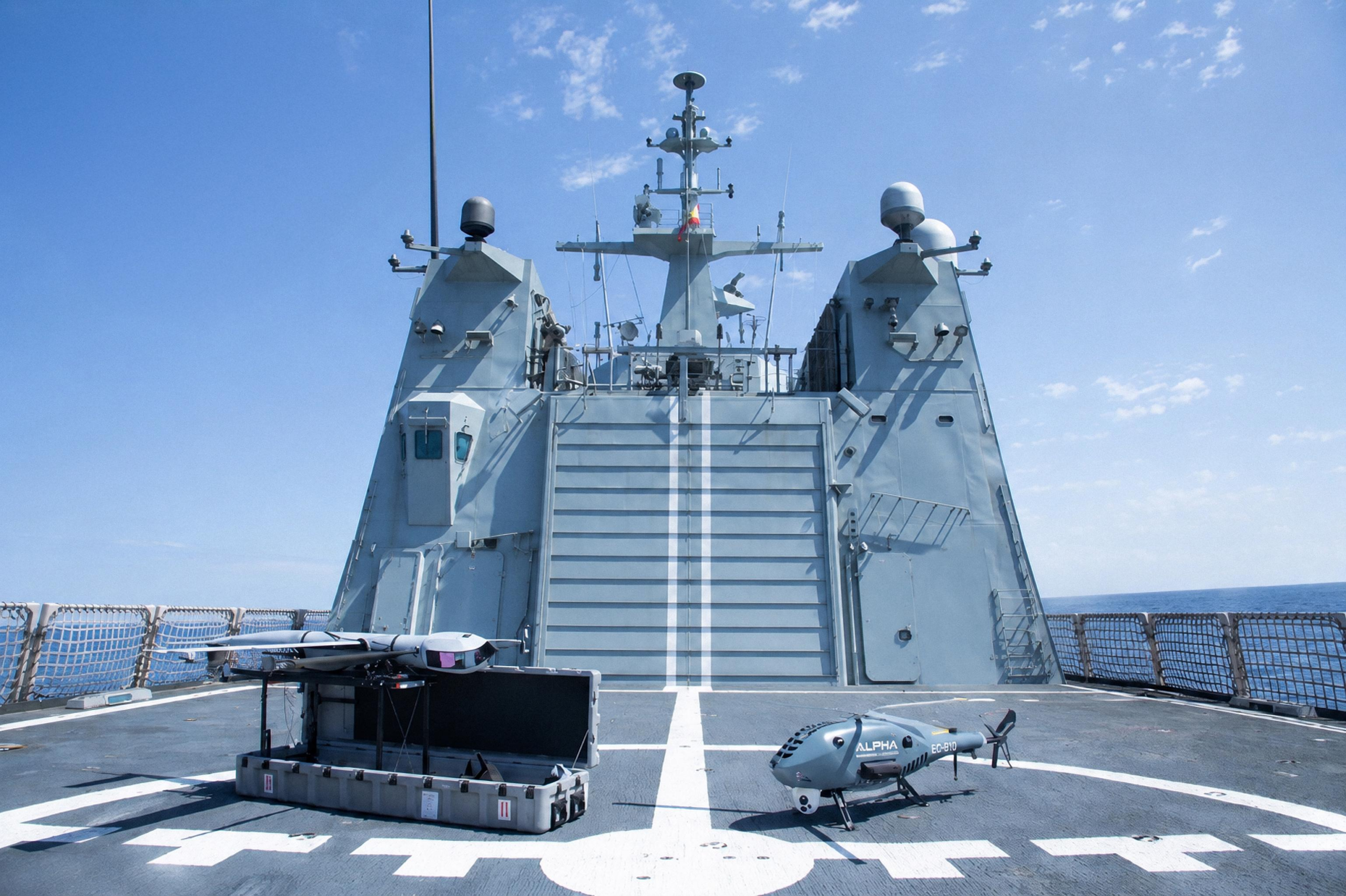
Airbus Helicopters and the Spanish Navy have completed a maritime flight trial linking a crewed H135 helicopter with two uncrewed aircraft and shipborne combat systems during operations from the offshore patrol vessel Rayo.
The exercise took place at Rota in southern Spain and brought together the H135, Airbus Flexrotor, Alpha Unmanned Systems’ A900, and Airbus’ HTeaming system. Both uncrewed platforms conducted take-offs and landings from the moving vessel, while a pilot inside the H135 managed the drones in flight through the HTeaming tablet. Live imagery and data were shared between the aircraft, the ship, and unmanned systems.
A simulated high-speed boat chase formed the operational scenario, with the Flexrotor and A900 tracking the target during an ISTAR maritime mission. Data from the trial was integrated into Navantia’s NAIAD autonomous vehicles defence system and then into SCOMBA, the Spanish Navy combat management system also developed by Navantia. The result was a practical demonstration of how crewed helicopters, uncrewed aircraft, and ship systems can feed a single maritime picture.
The trial brings several industrial threads together. Maritime helicopter operations, vertical take-off uncrewed aircraft, ship combat systems, unmanned-vehicle control software, and secure data links are often procured through separate routes. Crewed-uncrewed teaming only becomes useful when those systems exchange information cleanly, survive shipboard conditions, and remain manageable for operators already dealing with a demanding tactical environment.
The H135 gives the exercise an interesting platform base. The aircraft is widely used in civil, training, and public-service roles, while military operators use it for training and support missions. In a maritime teaming architecture, a light helicopter can act as a control and coordination node for uncrewed aircraft, extending sensor reach without committing larger naval helicopters to every surveillance task.
The Flexrotor and A900 point to another shift in naval autonomy. Vertical take-off and landing aircraft are attractive at sea because they reduce dependence on runways and large flight decks. Endurance, payload, wind tolerance, launch procedures, recovery safety, and maintenance access still define real-world usefulness, but the ability to operate from patrol vessels expands the addressable fleet. Smaller ships can gain surveillance reach that previously required larger aircraft-capable platforms.
The production challenge sits across the interfaces. Helicopters need avionics, displays, antennas, mission software, cybersecurity, and airworthiness approvals for drone control and data reception. Uncrewed systems need maritime hardening, reliable deck handling, stable payloads, and secure communications. Combat management systems need to ingest extra data streams without cluttering the tactical picture. Integration becomes the product.
The same movement can be seen across recent naval autonomy programmes. SubSea Craft’s MARS unmanned surface vessel has moved into production, showing how compact maritime autonomy is shifting from demonstration to contracted delivery. HAVELSAN’s ADVENT-AI combat management layer shows the software side of the same trend, where naval operators need help turning sensor and track data into usable command decisions.
The Spanish Navy test also highlights the role of national industrial ecosystems. Airbus, Alpha Unmanned Systems, Navantia, and the Spanish Navy each contribute a different layer: aircraft, uncrewed systems, tactical integration, combat management, and operational validation. That kind of arrangement is likely to become more common as European navies add autonomy to existing fleets without waiting for entirely new ship classes.
Shipboard operation remains a hard engineering environment. Salt, vibration, tight deck space, wind over deck, emissions control, electromagnetic interference, and limited maintenance manpower all place pressure on equipment that may have worked well ashore. Trials from moving vessels help expose those constraints early, before systems are packaged for fleet use or export.
The next step is repeatability. A successful trial proves the architecture can work; a deployable system has to work across weather, crews, platforms, and mission types. Operators will need training packages, maintenance procedures, spares, configuration management, and cyber assurance. Suppliers will need to stabilise interfaces without freezing innovation too early.
Spanish naval aviation is now demonstrating a model likely to spread across allied fleets: crewed aircraft remain central, but their reach is extended through uncrewed sensors and shipboard integration. The value will sit not in any single drone, helicopter, or console, but in the ability to manufacture and support the connective tissue between them.

