IN Brief:
- Global Military Products has received a four-year contract to manage and expand operations at the Quad Cities Cartridge Case Facility in Illinois.
- The site’s deep-drawn metalworking capability supports brass and steel cartridge cases from 40 mm through 155 mm, with a new mortar-barrel role planned.
- The contract is part of a wider industrial-base effort to turn underused government-owned capacity into reliable output for US and allied demand.
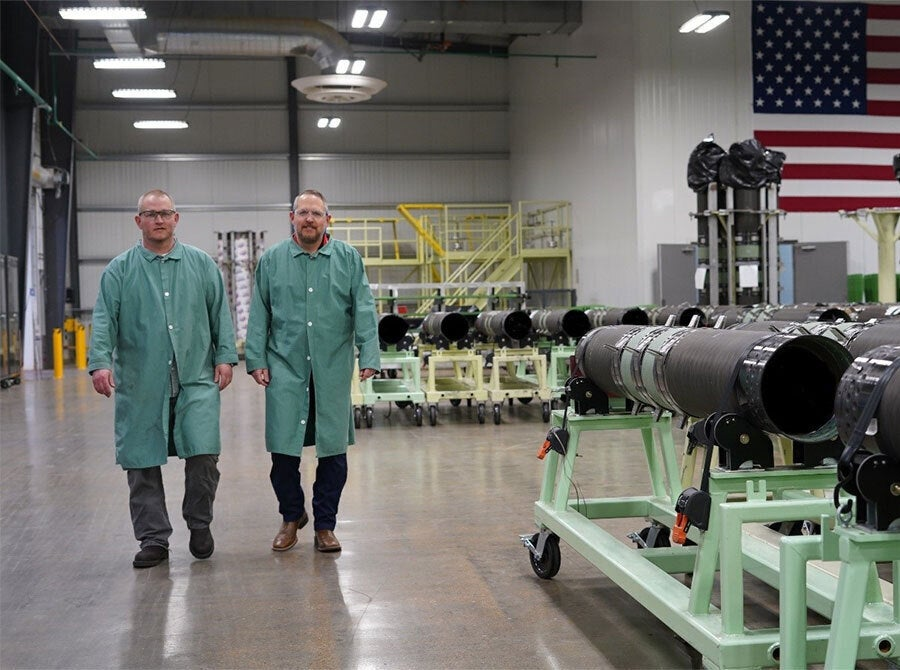
The US Army has moved management of the Quad Cities Cartridge Case Facility at Rock Island Arsenal to Global Military Products under a four-year agreement aimed at increasing cartridge-case production and widening the site’s industrial role. The arrangement gives Global Military Products responsibility for facility management and new product development, while also setting out plans for a domestic mortar-barrel production centre established with Ellwood National Forge.
On one level, the story fits the now familiar pattern of Western governments trying to rebuild munitions depth after years of underinvestment. On another, it is more specific than that. Quad Cities is not a greenfield announcement. It is an existing government-owned asset with specialised deep-drawn metalworking equipment, an available workforce base, and a defined manufacturing function that can be pushed harder if demand, process control, and contracting are lined up properly.
The site’s current industrial relevance lies in cartridge cases. These are the pressure-bearing metal bodies that house the propellant charge and primer systems used across a wide range of ammunition types. Quad Cities has the capability to produce brass and steel cartridge cases from 40 mm through to 155 mm, making it a useful node in the wider US ammunition network at a time when every additional source of throughput has become strategically valuable.
Why cartridge cases matter in artillery production
Large-calibre ammunition capacity is often discussed in terms of shell numbers, but cartridge cases are a separate manufacturing challenge with their own machinery, metallurgy, and bottlenecks. Deep-drawn forming, trimming, heat treatment, dimensional inspection, finishing, and proof requirements all have to be controlled to tight tolerances. A weakness in this segment can slow the output of complete rounds even when projectile bodies and explosive fill are available elsewhere.
That is why the Quad Cities contract deserves attention from defence manufacturers. Bringing additional cartridge-case capacity back into sustained use helps stabilise one of the less visible parts of the artillery supply chain. It also gives the Army and its contractors more flexibility in how they distribute production load across the organic and commercial base.
The mortar-barrel addition broadens the site’s role
The second element of the deal may prove just as important. Global Military Products intends to establish a domestic Mortar Barrel Production Center of Excellence at Quad Cities, creating a second US-based source for 81 mm and 120 mm mortar barrels. That adds forging, machining, finishing, inspection, and life-cycle quality demands that are different from cartridge-case work, but complementary from an industrial-base perspective.
For US defence manufacturing, the attraction is clear. One site gets a broader mission, unused capacity is converted into practical output, and the Army reduces dependence on a thinner supplier base in a category that still matters for allied readiness. The challenge, as ever, will be sustaining workforce, throughput, and quality over time rather than treating the contract as a one-off surge measure.