IN Brief:
- Project Golden Shield has been tested in a live-fire exercise at Fort Hood, Texas, focused on counter-UAS protection for armoured formations.
- The system links sensors, kinetic and non-kinetic effectors, command-and-control software, and tactical vehicles into a layered defensive network.
- Manufacturing requirements centre on ruggedised vehicle integration, modular effectors, power management, software upgrades, and sustainment at formation scale.
The US Army has tested Project Golden Shield in a live-fire exercise designed to protect armoured formations from small unmanned aircraft systems during manoeuvre operations.
The exercise, run by the 1st Cavalry Division at Fort Hood, Texas, from 7–9 April, brought together advanced sensors, kinetic and non-kinetic effectors, command-and-control systems, and tactical vehicles in a layered counter-UAS network. The work formed part of the division’s Pegasus Charge initiative and involved the 1st Cavalry Division, Army DEVCOM, and industry partners in a field environment.
Golden Shield moves counter-drone protection closer to armoured units rather than treating small UAS defence as a fixed-site mission. Small drones now threaten vehicles, logistics routes, command posts, and dismounted forces, requiring faster links between detection, classification, command decisions, and engagement.
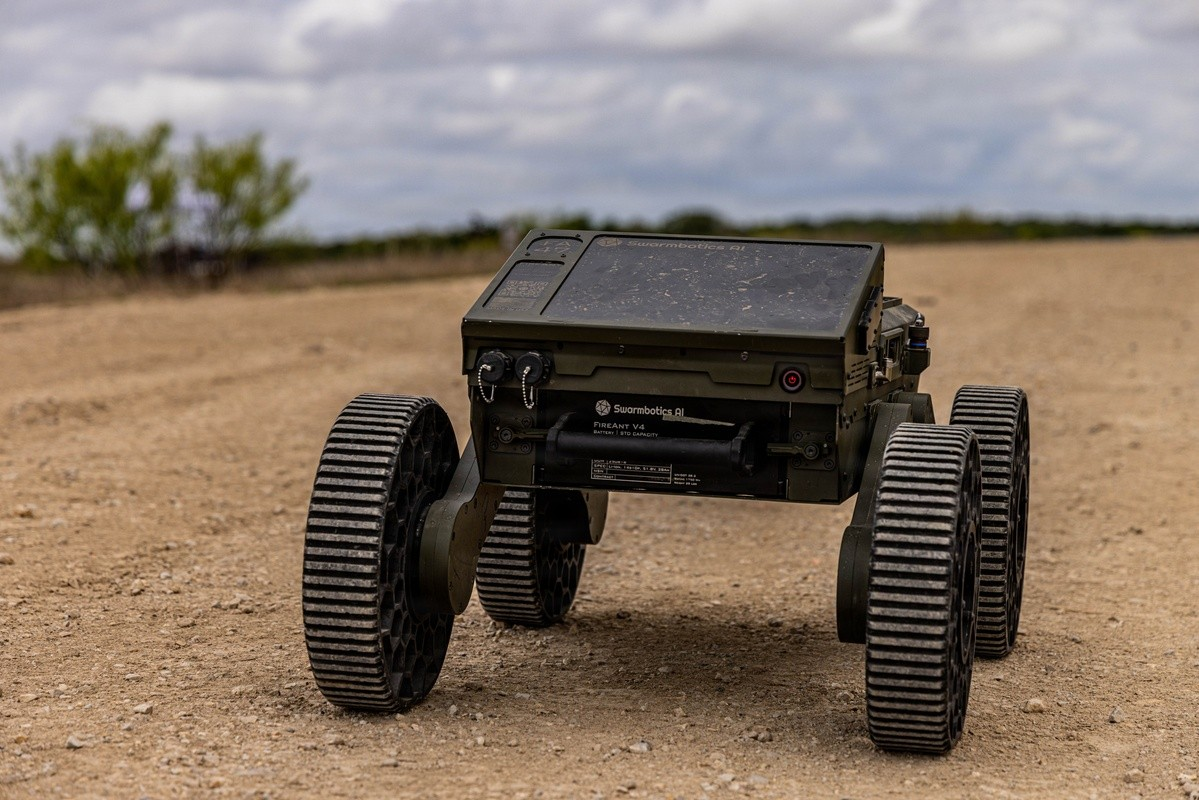
During the exercise, an autonomous sensor on one platform detected and classified a hostile drone, then transmitted data and an engagement command to an autonomous weapon system on another platform to destroy the target. That handover reduces the workload on crews already managing movement, communications, threats, and weapons systems in contested conditions.
“The future is formation-based layered protection, and this is the start of that,” said Alfred Grein, Executive Director for Research and Technology Integration for the US Army Combat Capabilities Development Command Ground Vehicle Systems Center. “Some [of the systems] are more mature than others. But understand that’s part of why we do experiments to determine what we think is ready to hand-off to Soldiers in the field environment.”
Golden Shield uses a scalable, open architecture built around a next-generation command-and-control system, multiple sensors, effectors, and the Vehicle Protection System Base Kit. The architecture allows the defensive network to be expanded, reduced, or reconfigured as new threats and technologies emerge.
Radar, radio-frequency detection, electro-optical tracking, electronic attack, kinetic interceptors, and directed-energy systems all develop on different cycles, with different qualification routes and supply chains. A modular architecture gives the Army a route to insert improved components without rebuilding the full defensive network.
Maj. Kevin Correa, the 1st Cavalry Division’s air and missile defence chief, said the next stage is to move the systems into formation training. “The intent is to take these systems we tested this week and begin to integrate them within our armored formations’ training,” he said. “In that way, we are able to fully exercise not only the systems, but the tanker’s ability to manage these systems while conducting their normal operations.”
Manufacturing requirements
Golden Shield sets out a production route that is wider than a single sensor, launcher, or interceptor. Armoured-force counter-UAS protection requires vehicle-ready packages combining rugged sensors, modular launchers, embedded computing, power management, radio-frequency systems, electronic-warfare equipment, tactical networking, and replenishable effectors.
Vehicle-mounted counter-UAS systems face vibration, shock, heat, dust, mud, water ingress, electromagnetic interference, constrained power availability, and limited space. Those pressures shape material selection, enclosure design, cooling, cabling, connectors, software resilience, and maintainability.
Kinetic and non-kinetic effectors also draw on different production bases. Interceptor systems require precision manufacturing, guidance integration, warhead safety, launcher compatibility, and ammunition logistics. Electronic-warfare systems depend on software updates, frequency coverage, antenna performance, power output, and electromagnetic compatibility. Golden Shield brings those requirements into one layered protection network.
Vehicle integration and sustainment
The data from the exercise will shape how the Army introduces counter-UAS protection across manoeuvre formations, including decisions on automation, human control, vehicle interfaces, and training.
Turning separate technologies into repeatable field packages requires common interfaces, secure data links, stable software baselines, and upgrade paths that do not overwhelm unit maintenance teams. A system that detects, classifies, assigns, and defeats drones across multiple vehicles has to remain usable by soldiers managing the wider demands of armoured operations.
Sustainment will be as important as initial performance. Armoured formations need spare parts, replacement effectors, software patches, test equipment, trained maintainers, and clear fault-diagnosis procedures. Counter-UAS systems that cannot be repaired, reloaded, or updated close to the front will struggle to remain useful once deployed at scale.
Golden Shield shows land-system protection becoming a networked function rather than a single-platform feature. Vehicles are becoming nodes in a defensive architecture, exchanging targeting data and sharing coverage across the formation. That increases demand for modular systems that can be built, integrated, upgraded, and supported at the speed of the drone threat.