IN Brief:
- Hanwha has positioned the K9MH as a ready-to-field option for the US Army’s mobile fires requirement.
- The system combines K9-family gun commonality with an 8×8 wheeled platform and rapid displacement.
- The industrial pitch is as important as the platform, with production localisation and supplier development built into the offer.
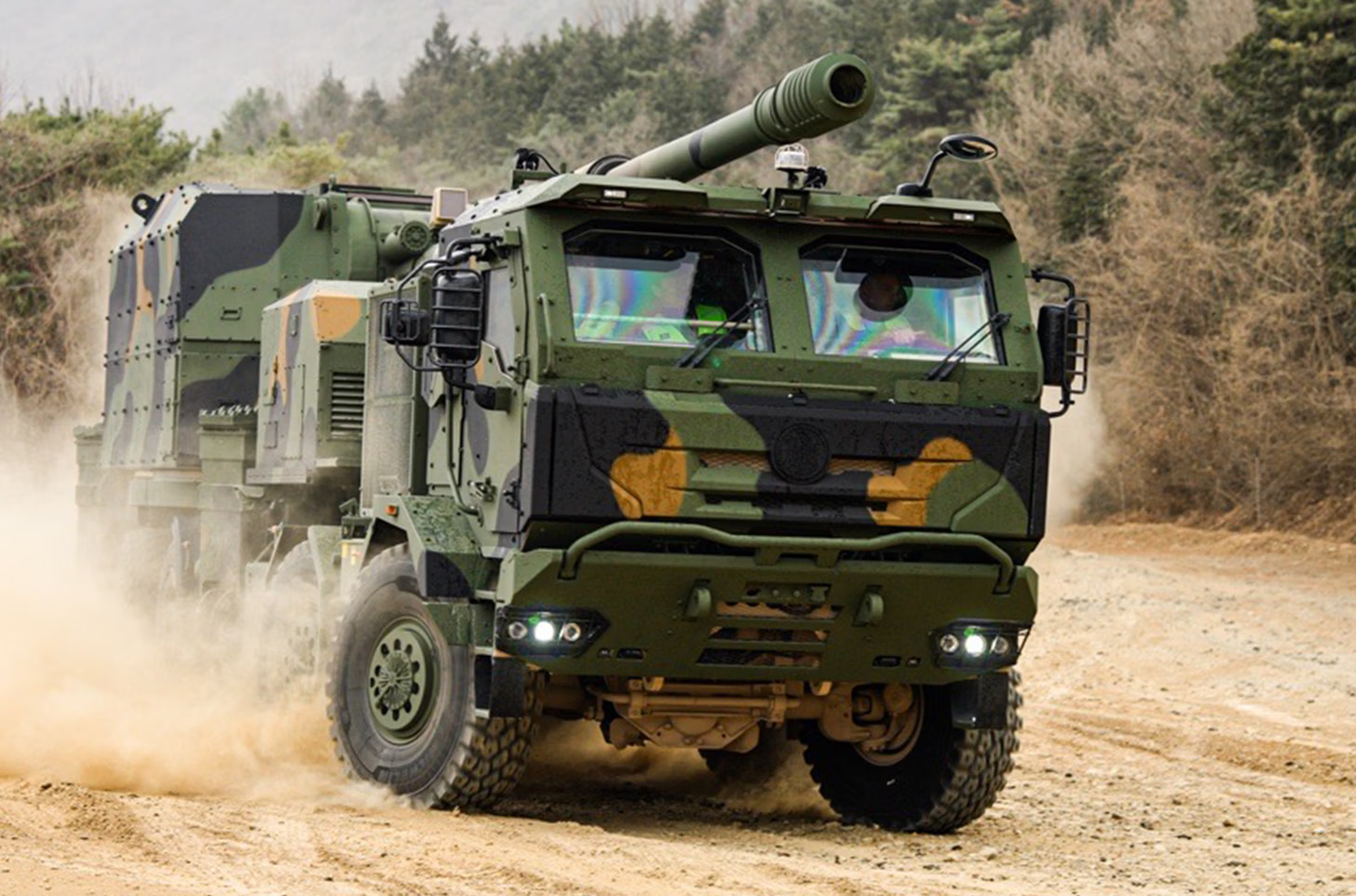
Hanwha Defense USA has advanced its K9 Mobile Howitzer, or K9MH, into the US Army’s current mobile artillery push, offering a wheeled 155mm system built around the wider K9 family’s gun architecture and sustainment logic. The move places a mature artillery line with substantial international manufacturing depth at the centre of another US modernisation competition, at a point when mobility, reload speed, and industrial scalability are carrying as much weight as raw range.
The K9MH is configured around an 8×8 platform and a 52-calibre 155mm gun, with emphasis on rate of fire, rapid emplacement and displacement, and compatibility with automated resupply concepts. That makes the offer broader than a single vehicle. It is a package built around common gunnery, ammunition flow, crew protection, and the ability to keep a dispersed fires unit supplied without dragging it back into older logistics patterns.
Hanwha has also tied the vehicle tightly to a localisation message, presenting it as a platform that can be built and supported with a strong US industrial footprint. In an artillery market now shaped by production resilience as much as platform performance, that is a central part of the proposal.
Production localisation and common architecture
Commonality across the K9 family is a major part of the programme’s industrial appeal. Shared gun architecture, mature subsystem knowledge, and an established global supply base reduce development risk and make it easier to move from trials to fielded output without reopening every part of the manufacturing chain.
Hanwha has set out a phased US production approach, with Alabama identified as the initial base for manufacturing and support activity. That aligns the bid with Washington’s wider push to strengthen domestic artillery production, repair capacity, and workforce depth.
Where the pressure falls in manufacturing
Modern artillery competitions are increasingly judged on how quickly systems can be built, upgraded, and sustained. Vehicles have to support long periods of demand, absorb electronics and automation changes, and remain supportable under operational pressure. That places stress on gun manufacturing, vehicle integration, driveline durability, ammunition handling, and supplier coordination.
For land-systems manufacturers, the K9MH sits in a familiar but demanding category: a combat vehicle offered not just as equipment, but as a production model with room for scale, local content, and future insertion of software and subsystem upgrades.