IN Brief:
- Randle Engineering is supporting the larger and heavy-fuel variants of Certo’s CAPSTONE coaxial UAV.
- The work spans airframe structures, driveline design, and heavy-fuel engine integration.
- The programme’s industrial challenge is shifting from flight demonstration towards producible, supportable aircraft architecture.
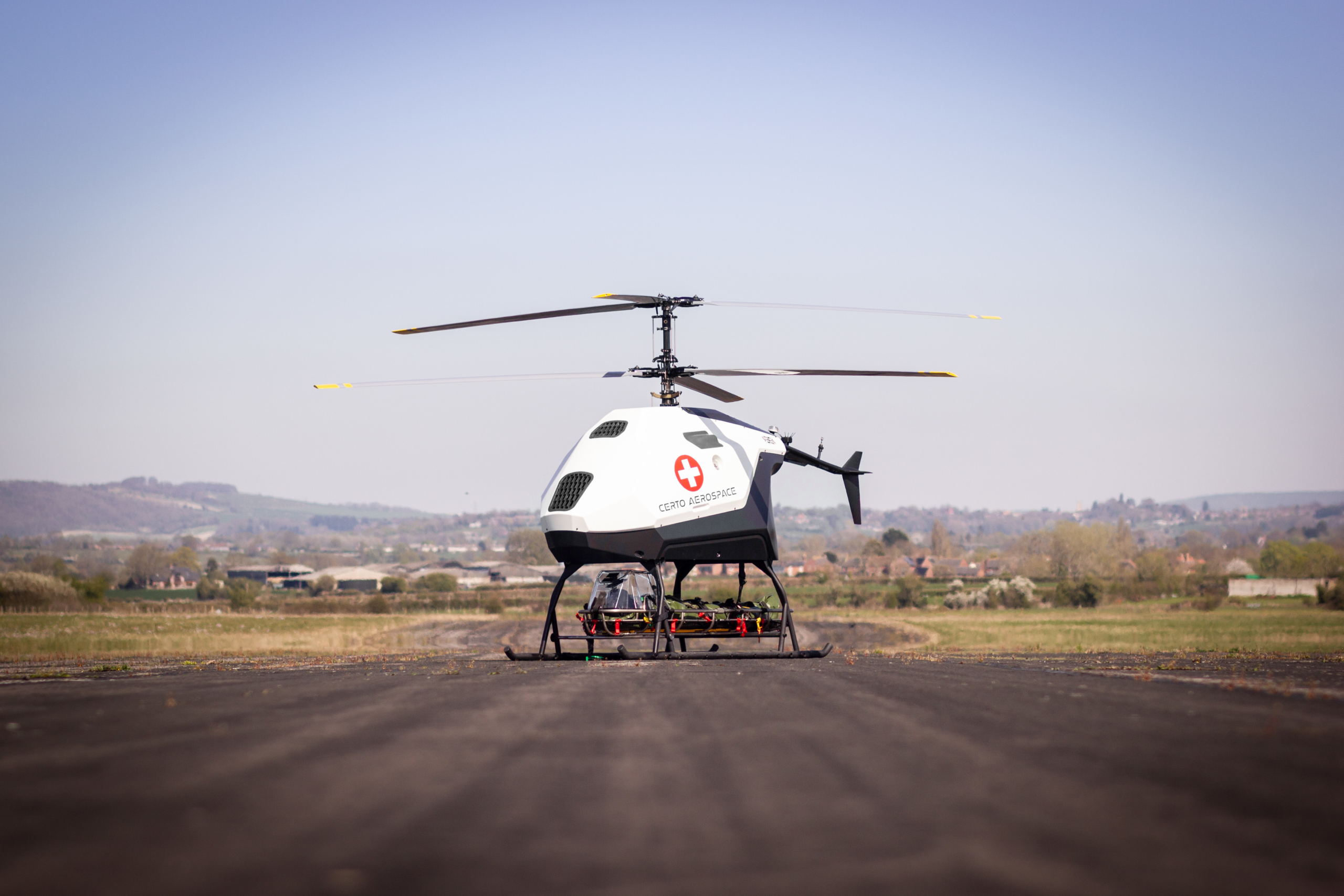
Certo Aerospace has brought Randle Engineering into the CAPSTONE programme as lead design consultancy for larger variants and heavy-fuel versions of the company’s coaxial heavy-lift UAV. The move adds specialist design and analysis support to a UK uncrewed aircraft effort that is now far enough into flight-test activity to focus not just on proving the concept, but on shaping a buildable, supportable aircraft family.
CAPSTONE is positioned as a heavy-lift coaxial platform aimed at defence and other critical missions, with prototypes carrying payloads up to 300kg and the programme now in its third year of flight trials. Certo is also working with BAE Systems on a collaborative tender connected to the British Army’s Project NYX requirement, which places additional weight on the programme’s ability to mature from demonstrator status into a credible procurement contender.
Randle’s tasking goes straight to the harder parts of aircraft development: aerodynamic airframe structures, heavy-fuel engine integration, and driveline systems. Those are exactly the areas that tend to determine whether an uncrewed rotorcraft can scale beyond a promising air vehicle into a family with acceptable payload fraction, vibration control, maintainability, and endurance.
Engineering the larger CAPSTONE variants
The design toolchain around the work is revealing. CAD, static and modal analysis, non-linear impact modelling, and finite-element optimisation all point to a programme concentrating on structural efficiency and subsystem maturity rather than basic proof of lift. That is usually the point at which an aircraft starts to become a product rather than a test article.
Heavy-fuel integration adds its own pressures. Fuel type, engine packaging, cooling, driveline load management, and maintenance access all have knock-on effects across airframe design and supportability, especially on a coaxial aircraft where compact geometry and vibration control must be handled together.
Why the programme matters industrially
For UK defence manufacturing, the significance runs beyond one aircraft. CAPSTONE sits inside a wider push to retain sovereign autonomy intellectual property, propulsion integration know-how, and producible VTOL design capability in-country. Bringing in an external engineering house with deep first-principles design experience suggests Certo is trying to industrialise that expertise rather than keep it confined to a narrow prototype team.
That is where many UAV programmes are tested most severely. Flying is one hurdle. Building something repeatable, maintainable, and scalable is another, and CAPSTONE increasingly appears to be entering that second phase.