IN Brief:
- Volklec has secured new backing to accelerate UK battery production from an initial 1GWh phase toward a 10GWh gigafactory.
- The programme links UKBIC-based industrialisation with wider gigafactory feasibility and infrastructure planning.
- For defence and aerospace supply chains, the story is about sovereign cells, origin control, and manufacturing resilience.
Volklec has secured new backing to accelerate the next stage of its UK battery manufacturing plan, moving from near-term cell production capability toward a larger sovereign-scale footprint. The work now spans both an initial 1GWh production phase and development activity for a future 10GWh gigafactory.
The programme combines two industrial tracks. One is focused on domestic power-cell manufacturing capability with UKBIC and AIH Group. The other is aimed at the engineering and infrastructure work required for a larger plant, with Arcadis and HSSMI involved in the next phase of development.
That gives the project a wider relevance than automotive alone. Battery cells are becoming more strategically important across a range of UK manufacturing sectors, including defence and aerospace, where buyers are paying closer attention to origin, traceability, and long-term supply resilience. Once a component becomes both performance-critical and supply-sensitive, domestic capacity starts to carry weight beyond cost.
Imran Khatri, founder of Volklec, said: “The UK’s limited domestic battery manufacturing capacity has resulted in a severe bottleneck for UK PLC, leaving high-value sectors exposed to global supply chain volatility and restricted access to critical technologies.” He added that the company’s staged approach to scale-up was intended to provide “a faster, more pragmatic route to domestic battery production” while building toward “the essential giga-scale manufacturing of tomorrow.”
From industrialisation centre to scaled output
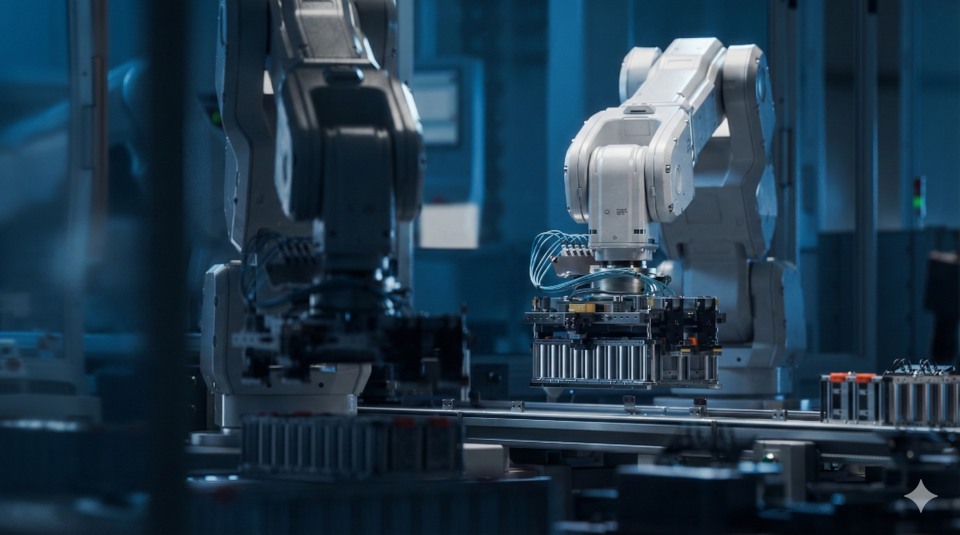
Battery manufacturing remains one of the more demanding forms of industrial scale-up. A line can be technically operational and still commercially weak if coating consistency, formation time, yield, moisture control, and quality assurance do not stabilise at the right level. That is why the route through UKBIC matters. Industrialisation facilities can reduce technical risk before a business commits to full-volume plant economics.
The next challenge is whether that staged route can convert into repeatable cell output at the speed required by downstream sectors. Defence and aerospace programmes in particular tend to demand confidence in provenance, process control, and supply continuity rather than simple access to nominal capacity.
Origin and resilience are becoming product features
For electrified defence and aerospace systems, the battery cell is increasingly a strategic sub-system rather than a commodity input. Portable power, uncrewed systems, specialist aerospace applications, and wider electrified support equipment all bring tighter scrutiny of chain of custody and materials security.
That is where projects like Volklec’s become more significant. The UK has spent years discussing battery sovereignty in broad terms. The harder test is whether domestic cell production can now move from industrialisation into credible scale without losing control of yield, quality, and supply-chain discipline along the way.