IN Brief:
- Astrolight has commissioned the Holomondas Optical Ground Station in Greece.
- The station will support PeakSat and ERMIS-3 optical communication demonstrations using Astrolight ATLAS-1 terminals.
- The project strengthens Europe’s ground-segment infrastructure for secure, high-throughput space-to-Earth laser links.
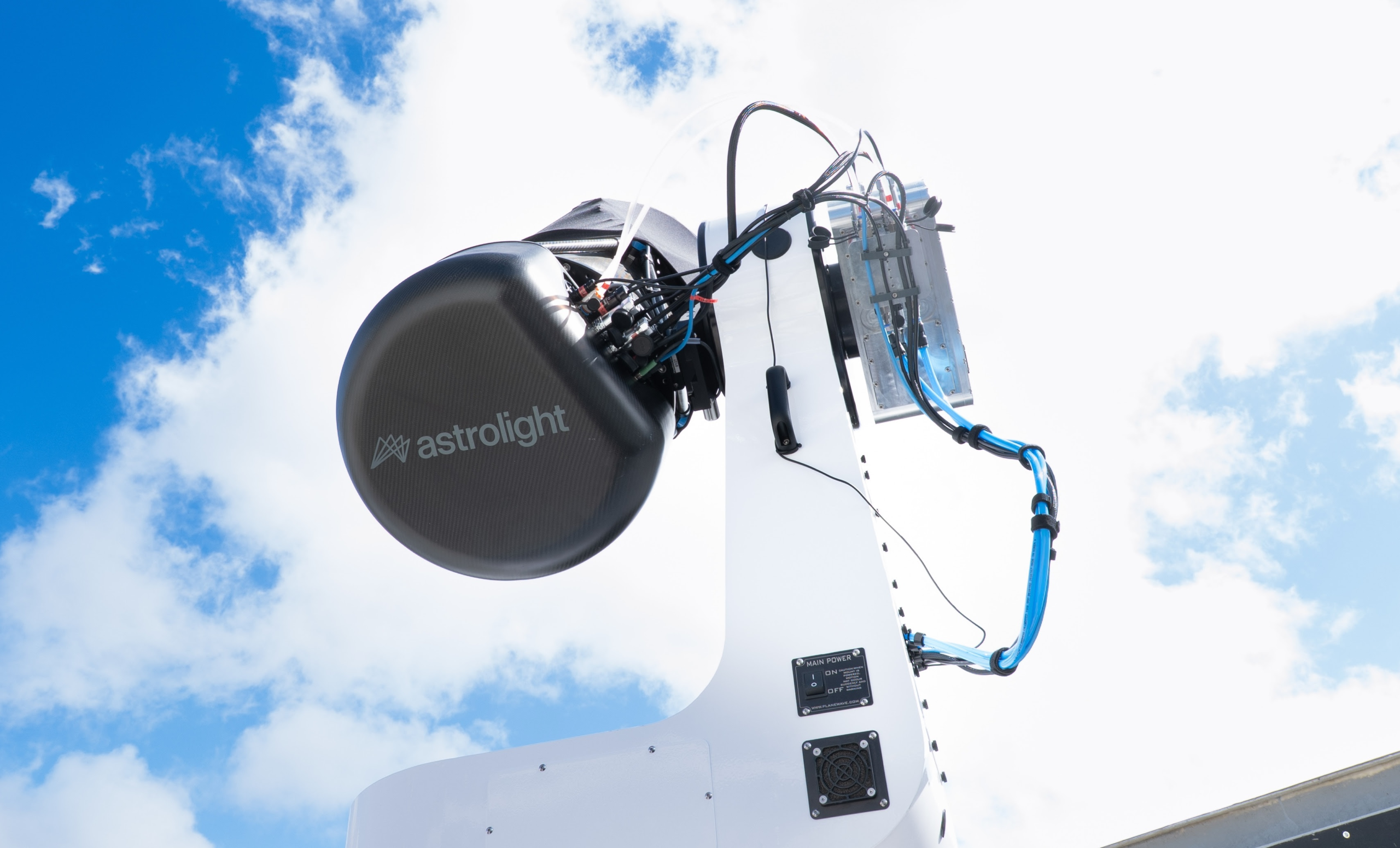
Astrolight has completed commissioning of the Holomondas Optical Ground Station in Greece, giving the country a new ground-segment asset for high-speed and secure space-to-Earth laser communication demonstrations.
The station will support Greek in-orbit demonstration and validation missions, including PeakSat and ERMIS-3, both of which carry optical communication payloads. The missions form part of ESA-supported activity under Greece’s connectivity programme and are designed to validate laser links between CubeSats in orbit and optical ground infrastructure on Earth.
Astrolight supplied both sides of the link for the PeakSat and ERMIS-3 missions: the Holomondas ground station and ATLAS-1 laser communication terminals onboard the satellites. That end-to-end arrangement gives the demonstration a coherent architecture, with space and ground segments designed to work together from integration through in-orbit testing.
The Holomondas site, originally an astronomical observatory, has been equipped with laser communication systems including an 808-nanometre laser beacon and a C-band optical receiver. The system supports precise beam alignment and optical data reception at speeds of up to 2.5 Gbps under changing atmospheric and operational conditions.
Space connectivity is often discussed through satellites, payloads, and constellations, but optical communications need a terrestrial network capable of receiving narrow laser beams accurately and reliably. Ground stations must manage pointing, acquisition, tracking, calibration, weather constraints, telescope stability, optical receiver performance, safety procedures, and data handling.
That creates an engineering and production challenge distinct from conventional radio-frequency ground infrastructure. Laser communication terminals use tightly controlled optics, fine pointing mechanisms, high-precision calibration, ruggedised electronics, thermal management, and software that can compensate for mechanical and environmental variation. The ground station becomes a precision instrument rather than simply an antenna site.
Astrolight’s work at Holomondas includes core optical systems and calibration technology designed to maintain accuracy during temperature changes and mechanical shifts. The company has also emphasised integration with more compact telescope and mount configurations, reducing the need for larger and more costly ground station infrastructure. If the approach proves reliable, it could lower the barrier for wider optical ground station deployment.
The project forms part of Europe’s broader push towards resilient, high-capacity space connectivity. ESA-supported Greek missions are testing data transfer, optical communications, and connectivity capabilities, while wider European initiatives are exploring laser communications for direct-to-Earth links, relay networks, quantum-secure communications, and future secure connectivity architectures.
Similar pressure is already visible in satellite communications terminals, where Greenerwave and Telespazio are targeting sovereign SATCOM terminal capability. Holomondas applies the same principle in the optical domain. Strategic communications resilience depends on trusted terminals, ground systems, software, service management, and integration capacity as much as spacecraft.
Laser communications offer higher data rates, narrower beams, and reduced susceptibility to electronic interference compared with RF links. Those characteristics are attractive for defence, intelligence, maritime, and national-security users handling large data volumes from Earth observation, surveillance, and distributed sensing platforms. They also introduce constraints around weather sensitivity, pointing accuracy, cloud avoidance, and the need for geographically distributed ground stations.
A single station can validate technology, but operational utility will depend on network depth. Multiple sites, scheduling tools, redundancy, weather diversity, secure data routing, and interoperability with different satellite terminals will all be needed if optical communications are to move from demonstration into routine service.
For Greece, the station builds space-sector capability around a practical ground asset. For Astrolight, it strengthens a product line spanning space, ground, and maritime laser communications. For European defence and space customers, it adds another step away from RF-only satellite communications towards a hybrid future in which optical links carry more high-throughput, secure traffic.
The next phase will depend on in-orbit performance. If PeakSat and ERMIS-3 validate reliable links to Holomondas, the station could become part of a wider European optical ground network and a production reference for the next generation of secure space connectivity.