IN Brief:
- Continuous Composites is working with the US Army DEVCOM Aviation and Missile Center on missile manufacturing applications.
- The effort will evaluate CF3D technology, advanced materials, and fibre-steered design.
- Candidate applications include nose cones, fins, leading edges, bulkheads, and other high-performance missile structures.
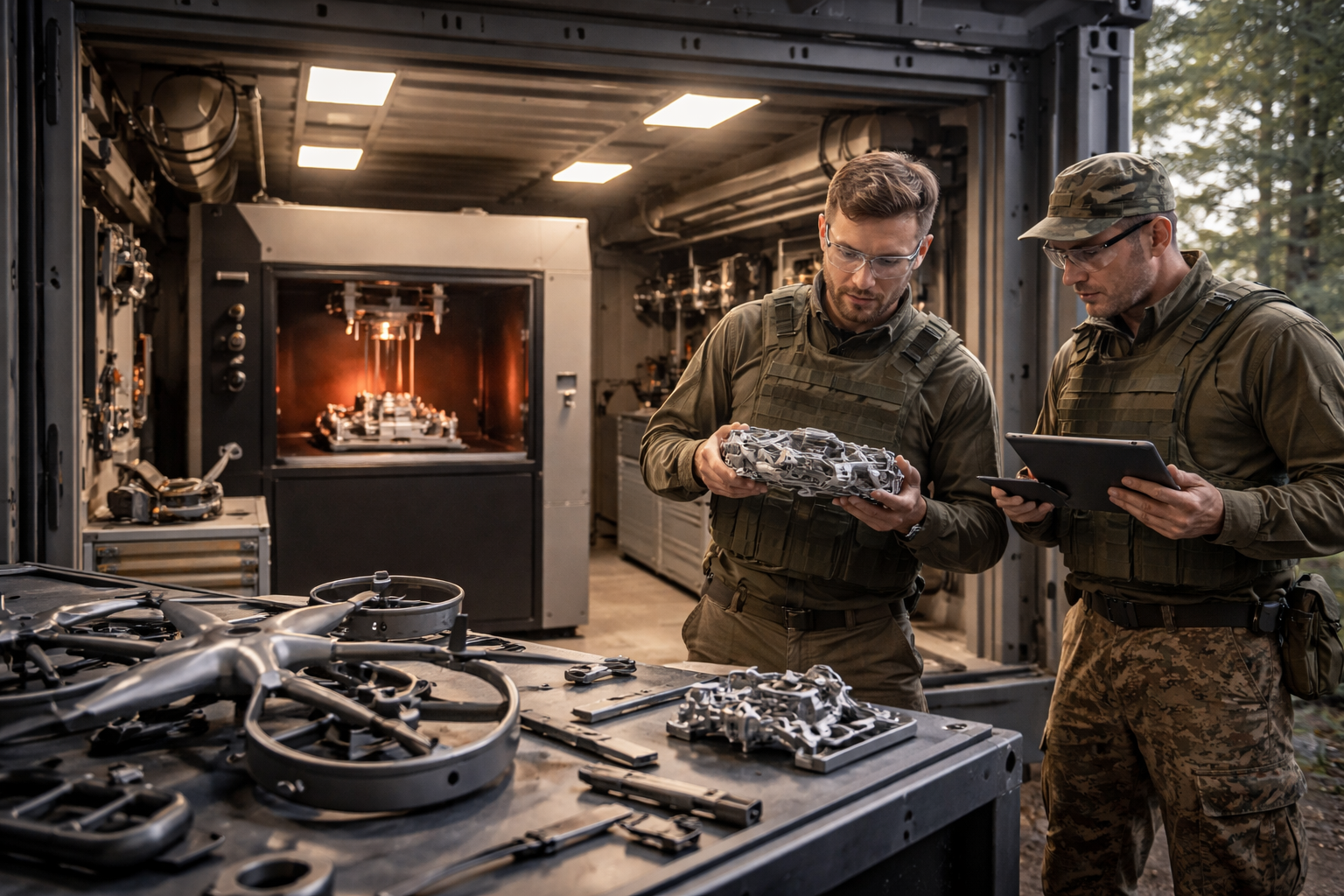
Continuous Composites is advancing additive composite manufacturing for missile components under a multi-year US Army effort, placing continuous fibre 3D printing into one of the defence industrial base’s most pressured production areas.
The work involves the US Army DEVCOM Aviation and Missile Center, the Army’s Manufacturing Technology programme, and America Makes. Continuous Composites will evaluate how its CF3D process, advanced materials, and fibre-steered design can support next-generation missile structures, including applications associated with Precision Strike Missile architectures.
Candidate components include nose cones, fins, leading edges, bulkheads, and other structures that must combine high performance with consistent quality. The project is focused on producibility, affordability, throughput, yield, reduced variability, and supply-chain resilience — the factors now driving much of the missile manufacturing debate.
Western inventories have been strained by support to Ukraine, increased deterrence planning, air-defence demand, and renewed interest in long-range fires. The resulting pressure is not only a matter of placing larger orders. Many missile production chains rely on specialist materials, qualified suppliers, long-lead components, constrained test capacity, and processes designed for peacetime output rather than sustained surge.
CF3D offers one potential route through part of that constraint. Continuous fibre reinforcement can deliver strong, lightweight structures with tailored load paths, while additive production may reduce dependence on tooling and allow more flexible geometries. Fibre-steered design can place material where performance demands it, rather than forcing engineers to accept the limitations of conventional lay-up or machining routes.
Missile components are an unforgiving application. Structures may have to withstand high acceleration, vibration, thermal stress, aerodynamic loads, storage conditions, handling damage, and tight dimensional requirements. A process that works for a demonstrator must prove that it can deliver consistent parts under defence qualification rules and at a rate that improves, rather than complicates, production.
That is why the manufacturing-technology route is important. The programme is not simply exploring whether additive composites are technically interesting. It is testing whether the process can be brought closer to a qualified production environment, with evidence around repeatability, inspection, material behaviour, and cost.
Additive manufacturing is already moving into named missile structures rather than generic experimentation. Work to place Tomahawk components on an additive production path reflects the same production pressure from another direction. Defence customers are looking for processes that can shorten bottlenecks, reduce tooling delay, and make designs more adaptable without weakening reliability.
Qualification remains the critical barrier. A printed composite part must be validated across material consistency, fibre placement, bond quality, fatigue behaviour, thermal performance, environmental durability, and inspection methods. Defence buyers also need process controls that prevent hidden variation between machines, operators, material batches, and software versions.
Digital thread management will therefore be central. Additive manufacturing links design files, machine settings, material feedstock, process data, inspection records, and configuration control more tightly than many conventional routes. That creates opportunity for better traceability, but it also raises cybersecurity and data-integrity requirements. A missile component produced through a digital process needs protection against tampering, unauthorised changes, and uncontrolled variation.
The supply-chain question is similarly two-sided. CF3D could reduce dependence on some traditional tooling and machining routes, but it introduces new dependencies around machines, feedstock, software, maintenance, and trained operators. A resilient production model will need redundancy in those areas as well as clear routes for repair, inspection, and scale-up.
For Continuous Composites, the Army work gives CF3D a direct path into a high-priority defence application. For the Army, it provides a way to test whether advanced composite printing can support missile output without accepting excessive technical risk. For the wider industrial base, it reinforces the idea that production rate has become part of military effectiveness.
The likely value of CF3D will sit in targeted applications rather than wholesale replacement of conventional missile manufacturing. Components that benefit from fibre orientation, weight reduction, geometry flexibility, or tooling reduction could be strong candidates. Other components may remain better suited to established methods. The advantage will come from matching process to problem, not forcing additive manufacturing everywhere.
The missile sector is now entering a more disciplined phase of advanced manufacturing. Novel processes are being judged against named parts, specific production constraints, and measurable output improvements. Continuous Composites has moved into that phase, where the promise of additive production has to meet the hard arithmetic of missile stockpiles.