IN Brief:
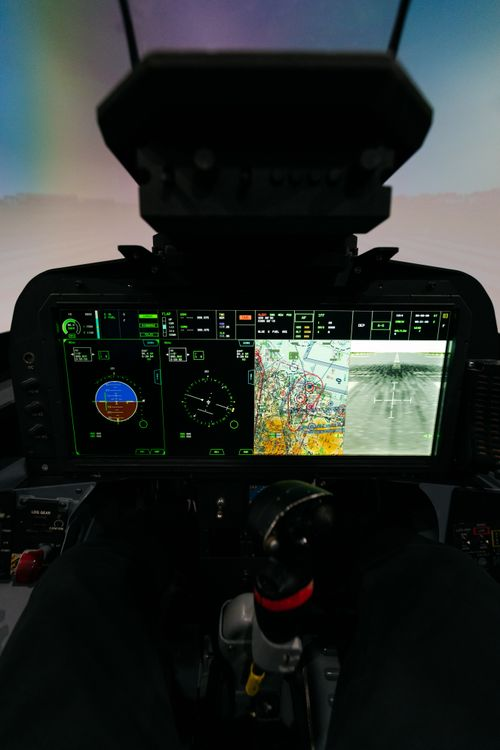
- Sixteen F-35 full mission simulators were networked across Yuma, Miramar, Iwakuni, and Lemoore.
- F/A-18 simulators and an E-2D Hawkeye controller at Oceana joined the distributed training environment.
- The two-hour scenario exercised command-and-control, tactical data exchange, and mission rehearsal across air, surface, and cyber domains.
Lockheed Martin has connected 16 F-35 full mission simulators across four geographically separated operating bases during a two-hour distributed mission rehearsal that also incorporated F/A-18 simulators and an E-2D Hawkeye controller.
The F-35 devices were located at Marine Corps Air Stations Yuma and Miramar, Marine Corps Air Station Iwakuni in Japan, and Naval Air Station Lemoore. F/A-18 simulators and the E-2D controller joined from Naval Air Station Oceana, extending the exercise beyond a single aircraft type and service location.
Lockheed used its tactical environment simulation to create a common scenario spanning air, surface, and cyber activity. The company reported that the participating sites maintained command-and-control connectivity, exchanged tactical information, and completed the planned training objectives during the event.
The engineering workload behind distributed simulation sits largely in the connections between training devices. A high-fidelity simulator can reproduce its own cockpit and aircraft systems accurately while still being of limited value in a large-force rehearsal if tracks, communications, timing, weapons effects, and other participants are represented differently at each site.
Networking 16 F-35 devices with F/A-18 and E-2D participation requires the synthetic environment to maintain a coherent version of the same mission for every crew. Each participant needs compatible information about aircraft positions, threats, sensors, and tactical events while the training system manages data moving between locations separated by substantial distances.
Lockheed’s F-35 training architecture already uses full mission simulators as a major part of pilot qualification and continuation training. The company says roughly half of initial qualifying flights are conducted synthetically, allowing crews to rehearse aircraft handling and mission tasks without consuming airframe hours for every event.
Distributed mission rehearsal extends that model from individual proficiency into formation and command-and-control training. Live exercises involving fighters, airborne controllers, ranges, tankers, maintenance teams, and several operating locations require extensive resources and coordination. A synthetic network allows parts of that interaction to be rehearsed more frequently while retaining live flying for tasks that require the physical aircraft.
The addition of an E-2D controller is particularly relevant to the structure of the exercise. The Hawkeye’s role centres on surveillance, battle management, and command-and-control, so its inclusion introduces a different operator function from the fighter simulators and tests whether information can move through the synthetic environment in a form useful to a controlling platform.
F/A-18 participation creates another layer of interoperability. Different aircraft communities operate different mission systems, procedures, and training devices, yet a joint scenario requires them to share enough information to conduct a common tactical problem.
Lockheed has not released the network architecture, latency measurements, security arrangements, or detailed performance results from the rehearsal. The reported completion of the event therefore establishes successful connectivity and execution at the level disclosed by the contractor rather than providing a quantitative benchmark for distributed-training performance.
Configuration control presents a continuing challenge as these networks become more sophisticated. An F-35 simulator needs to represent the relevant aircraft hardware and software baseline closely enough that tactics practised synthetically remain applicable to the operational jet. Updates to mission software, sensors, displays, weapons, or communications can therefore trigger corresponding changes across the training enterprise.
Connecting several sites adds another layer of version management. Threat libraries, synthetic terrain, datalinks, command applications, and representations of other aircraft must remain compatible across the exercise, while cybersecurity controls protect a network that now carries operationally representative mission behaviour between installations.
The F-35 programme has been investing in smaller-footprint training devices and distributed mission capabilities alongside conventional full mission simulators. Lockheed’s current training material describes both full mission simulation and modified mission-rehearsal systems as part of an architecture intended to increase capacity without reproducing a full simulator installation for every additional training slot.
That shift changes the training system from a collection of devices into infrastructure that requires software sustainment, networking, cyber protection, and recurring integration work throughout the aircraft’s service life. Simulator hardware may remain in place for years, but computing, visual systems, operating software, aircraft baselines, and threat representations continue to change around it.
The four-base event demonstrates how that infrastructure can be used across the Pacific and continental United States rather than concentrating a complete training package at one installation. It also offers a mechanism for units to rehearse together before aircraft and personnel assemble for live activity.
No follow-on schedule or additional participating bases were announced with the exercise. The next measure of maturity will be whether rehearsals at this scale become repeatable training events, with new aircraft types and locations joining without extensive bespoke integration each time.
The September event has established the current benchmark: 16 F-35 simulators at four bases, F/A-18 and E-2D participation from a fifth location, and a common two-hour multidomain scenario. Repeating that structure routinely will determine whether distributed mission rehearsal becomes an operational training tool rather than an occasional integration demonstration.