IN Brief:
- Raytheon has received a five-year AMRAAM production contract with two option years valued at up to $20.7 billion.
- An earlier production agreement established a target of at least 1,900 missiles annually.
- RTX says AMRAAM output nearly doubled during 2025 compared with 2024 as investment expanded production capacity.
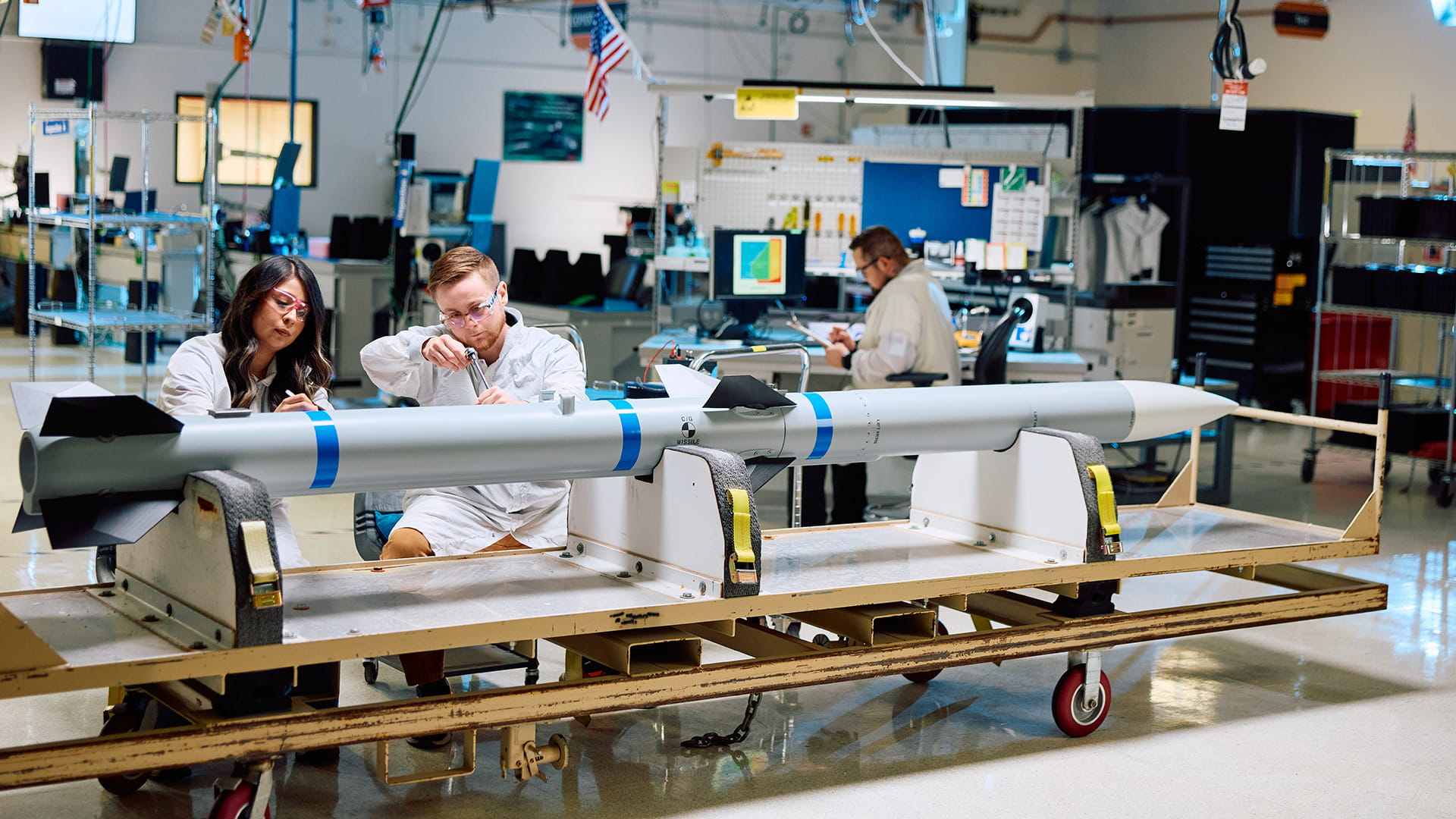
Raytheon has received a five-year AMRAAM production contract with two additional option years valued at up to $20.7 billion, providing a long term framework for output as US and international customers increase missile demand.
The award follows an earlier production agreement between Raytheon and the US Department of War supporting annual manufacture of at least 1,900 Advanced Medium-Range Air-to-Air Missiles. RTX says it nearly doubled AMRAAM production in 2025 compared with 2024.
The latest contract gives the programme a longer planning horizon than a succession of smaller annual lots. Actual expenditure will depend on funded orders and use of the option years, but the ceiling provides Raytheon and its suppliers with a much clearer view of expected demand.
That visibility matters because missile output is constrained by more than final assembly. AMRAAM combines propulsion, guidance electronics, control actuation, structures, energetic materials, power systems and specialist components, each supported by its own qualified suppliers and manufacturing processes.
A bottleneck in one comparatively small component can restrict complete missile deliveries even where final assembly capacity is available. Increasing the headline build rate therefore requires investment across lower-tier suppliers rather than simply adding labour at Raytheon’s Tucson operations.
RTX says it is working with hundreds of small and medium-sized suppliers as it expands output. The company is also examining international co-production, which could provide additional qualified sources while placing some manufacturing activity closer to overseas customers.
Qualification makes that expansion slower than conventional industrial sourcing. Missile components can require controlled materials, environmental testing, traceability and government approval before a new supplier is accepted into production.
Production equipment can be equally specialised. Rocket motors and energetic materials require dedicated buildings and safety arrangements, while guidance electronics depend on secure component supply, controlled manufacturing and extensive test capacity.
The multiyear contract gives suppliers a stronger basis for investing in those processes. Tooling, additional shifts, recruitment, test equipment and larger material orders are easier to justify when demand is visible across several years rather than one production lot at a time.
AMRAAM also serves a particularly broad customer base. RTX says the missile operates from 14 platforms and is fielded by 44 countries, with more than 7,000 successful live fires recorded across testing and combat use.
The weapon’s production demand extends beyond fighter aircraft because AMRAAM is also the principal interceptor family used by NASAMS ground based air defence. Fighter inventories and expanding surface air defence programmes therefore draw from the same wider missile production system.
That creates a planning problem as European and other allied governments expand ground based air defence while air forces also seek to rebuild air-to-air missile stocks. Increased output has to cover several services and international customers rather than one aircraft programme.
The current missile standard includes updated processors intended to support faster software changes. Electronics and software configuration therefore form part of the production challenge alongside physical manufacturing, particularly where older and newer missile baselines remain in support at the same time.
Configuration control becomes increasingly important at high output. A change to software, processors or another component has to be introduced without destabilising production already under way, while test equipment and documentation must remain aligned with the missiles leaving the factory.
Higher volume also places pressure on acceptance activity. Completed missiles still require inspection and testing before delivery, meaning final manufacturing gains can be lost if acceptance facilities and personnel do not expand at a corresponding rate.
The Department of War has framed the arrangement around faster production and stockpile replenishment rather than introduction of a new missile design. Manufacturing execution is therefore the central measure: supplier deliveries, yields, test throughput and quality will determine how much of the authorised rate becomes finished inventory.
Raytheon’s production framework provides the industrial base with a stronger demand signal than earlier annual contracting. The next test will be whether the supporting network can sustain at least 1,900 missiles each year without shifting the bottleneck from final assembly into motors, electronics, energetics or acceptance testing.