IN Brief:
- Voyager already holds more than $60 million of contracts to provide technology for Anduril weapons programmes.
- Existing work includes solid rocket motors, divert and attitude control systems and other propulsion technologies.
- The partnership covers development, testing, qualification and production as both companies expand US manufacturing capacity.
Anduril Industries and Voyager Technologies have formalised a strategic partnership covering advanced weapons and propulsion, building on more than $60 million of existing Voyager contracts supporting programmes the two US companies are already pursuing together.
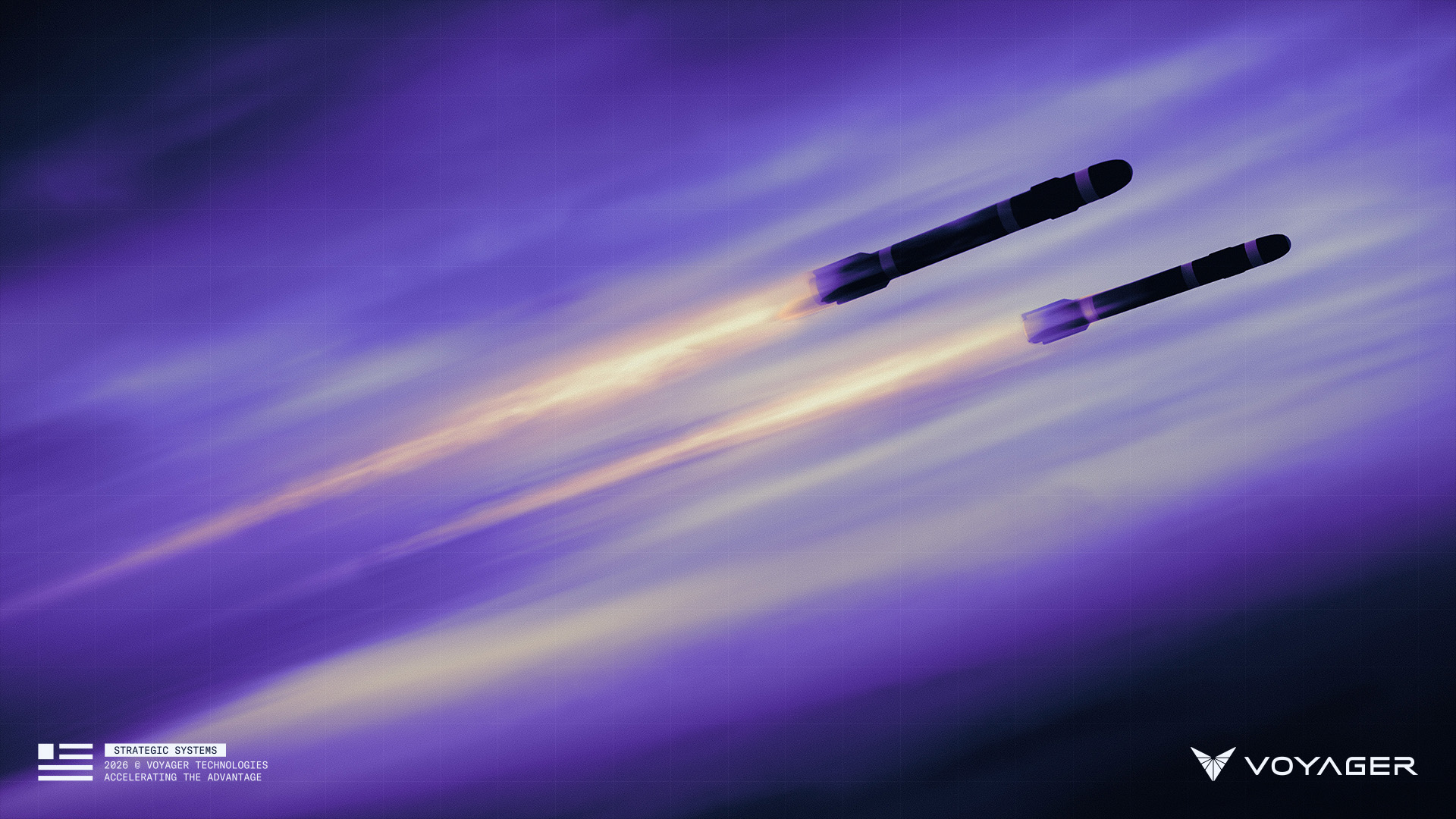
The arrangement covers development, testing, qualification and production of technologies for US weapons and missile defence systems. Voyager is already contracted to provide Anduril with solid rocket motors, divert and attitude control systems and other equipment across several programmes.
The companies have not identified every weapon covered by the relationship. They say the existing work includes several strategic programmes and that the new agreement establishes a shared pipeline for additional opportunities.
That makes the agreement broader than a single missile subcontract. It links two companies investing heavily in development and manufacturing capacity at a time when propulsion remains one of the more constrained parts of the US missile industrial base.
Rocket motors require specialist energetic materials, controlled manufacturing processes, purpose-built facilities and lengthy qualification work. Divert and attitude control systems add another technical discipline, using precisely controlled thrust to alter the orientation or trajectory of an interceptor during flight.
Those systems have to perform reliably after storage and under high acceleration, temperature and vibration loads. Manufacturing consistency therefore matters as much as individual component performance during development.
Bringing a weapon through prototype testing does not automatically provide that consistency. Production tooling, material sources, inspection processes, test equipment and workforce skills must be established early enough to prevent industrialisation from becoming a separate programme after development has finished.
The Anduril and Voyager agreement is explicitly structured around that transition. Their stated work runs from development and testing through qualification and production rather than stopping after a demonstration phase.
Anduril is expanding its own manufacturing footprint through a 1.18 million square foot campus in Long Beach, California, scheduled to open in 2027. The company also has production activity at its Arsenal-1 site in Columbus, Ohio.
Voyager is developing a separate American Defense Complex in Pueblo, Colorado, intended for advanced design, testing, qualification and production of propulsion and related defence technology.
The Colorado site is being designed for considerably higher volume than conventional prototype facilities. Voyager has said the complex could support approximately 15,000 to 20,000 propulsion systems per month across its wider portfolio once fully scaled.
That figure is a planned site capacity rather than a commitment to produce that number of motors for Anduril. Actual output will depend on programme awards, product mix, qualification and customer demand.
Voyager says it has invested more than $500 million across propulsion, energetics and manufacturing capacity. The existing Anduril orders provide one source of workload for that expansion while the partnership creates a route for additional programmes to use the same industrial base.
The companies also point to the location of engineering teams in Southern California as a way to shorten development cycles. Physical proximity can reduce the delay between a weapon integration problem appearing during testing and propulsion engineers evaluating the hardware or implementing a design change.
That becomes particularly useful during qualification, when changes to structures, software, control systems or propulsion can affect several other parts of the missile. Faster iteration is useful only if configuration management remains disciplined enough to ensure production drawings and test hardware stay aligned.
The partnership gives Anduril access to specialist propulsion capability without requiring every energetic-material process to be created internally. Missile manufacturing contains several areas where dedicated suppliers already possess infrastructure and qualification experience that would be expensive and slow for a prime contractor to duplicate.
Voyager gains a different benefit from the relationship. Large propulsion facilities carry substantial fixed costs, so a pipeline spanning several weapons can make better use of manufacturing equipment and skilled personnel than reliance on one programme.
The more than $60 million of existing contracts also distinguishes the announcement from an agreement built entirely around possible future work. Hardware is already being supplied while the two companies establish the framework for additional development and production.
The unresolved issue is volume. Neither company has disclosed the quantities associated with the existing contracts or provided production schedules for the programmes concerned.
The next industrial milestone will therefore be the point at which qualified designs begin moving into larger funded production lots. Facilities in California, Colorado and Ohio provide physical capacity, but programme maturity and customer orders will determine how much of it is ultimately used for the weapons covered by the partnership.