IN Brief:
- AERIE packages more than 20 counter-UAS interceptors inside a deployable 20-foot ISO container.
- The prototype combines Praetorian Aeronautics’ Arrow interceptor with its Hadrian command and control system.
- Rheinmetall and Praetorian developed the demonstrator in 12 months, with operator demonstrations planned for Q4 2026.
Rheinmetall Defence Australia and Praetorian Aeronautics have completed a prototype containerised counter-UAS system within 12 months, moving AERIE into operator demonstrations scheduled for the fourth quarter of 2026. Built around a standard 20-foot ISO container, the system carries more than 20 interceptors while combining transport, launch capacity, command and control and kinetic effectors in a package that can be moved using established container handling equipment.
Rheinmetall and Praetorian have centred the demonstrator on Praetorian’s Arrow interceptor and Hadrian command and control system, with Arrow providing the airborne effector and Hadrian coordinating engagements. The launcher architecture can also accept different interceptors, allowing the companies to change the effector mix as target sets, cost constraints or customer requirements evolve without redesigning the complete container system.
Allowing the launcher to carry several interceptor types also gives the architecture a route to address one of the central economic problems in counter-UAS defence. Small drones can be deployed in numbers and may cost far less than conventional surface-to-air missiles, so relying on one expensive effector for every target can make an otherwise capable system difficult to sustain. AERIE does not remove that problem, but a magazine of more than 20 rounds gives operators greater depth before replenishment becomes necessary and creates room for future interceptor choices matched more closely to different threats.
Because the magazine is housed inside a standard container, the same design decision affects logistics as well as engagement capacity. Existing container handling vehicles can move the launcher without a dedicated chassis, but the practical advantage depends on how quickly crews can position the unit, connect power and communications and bring it into the wider sensor network after arrival. Operator demonstrations will therefore have to test the deployment sequence as a complete process rather than treating transport and firing as separate functions.
Once the ready magazine begins to empty, that process extends directly into resupply. Sustained defence against repeated attacks requires replacement interceptors to reach the launcher before remaining stocks fall below the level needed for the expected threat, and Rheinmetall says AERIE has been designed for rapid reload. The useful measure will be whether crews can actually replenish the container at a rate consistent with the number of engagements the system is intended to support.
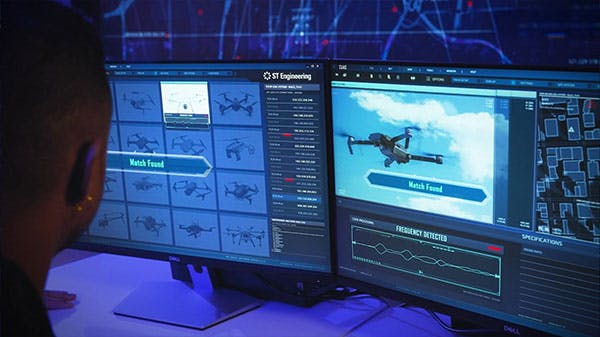
That logistics chain connects with a separate dependency on external sensing because Hadrian needs reliable target information before any interceptor can be assigned. Radar, passive radio-frequency sensors, electro-optical equipment or other surveillance systems may provide those tracks, while the command software has to determine which contacts represent threats and which effector should respond. Rheinmetall has not identified a complete sensor package permanently integrated with AERIE, so the prototype should be understood as one layer inside a wider air defence architecture.
Where sensing remains external, the quality of the incoming track becomes part of the performance of the weapon system itself. Position accuracy, update rate, classification confidence and communications latency all influence whether the correct interceptor can be assigned in time, and poor data can produce a poor engagement decision even when the launcher and Arrow are operating correctly.
Australia is developing several counter-UAS programmes that approach the same integration problem from different directions, including passive sensing work on the Redback infantry fighting vehicle, expanded DroneShield research activity in Adelaide and consideration of protection against drones at short range for future Hunter class frigates. Although the sensors, platforms and effectors differ, each programme has to connect detection, command and engagement functions without creating isolated systems unable to exchange useful tracks.
Within that wider development environment, AERIE reached prototype form quickly by combining Rheinmetall’s systems engineering and experience in air defence with an interceptor and command system developed in Australia by Praetorian. Moving beyond prototype status will require evidence that the complete architecture works under realistic operating conditions, including the less visible tasks around transport, setup, target assignment and replenishment.
The Q4 demonstrations therefore need to exercise the sequence from arrival through engagement rather than simply show that an interceptor can leave the launcher. Crews will have to position and connect the container, receive target data, manage several tracks, allocate effectors, fire and reload while preserving command links if communications or sensor inputs degrade.
Arrow’s own flight performance will define another part of that operating envelope because seeker behaviour, manoeuvrability, terminal accuracy and interceptor cost determine which target classes can be engaged and at what range. AERIE has already shown that more than 20 interceptors, an Australian command system and a deployable container can be assembled into one demonstrator; the next stage is to show whether those elements remain coherent when the system is operated as part of a real defensive network.