
IN Brief:
- Balaena and Kongsberg Maritime signed a memorandum in Norway on 13 November after announcing the Arctic Hunter vessel proposal earlier that week.
- The parties propose building commercially derived vessels at Balaena’s Birkenhead facilities for later military systems integration.
- Type 92 procurement, vessel numbers, contract value and the funded construction timetable remain undecided.
British shipbuilding group Balaena and Kongsberg Maritime signed a memorandum of understanding in Norway on 13 November covering their proposed construction partnership for Arctic Hunter, the uncrewed surface vessel being offered against the Royal Navy’s emerging Type 92 anti-submarine warfare requirement. Kongsberg had identified Balaena as its intended UK shipbuilding partner when it introduced the vessel concept four days earlier; the signed agreement is the new industrial development.
The agreement formalises the companies’ intention to combine Norwegian ship design and autonomy expertise with British vessel construction and outfitting capacity. Birkenhead is the proposed build location, with military systems integration envisaged after a commercially derived vessel has been constructed. The memorandum is a cooperation arrangement, not a Royal Navy selection, a financed construction order or a commitment to build a specified number of ships.
Kongsberg previously set out the Arctic Hunter proposal on 9 November, describing an Arctic-capable commercial hull adapted for uncrewed anti-submarine sensing. Balaena was already named in that proposal. The 13 November signature advances the prospective industrial relationship, rather than introducing another hull design or announcing a procurement programme with contracted funding.
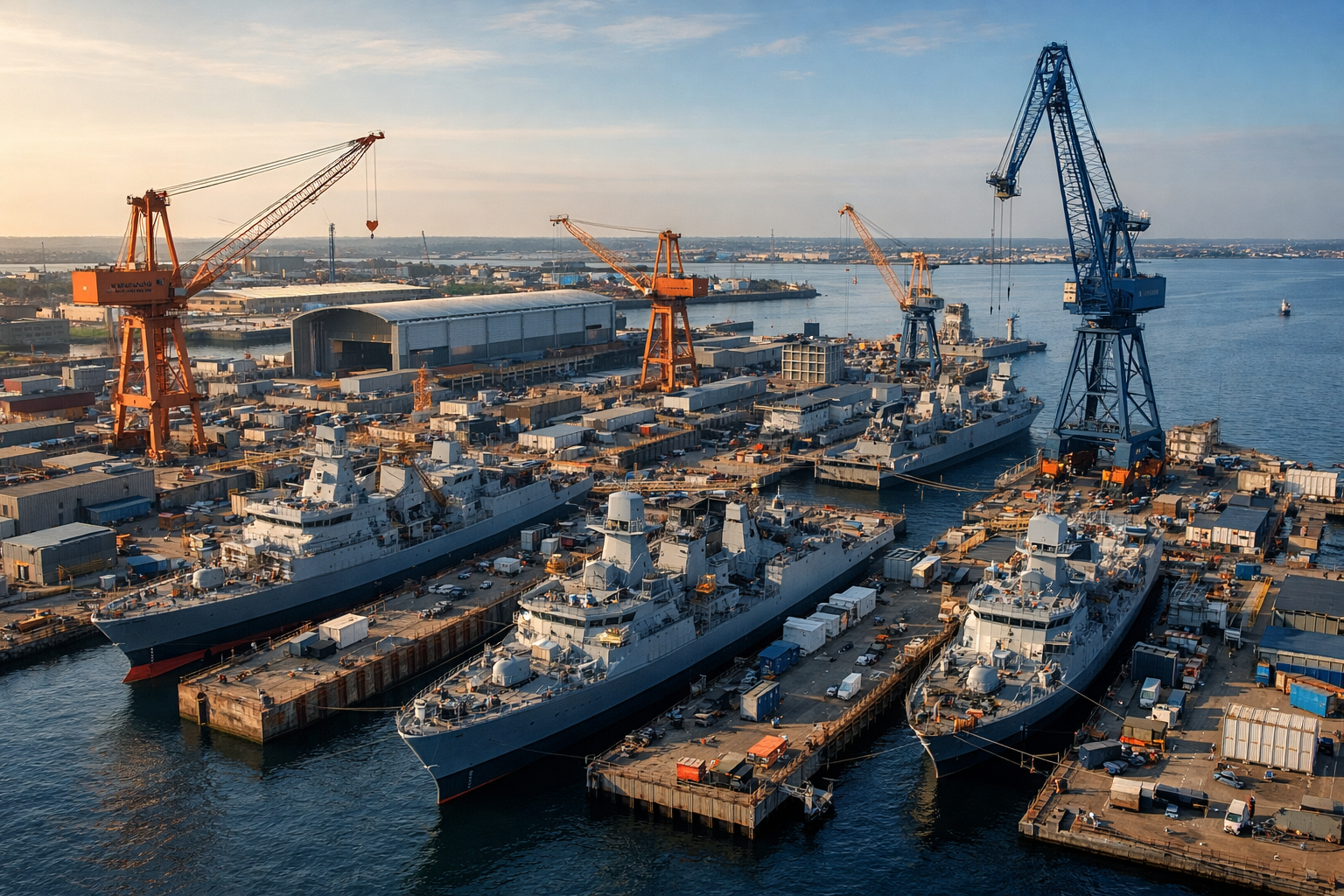
Balaena identifies four large dry docks, a non-tidal wet basin, fabrication equipment and a dedicated modular construction hall at Birkenhead. Those facilities could support hull assembly, outfitting and work on large sections in parallel, depending on yard availability and the detailed production design. The company’s reported workforce exceeds 2,000 across its UK and Gibraltar operations; no Arctic Hunter headcount or new recruitment commitment has been disclosed.
Constructing a commercially derived hull before installing specialised military systems offers a potential separation between shipyard fabrication and naval integration. The arrangement requires early agreement on structural allowances, cable routes, machinery layout, available power and the spaces reserved for mission equipment. Work planned for a later integration phase can still affect the underlying ship design if electrical load, sensor location or structural requirements change.
In a conventional vessel, watchkeeping and maintenance tasks are undertaken by personnel aboard. Long-endurance uncrewed operation imposes different requirements on machinery monitoring, fault isolation and the ability to manage degraded systems remotely. Those functions must be designed into the vessel and tested in the expected operating conditions. The suitability of an adapted commercial design therefore depends on engineering and acceptance work beyond the availability of an established hull form.
Thales UK is identified in Kongsberg’s wider proposal as the intended supplier of sonar and secure military communications equipment. Sonar installation affects cable pathways, weight and electrical requirements, and the vessel’s own machinery noise can interfere with sensing. Interfaces between hull construction, autonomous controls and classified equipment would need a controlled technical baseline so that an otherwise complete vessel does not require extensive redesign before acceptance.
Fabrication and outfitting at a commercial shipyard can be scheduled separately from the installation and verification of some mission systems, but the boundary between those tasks is not arbitrary. Changes to payload weight, cooling needs or antenna positions can require electrical, structural and stability checks. The division of work among Balaena, Kongsberg, Thales and any final integrator has not been specified in the signed memorandum.
Balaena has linked the partnership to potential UK shipbuilding employment, apprenticeships and supplier opportunities. Those benefits depend on a customer selecting the design and placing an executable order. The company has not announced programme-specific hiring or allocated contracted work to named UK subcontractors. Its existing industrial capacity is therefore an input to the bid, not evidence that Type 92 vessel production has begun.
Kongsberg has set an ambition for the vessels to be ready for militarisation and deployment before the end of the decade. That remains a supplier target rather than an agreed Royal Navy in-service date. Detailed design, availability of long-lead equipment, yard scheduling, installation of autonomous systems, sea trials and acceptance would all have to be reconciled with any future contract timetable.
Industrial responsibility must also extend beyond first construction. Uncrewed vessels require verified remote machinery monitoring, fault-management arrangements and support plans for maintenance that cannot be carried out routinely by an embarked crew. Ownership of design documentation, software changes, class and regulatory approvals, and technical support rights would affect both the proposed build process and subsequent operation; the memorandum does not make those provisions public.
The new signed agreement gives Balaena and Kongsberg a documented basis for coordinating a bid and discussing construction work, engineering interfaces and production planning. It does not identify a funded contract or a production start date. The Royal Navy’s selection process and a subsequent executable shipbuilding agreement will determine whether the Birkenhead proposal progresses into construction.
Arctic Hunter remains a proposed naval surveillance vessel rather than a contracted platform. Balaena’s construction role is now formalised between the companies, while ship quantities, acceptance arrangements and the allocation of funded industrial work await a customer decision. Those are the next points at which the proposed British production programme can be measured against delivered progress.