IN Brief:
- Stevens Aerospace & Defense completed Garmin's thousandth King Air G1000 retrofit on a US Army C-12 Huron.
- More than 40 Army C-12 aircraft have received G1000 NXi upgrades as part of an effort to sustain the fleet through 2050.
- The milestone aircraft received Garmin Autothrottle, while Autoland is a separate capability available for eligible King Air configurations.
Garmin has marked the completion of the thousandth G1000 integrated flight deck retrofit for Beechcraft King Air aircraft, with the milestone installation delivered to the US Army on a C-12 Huron. Stevens Aerospace & Defense equipped the aircraft with the G1000 NXi avionics suite and Garmin Autothrottle, continuing a military modernisation programme intended to address ageing cockpit equipment and support the C-12 fleet’s service life through 2050.
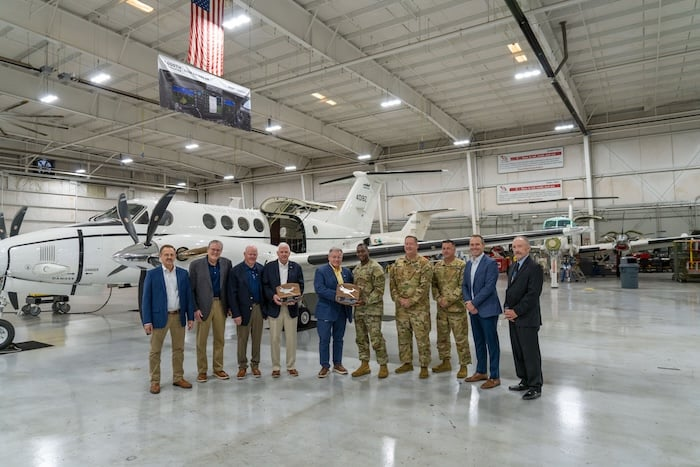
The delivery was marked during a ceremony at Stevens Aerospace on 6 October, before Garmin announced the milestone on 13 October. More than 40 US Army C-12 aircraft have received G1000 NXi upgrades, while the thousandth installation represents Garmin’s worldwide King Air retrofit programme across military and civilian operators. Stevens Aerospace holds the Army contract for the conversions, with Amentum also involved in supporting the wider modernisation programme. Garmin has not disclosed how many Army aircraft remain to be upgraded or the timetable for completing the work.
The C-12 Huron is a military derivative of the twin-engined King Air turboprop, used for transport and other support duties. Sustaining these aircraft for several more decades requires attention to the continuing availability of components and the ability to maintain the equipment installed on each aircraft. Older cockpit instruments and navigation systems can become progressively harder to support as electronic components are discontinued, while modifications introduced over a long service life may create differences between individual aircraft. Replacing the legacy avionics with a common architecture addresses part of that problem without requiring replacement of the airframes.
G1000 NXi integrates flight and navigation information within large digital displays, including primary flight displays and a multifunction display. The system combines data from aircraft sensors and supporting avionics so that crews can monitor flight conditions, navigation and other information through coordinated interfaces. Synthetic Vision Technology provides a computer-generated representation of terrain and other features, while electronic flight information reduces reliance on separate instruments and manual reference material. These capabilities depend on the approved aircraft configuration, the available navigation information and the correct maintenance of supporting databases.
Installing a modern flight deck in an established airframe requires more than replacing cockpit displays. Engineers must integrate the avionics with existing aircraft electrical systems, sensors, navigation equipment and any additional mission-specific hardware. Wiring and mounting arrangements must accommodate the new equipment, while the completed installation requires ground checks and applicable flight verification before the aircraft returns to service. Variations between King Air models and earlier modifications can complicate the work, making approved installation instructions and configuration records important throughout the programme.
Garmin received its first supplemental type certificate for a King Air G1000 retrofit in November 2007, followed by certification of the G1000 NXi architecture in January 2017. The programme has since expanded across the C90A/B, 200, B200, 300 and 350 series, alongside applicable military C-12 configurations. Its long development history has allowed Garmin to introduce additional functions while supporting aircraft already equipped with earlier versions of the flight deck. Compatibility still depends on the individual aircraft and the approvals covering each modification.
Garmin Autothrottle, installed on the milestone C-12, adds automatic management of engine power through different phases of flight. Integrated with G1000 NXi, it can maintain selected airspeeds and power settings while accounting for aircraft configuration and engine operating limits. The system is designed to protect against excessive interstage turbine temperature and torque, and it can respond to overspeed, underspeed and certain engine failure conditions. These functions remain subject to the approved installation and operating procedures, with the crew retaining responsibility for aircraft operation.
Autoland is a separate Garmin capability that can control and land an appropriately equipped aircraft if its crew becomes incapacitated. Although Garmin now offers Autoland for eligible King Air configurations, the October announcement identifies G1000 NXi and Autothrottle as the equipment installed on the Army’s milestone aircraft. There is no confirmation that this C-12 received Autoland, and the availability of that technology elsewhere in the King Air family should not be interpreted as evidence that it forms part of the Army’s current fleet configuration.
The retrofit programme also changes the requirements for maintaining the aircraft over time. Standardising cockpit equipment can reduce differences in replacement parts, software support and technical procedures, while integrated fault information may assist maintenance personnel investigating avionics problems. However, the complete aircraft still contains equipment from several manufacturers and different production periods. Maintaining compatibility between those systems requires continuing engineering support, controlled software updates and appropriate records whenever components are replaced or modified.
Jim Williams, senior vice-president at Stevens Aerospace, said the Army selected G1000 NXi as its next-generation avionics solution to support C-12 mission readiness through 2050. Army fixed-wing project manager Lieutenant Colonel James B. Hickey also identified ageing analogue equipment and increasing maintenance requirements as reasons for the modernisation. Both statements place the work within a long-term sustainment programme in which extending aircraft service life depends partly on keeping the cockpit systems supportable.
The thousandth King Air conversion demonstrates the scale reached by a retrofit programme operating since 2007, while the Army’s installations represent a smaller, defined part of that total. Further military deliveries will depend on the remaining aircraft modification schedule and the capacity to complete installation, verification and acceptance work. The October milestone confirms another upgraded C-12 and continued industrial support for an aircraft family expected to remain in military service for many years.