
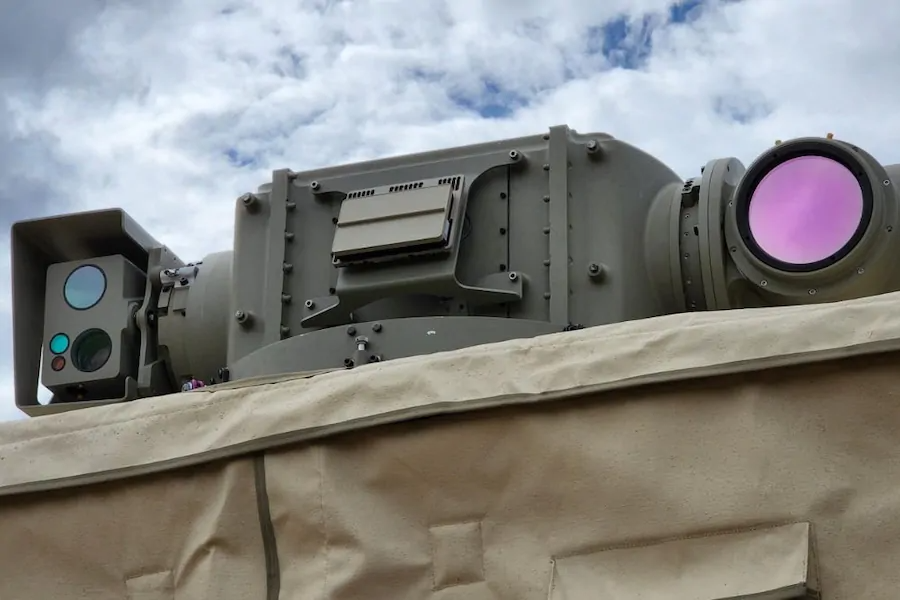
IN Brief:
- Seven industry teams were invited to Phase II after a review of 13 technical submissions for a US counter-drone laser evaluation.
- Vendors must complete laser safety and command-system integration checks before planned December live-fire testing at Dugway.
- Successful trials could lead to purchase orders, but no production award, equipment quantity or procurement value has been confirmed.
Seven defence industry teams have advanced to the second phase of a US evaluation of high-energy lasers for counter-drone protection, with live-fire trials planned for mid-December at Dugway Proving Ground. The Department of War’s Office of Research and Engineering and Joint Interagency Task Force 401 selected the teams after reviewing 13 technical white papers. The invitations are for testing, not production contracts.
The seven entries are Allen Control Systems‘ BULLFROG HEL, Aurelius Systems’ ARCHIMEDES, AeroVironment’s BlueHalo LOCUST X1, Kord Technologies’ FIREFLY, Lockheed Martin’s IPG-based Crossbow system, Thor Dynamics’ LASER ARMOR HEL, and Yrikka’s drone-based TALOS. Each is due to be evaluated against representative uncrewed aircraft targets. The department has published no preferred supplier, order quantity, contract value, or final ranking from the initial assessment.
Participating companies are due to complete laser safety certification and command-and-control integration during November. Their systems must then spend a week at Dugway undergoing technical safety reviews, communications verification, and preliminary range readiness checks. These steps will establish whether equipment can be operated safely within the test environment and exchange the necessary control information before target tracking and defeat are assessed in live firing.
High-energy laser systems rely on the controlled delivery of optical energy to a target, but a successful interception involves several connected subsystems. A sensor must detect or receive a cue about an object, tracking equipment must maintain an accurate line of sight, and the fire-control system must keep the laser directed at the intended target long enough for the desired effect. Operators also need a command pathway that can coordinate target identification and engagement decisions. The announced evaluation is intended to examine integrated systems rather than a laser source in isolation.
The planned scenarios will examine tracking and defeat against targets described by the department as operating both above and below the horizon. The notice does not specify individual engagement geometry, laser output, or the test conditions that will be applied to each entrant. Atmospheric obscuration, target movement, and line-of-sight restrictions can affect the ability to maintain energy on a target. None of the seven platforms has yet received a publicly reported score or validated operating envelope from this evaluation.
Safety work forms a substantial part of the preparation because powerful optical systems create hazards outside the intended target area. Assessing operational controls, exclusion measures, and the behaviour of tracking and pointing equipment is necessary before live tests can begin. Command-and-control integration introduces another set of requirements: sensors and weapon controllers must exchange target information reliably, with appropriate timing and system status data, even if they originate from different suppliers. Passing the planned pre-test checks would enable participation in the firing scenarios, not demonstrate that a system has already met procurement performance requirements.
Counter-drone laser designs offer the possibility of repeated engagements without consuming an interceptor missile on each shot. That advantage depends on electrical supply, heat rejection, optical condition, and the ability of sensors and pointing equipment to hold a moving target. Sustained operation can be limited by thermal management and maintenance even when sufficient electrical power is available. The November selection notice provides no electrical load, laser output, measured engagement cost, or thermal endurance figures for the competing systems.
Yrikka’s TALOS is described as a drone-carried laser, while the notice does not provide sufficient configuration details to compare mobility, power demand, or cooling requirements across the other six entrants. Common live-fire scenarios will produce a more consistent basis for assessing different systems than their written submissions alone. Performance will depend on how sensors, pointing controls, safety equipment, and the laser source behave together, rather than on any single component’s advertised specification.
Army Brigadier General Matthew Ross, director of Joint Interagency Task Force 401, has described an intention to move successful systems towards purchase orders that could support production lines. That remains the programme’s proposed acquisition route, not an order placed with any of the seven teams. The department has not disclosed the contractual mechanism, funding, or performance thresholds that would govern a subsequent procurement decision.
Allen Control Systems established a dedicated directed-energy division earlier in November, a separate organisational development. Its inclusion in the seven-team evaluation represents a new programme milestone rather than another description of that internal change. The common procurement programme also includes six other suppliers, each offering a distinct named system.
Selection from 13 technical submissions established which systems will enter the next evaluation phase; it did not establish their field performance. Safety clearance, communications interoperability, tracking stability, and target defeat must still be examined at the range. Even successful demonstrations would leave production capacity, support arrangements, and an award decision to resolve. The department has not specified funded order quantities or production volumes for the shortlisted designs.
Laser safety certification and command-system integration are scheduled to precede Dugway’s range checks, with live-fire scenarios planned for mid-December. The next procurement decision will depend on the results of those activities. No winning platform, contract value, or fielding date was announced when the seven teams were invited to participate.