IN Brief:
- The Ranger R10-3DX has stated detection ranges exceeding 3km for micro-UAS targets, 6km for pedestrians and 12km for light vehicles.
- Four radar panels provide 360-degree horizontal coverage, with digital beam-forming and AI-assisted classification.
- Teledyne FLIR introduced the system at AUSA 2026, with commercial availability planned for the first quarter of 2027.
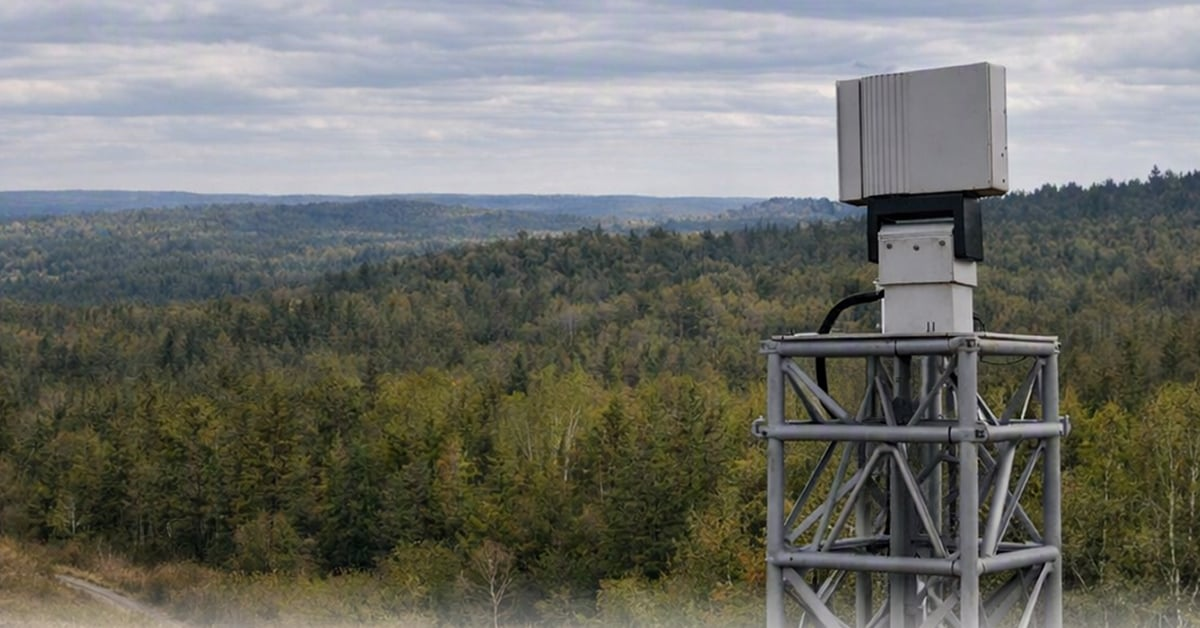
Teledyne FLIR Defense has introduced the Ranger R10-3DX, a compact radar designed to detect and track small uncrewed aircraft and other moving targets around military facilities, critical infrastructure and mobile defence platforms. The system uses digital beam-forming and automated target classification, with modular panels providing surveillance coverage around protected sites. Unveiled at the Association of the United States Army’s 2026 exhibition in Washington, the radar is expected to become available during the first quarter of 2027.
Ranger R10-3DX is intended for counter-drone surveillance, force protection and other security applications requiring information about objects moving through a defined area. Teledyne FLIR specifies detection ranges exceeding 3km for micro-uncrewed aircraft, 6km for pedestrians and 12km for light vehicles. These are manufacturer-reported capabilities associated with different target categories, rather than a single detection range applicable to every object. The company has not published detailed test conditions or independently verified performance results for the newly introduced radar.
Digital beam-forming allows the radar to direct and process measurements electronically, supporting surveillance across its field of view without relying entirely on a mechanically rotating antenna. The technique uses signals received through the radar’s antenna arrangement to form beams and estimate the positions of detected objects. Repeated measurements can then be used to maintain information about their movement. The achievable tracking performance depends on the target, surrounding environment and the processing arrangements used within the installed configuration.
A single R10-3DX panel provides 90 degrees of horizontal coverage and up to 60 degrees in elevation. Four panels can be arranged to provide full 360-degree azimuth surveillance around a protected location, with Teledyne FLIR specifying refresh rates of 2Hz or 4Hz for the resulting arrangement. More frequent updates can help maintain information about targets that change direction, although the actual ability to follow an object depends on whether the radar continues to detect it and on the quality of the measurements. The published refresh rates do not establish uninterrupted tracking under every operating condition.
Each radar panel measures approximately 49cm by 37cm by 11cm, weighs 13kg and has a stated power consumption of 180W. The dimensions support installation where available space and equipment mass are constrained, but a complete four-panel system also requires suitable mounting, power distribution and connections to other equipment. Engineers must consider the location of each panel and any structures that could obstruct its view. A mobile installation introduces additional requirements arising from vehicle movement, vibration and the position of the radar relative to the supporting platform.
Small drones can be difficult radar targets because their physical size, materials and movement produce returns that differ from those of larger aircraft. Birds and other objects can also generate radar tracks that require interpretation, while nearby buildings or terrain may contribute unwanted reflections. The R10-3DX incorporates AI-based classification algorithms intended to distinguish drones, aircraft, birds, pedestrians and vehicles. Those classifications can assist operators in assessing detections, although the manufacturer has not released detailed accuracy measurements or confusion rates for the different target categories.
Tracking several objects at once is a requirement for systems intended to monitor complex airspace activity. Radar processing must maintain separate tracks as objects move, including situations where targets approach one another or change direction. Digital beam-forming and automated classification are intended to support that work, particularly where multiple drones enter a protected area. Teledyne FLIR has not disclosed the maximum simultaneous track capacity or published the results of an independent swarm trial for the R10-3DX, so the manufacturer’s capability descriptions should not be treated as quantified performance guarantees.
The radar can also supply detection information to electro-optical and infrared equipment, allowing a connected camera to be directed towards an area of interest. This combination makes use of radar’s ability to monitor a wider area and optical equipment’s ability to provide additional visual or thermal information. Integrating the sensors requires their position references and communications interfaces to be compatible, while updates must be delivered promptly enough to support tracking of a moving object. Teledyne FLIR identifies integration with mitigation equipment as another intended application, but the R10-3DX itself is a surveillance sensor rather than an interceptor.
The company describes the new system as suitable for fixed installations and mobile platforms, with compatibility for external inertial measurement equipment or onboard sensors. Such information can assist integration where the radar’s orientation changes during operation. Teledyne FLIR also states that the system has been qualified against MIL-STD-810H environmental and MIL-STD-461G electromagnetic compatibility requirements. The precise scope of testing has not been disclosed, and compliance with defined military test methods should not be interpreted as unrestricted operation under all environmental or interference conditions.
The launch extends an established manufacturing programme rather than introducing Teledyne FLIR to surveillance radar production. In August 2026, the company announced that its engineering and manufacturing facility in Laval, Quebec, had delivered the 3,000th Ranger-series radar. The site has been producing Ranger equipment since 2005, supplying defence and security customers in more than 40 countries. That production history covers the wider product family; it does not establish that the newly introduced R10-3DX has already entered volume manufacture or secured an equivalent customer base.
The Laval operation provides experience in radar engineering, assembly and technical support across several Ranger configurations. Introducing another model involves maintaining control over its mechanical and electronic design, production testing and software configuration. Equipment intended for mobile or exposed installations also requires appropriate verification of the complete assembly rather than individual electronic components alone. Teledyne FLIR has not announced the planned annual production volume for R10-3DX or identified any additional factory investment associated with its launch.
Rob Tarantino, senior vice-president of surveillance at Teledyne FLIR Defense, described the new radar as a compact system intended to provide earlier detection and tracking of small drone threats. The company has identified military installations, airports, borders and critical infrastructure among its potential applications, but it has not announced a launch customer, contract value or production quantity.
With availability scheduled for the first quarter of 2027, the next milestones will involve customer integration and confirmation of performance under defined installation conditions. The R10-3DX adds a smaller modular surveillance option to the Ranger portfolio, while the detection ranges, tracking capabilities and classification performance achieved by completed customer systems remain to be established through subsequent deployments and testing.