IN Brief:
- Project Intuity combines a wide-area visor display, head tracking, spatial audio, and battlespace visualisation.
- Its modular architecture will support development of display optics, eye tracking, interfaces, and future mission functions.
- Production maturity will depend on low-latency electronics, optical consistency, human factors, protection, certification, and maintainability.
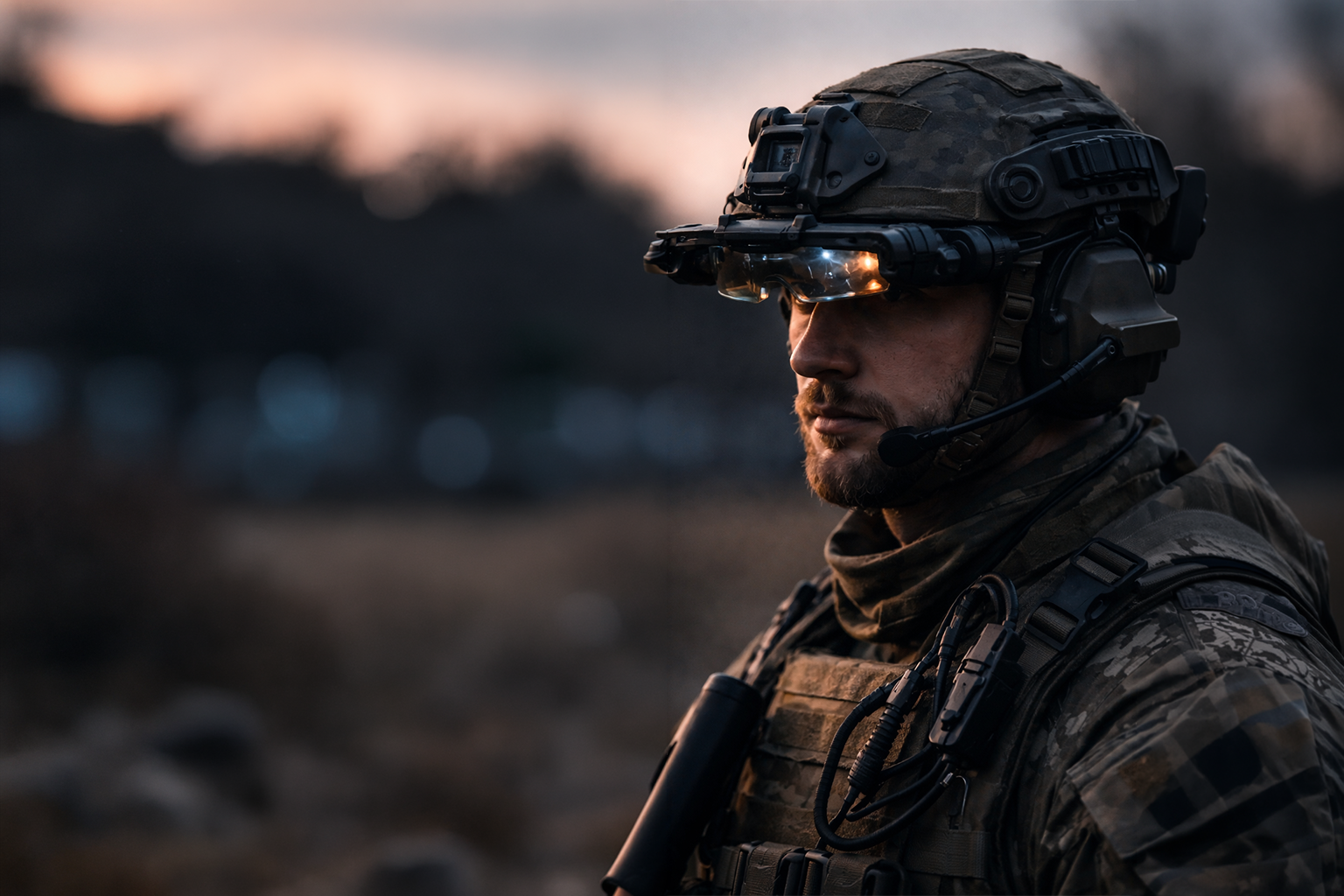
BAE Systems has unveiled Project Intuity, a modular helmet-mounted display demonstrator created to test how future combat-air crews receive, filter, and act on information from aircraft sensors, weapons, networks, and collaborative uncrewed systems.
Combining a wide-area visor display with head tracking, spatial audio, integrated sensing, and battlespace visualisation, the demonstrator provides a development platform rather than a finished production helmet. Work will continue at BAE Systems’ Rochester facility as technologies and mission requirements mature.
Sixth-generation combat aircraft are expected to fuse data from onboard sensors, other aircraft, satellites, weapons, ground systems, and autonomous collaborators. Presenting that volume of information without overwhelming the pilot requires more than placing additional symbols across an existing display.
Visual information has to be prioritised according to mission phase, threat, confidence, and urgency. Spatial audio can direct attention without adding another graphic, while eye tracking may allow the system to identify where the pilot is looking, alter the information presented, or support future control functions.
Head tracking must remain accurate as the wearer moves rapidly under acceleration, vibration, changing light, and the constraints imposed by oxygen masks and protective equipment. Display imagery must stay aligned with the outside world, because even small delays or calibration errors can create misleading target positions, discomfort, or loss of confidence.
Those demands place timing, software, optics, processing, sensors, and mechanical fit within the aircraft’s safety architecture. The helmet no longer operates as a peripheral display; it becomes an extension of the mission system and, potentially, a control interface for other platforms.
A wearable system with aircraft-level demands
Production draws together several manufacturing disciplines that rarely tolerate wide variation. The shell must provide impact protection while remaining light enough to reduce neck strain. Visors and waveguides require optical clarity, consistent coatings, distortion control, and resistance to scratching, temperature changes, moisture, and repeated handling.
Electronics must manage power and heat inside a confined wearable system, while connectors, cables, communications, hearing protection, oxygen interfaces, night capability, and ejection-seat compatibility need to operate without compromising fit or movement.
Individual pilots also require different sizing and adjustment. A production system must deliver consistent optical and tracking performance while accounting for variation in head shape, eye position, and equipment fit. Calibration and maintenance have to remain practical at squadron level rather than depend on factory specialists.
BAE Systems already has more than 1,000 helmet-mounted displays in service across ten countries, providing experience in assembly, calibration, repair, and long-term support. Project Intuity nevertheless extends the architecture towards a denser and more dynamic information environment.
Future crews may supervise several uncrewed aircraft while flying, monitoring threats, communicating, and managing weapons. Automation can filter data and recommend actions, but poorly designed presentation may increase workload if pilots cannot understand a system’s confidence, constraints, or changing task status.
Human-factors testing must therefore progress alongside autonomy software. Pilots need to evaluate the helmet in representative simulators, high-workload missions, varied lighting, and eventually flight, allowing engineers to refine symbol density, alert behaviour, control methods, and the division of responsibility between human and machine.
The modular architecture also needs a secure upgrade route. Mission software, symbology, threat presentation, processors, sensors, and collaborative-platform controls will evolve throughout the aircraft’s service life. Replaceable modules could avoid discarding the complete helmet whenever one technology becomes obsolete, although modularity introduces additional interfaces and certification work.
Project Intuity is developing within the same industrial environment as Britain’s future combat-air demonstrator, where structures, software, propulsion, sensors, and manufacturing methods are advancing in parallel. The helmet sits at the point where many of those systems reach the human operator.
Low-volume development hardware can be individually adjusted and extensively inspected, but operational fleets require repeatable optics, robust electronics, documented calibration, repair capacity, and a stable supply of specialised components. Production yield will be influenced by coating defects, alignment tolerances, electronic availability, and the ability to test each complete unit efficiently.
Project Intuity places the helmet firmly inside the future aircraft architecture. Its progress towards service will depend on whether advanced display and autonomy functions can be combined with protection, comfort, optical consistency, maintainability, and an upgrade path that survives decades of combat-air development.