IN Brief:
- NP Aerospace has won a GDLS–Canada contract for add-on armour systems for a Light Armoured Vehicle international order.
- The multi-year programme covers design, development, testing, certification, and production.
- The work strengthens composite survivability production and expands NP Aerospace’s Canadian defence-manufacturing footprint.
NP Aerospace has secured a General Dynamics Land Systems–Canada contract to design and manufacture add-on armour systems for a Light Armoured Vehicle international order, expanding its role in armoured-vehicle survivability and composite protection.
The multi-year programme covers design, development, testing, certification, and production of add-on up-armour systems using NP Aerospace’s composite armour technology. Delivery will be led by the company’s Canadian business, with the work expected to support workforce growth in London and Southwestern Ontario.
The award builds on existing cooperation with GDLS–Canada, including Armoured Personnel Transport Modules delivered through Marshall Canada for Canada’s Logistics Vehicle Modernization programme. Such continuity is valuable in armour work, where qualification history, test evidence, delivery discipline, and customer trust shape supplier selection.
Add-on armour is often described as a vehicle upgrade, but production is demanding. Modules must defeat defined ballistic and blast threats while staying within vehicle weight limits. They must fit accurately to hull geometry, avoid interference with hatches, sensors, cooling, weapons, mobility, and maintenance access, and remain durable under vibration, weather, and operational damage.
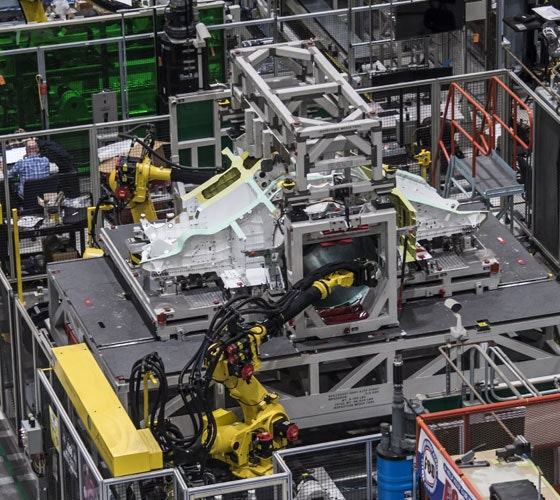
Composite armour adds further process control. Material lay-up, curing, bonding, machining, inspection, batch traceability, and environmental qualification all influence performance. A module that is slightly out of tolerance can affect installation time, protection, and fleet availability.
For vehicle primes, survivability packages also influence export competitiveness. International LAV customers want protection upgrades, but they also want predictable cost, delivery, and support. A trusted armour partner reduces programme risk because the protection package can be qualified as part of a controlled vehicle configuration rather than added as an afterthought.
Armoured-vehicle production is again becoming a capacity question across allied markets. Recent expansion in US land-systems manufacturing has put attention on machining, inspection, turret work, automation, and skilled labour. Armour production belongs in the same category because survivability sits on the production-critical path.
The Canadian delivery role gives GDLS–Canada a local survivability partner embedded in the national industrial base while drawing on NP Aerospace’s broader expertise. For defence customers, regional manufacturing and support reduce dependence on long supply chains and can simplify audits, repair planning, and future upgrade activity.
Workforce development will be a useful measure of the programme’s depth. Armour engineering needs materials specialists, production technicians, test engineers, quality staff, project managers, and documentation teams familiar with defence requirements. A multi-year contract gives companies a stronger basis for hiring, training, and retaining those skills.
The threat environment keeps raising protection requirements. Armoured vehicles now face mines, shaped-charge weapons, top-attack munitions, drones, artillery fragments, and electronic surveillance that makes exposure more dangerous. Add-on armour must evolve without consuming the payload margin needed for electronics, counter-UAS systems, radios, power upgrades, and crew equipment.
That balance sits at the centre of survivability engineering. Protection must improve, but medium vehicles cannot become so heavy that mobility, reliability, and transportability suffer. Composite systems offer one route through that trade-off, provided manufacturing remains consistent and affordable.
NP Aerospace’s GDLS–Canada contract reinforces the industrial weight behind survivability. Materials processing, certification, local manufacturing, and repeatable protection-system production are now central to armoured-vehicle export programmes, not secondary work once the platform has been sold.