IN Brief:
- General Atomics Electromagnetic Systems has received a US Army contract under the ERAP programme.
- The projectile is designed to manoeuvre at extended range while remaining compatible with existing 155mm artillery systems.
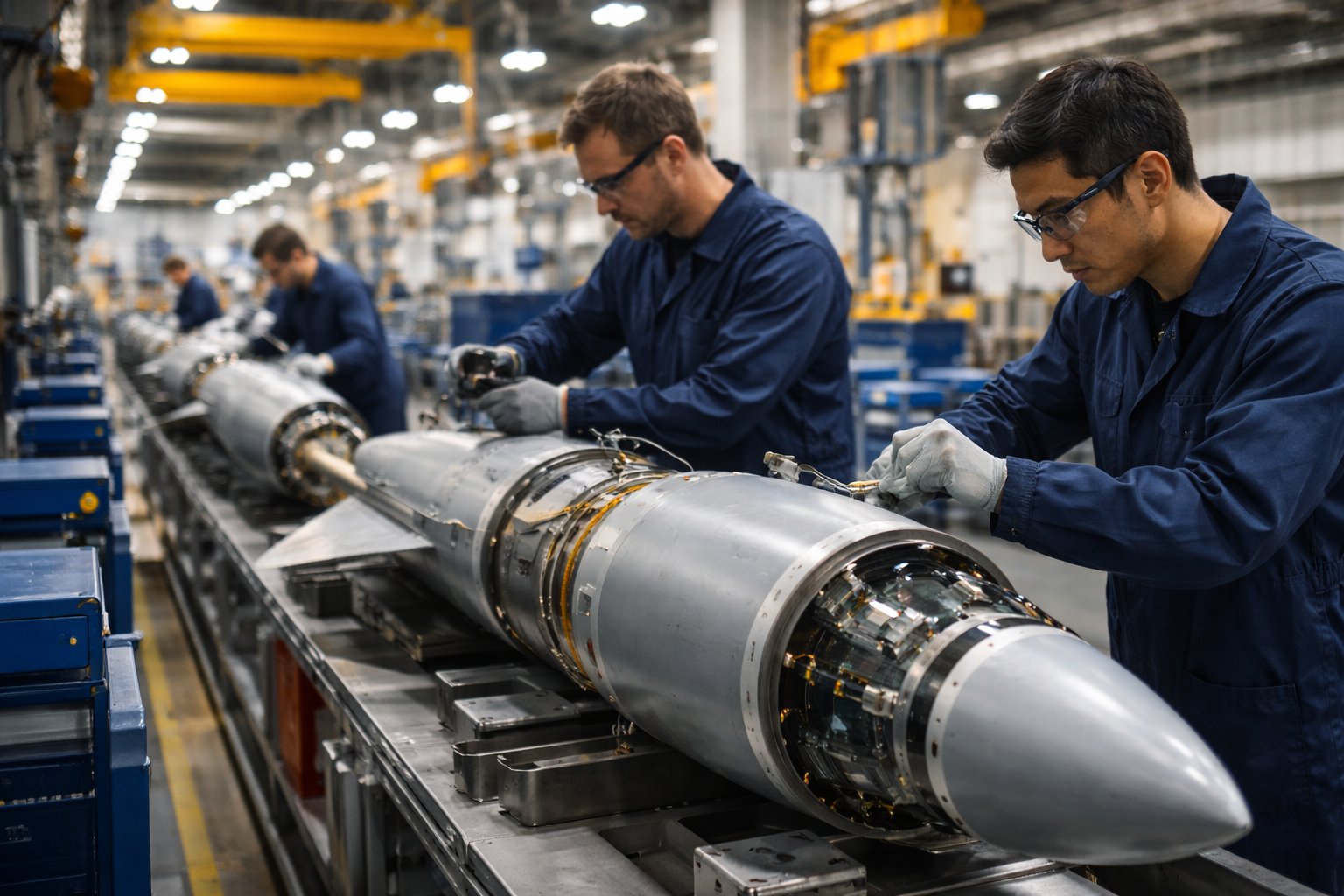
- The programme brings advanced munitions manufacturing into deployable wings, redundant guidance, precision assembly, and surge-capable production.
General Atomics Electromagnetic Systems has received a US Army contract to demonstrate a long-range manoeuvring 155mm projectile under the Extended Range Artillery Projectile programme.
The ERAP effort is intended to validate a next-generation projectile capable of significantly greater range than current rounds while retaining precision in GPS-degraded or GPS-denied environments. The Army is targeting initial operational capability by fiscal year 2030, creating a demanding schedule for development, testing, qualification, and production preparation.
The GA-EMS projectile is engineered for extended range without rocket assist and remains compatible with legacy cannons and loaders. It includes deployable wings and redundant guidance systems, giving existing howitzers a path toward longer-range precision effects without waiting for a wholly new gun fleet.
A manoeuvring 155mm projectile is much closer to a compact aerospace system than a conventional shell. It must survive gun launch, deploy aerodynamic surfaces, navigate accurately, manoeuvre at speed, and function after extreme acceleration, thermal, and vibration loads. Guidance electronics, actuation, power supply, fuzing, warhead integration, and shell-body production all need tight process control.
Compatibility with existing cannons adds constraints. If the round can work with current barrels and loading systems, the Army can improve capability through ammunition rather than platform replacement. That advantage limits diameter, length, mass, structural design, and handling geometry. Every added function has to fit inside a projectile body that remains safe to store, transport, load, and fire.
General Atomics has invested in advanced manufacturing capacity, including automation, modular production processes, and new materials at its Tupelo Manufacturing Center of Excellence in Mississippi. That production base is relevant because the Army does not only need a successful flight demonstration. It needs a munition that can be qualified, inspected, and delivered in useful numbers.
The wider US fires base is already wrestling with production economics. Recent motor-test work around massed fires has shown how rocket motors, energetics, casing tolerances, inspection, and distributed production can set the pace for munition output. ERAP brings similar pressure into the guided-artillery space.
GPS resilience is another defining requirement. Precision fires have relied heavily on satellite navigation, but electronic warfare has made that assumption fragile. Redundant guidance, inertial performance, seeker options, and navigation protection now carry as much weight as range. Artillery ammunition is being pulled into the same contested-PNT environment affecting drones, missiles, and autonomous systems.
Cost will shape procurement. Advanced projectiles can be cheaper than tactical missiles while giving artillery greater reach, but they remain far more expensive than conventional ammunition. The Army will need to decide where ERAP sits between unguided shells, guided rounds, rockets, and missiles. Manufacturers will have to keep unit cost low enough for stockpiling rather than occasional use.
The programme also supports a broader shift toward smarter magazines. Existing guns gain new value when paired with advanced ammunition, allowing forces to extend capability without replacing every launcher or platform. That makes ammunition design, electronics production, and test capacity central to land modernisation.
GA-EMS now has to prove that its projectile can move from engineering promise into repeatable manufacture. If it succeeds, the result could change the economics of long-range fires by giving existing howitzers more reach, more resilience under jamming, and a new production lane for precision artillery.