IN Brief:
- Rheinmetall has unveiled a Containerized Missile Launcher for the FV-014 loitering munition system.
- The launcher is designed to support scalable deployment within a wider reconnaissance-and-strike network.
- The development moves FV-014 from portable munition into a broader production, launch, and command architecture.
Rheinmetall has unveiled a Containerized Missile Launcher for its FV-014 loitering munition system, adding a modular launch architecture to a European-designed reconnaissance-strike weapon.
The FV-014 combines target reconnaissance and precision attack in a portable fixed-wing system with a range of up to 100km and endurance of around 70 minutes. It carries a high-explosive dual-purpose payload and is designed to operate through signal interference while retaining human-in-the-loop control.
The new launcher changes how the system can be deployed. A man-portable loitering munition gives small units precision reach, but a containerised launcher turns the same weapon into a more scalable fires asset. It supports protected storage, preloaded rounds, faster launch cycles, and easier integration into vehicle or fixed-site architectures.
Rheinmetall has already placed FV-014 on a series-production path through a Bundeswehr framework agreement, with first deliveries expected from 2027 after qualification. The FV-014 production route is built around European manufacture, modularity, standardised parts, and volume output. The CML extends that model from munition production into launch infrastructure.
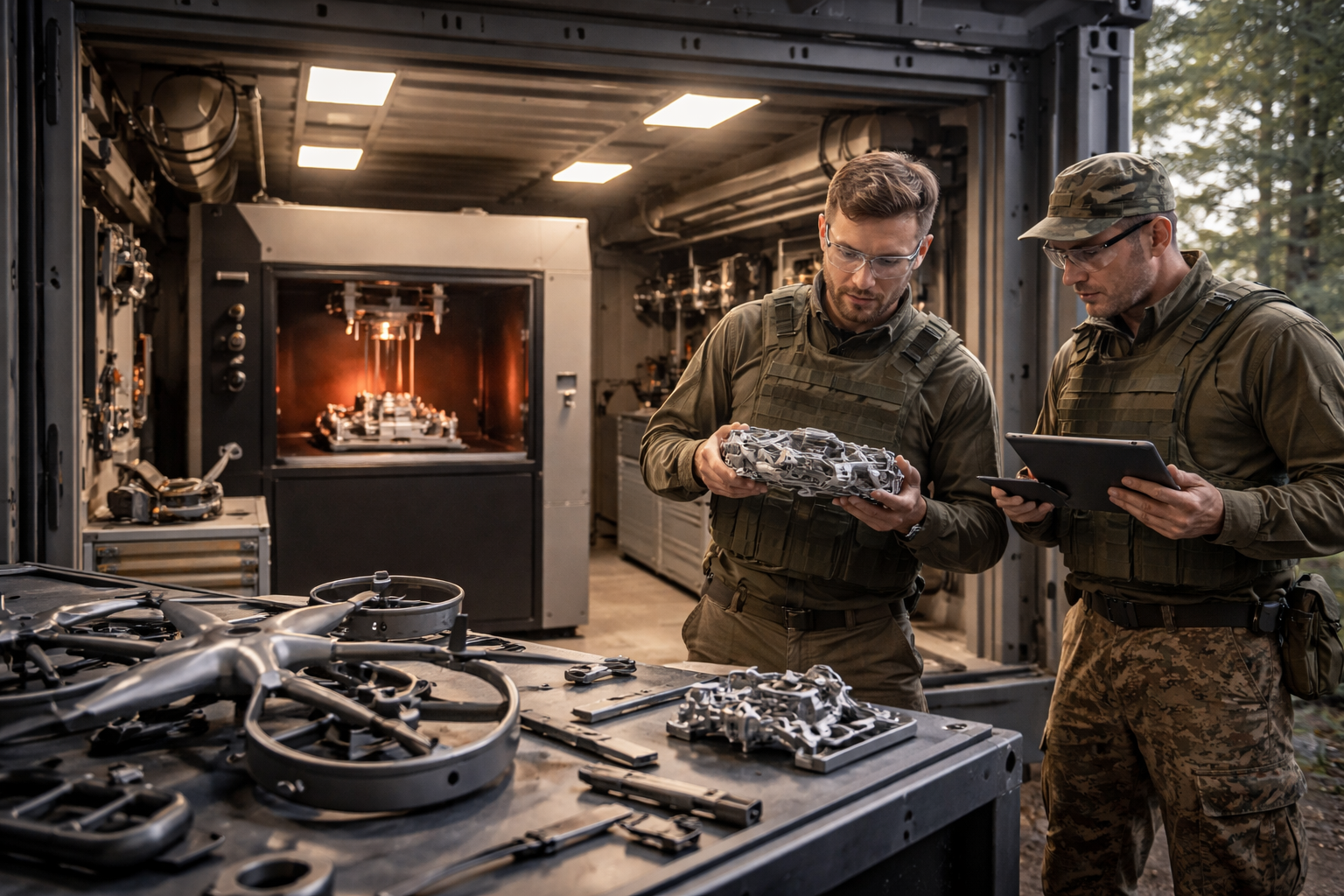
Containerised systems appeal because they can be moved, stored, concealed, and installed more easily than bespoke launch vehicles. They also create a manufacturing model around standardised launch cells, power systems, environmental protection, control electronics, cabling, safety interlocks, and software interfaces.
The development reflects a wider European search for affordable precision fires. Armies want longer reach, deeper magazines, and lower unit costs, but guided rockets, cruise missiles, and high-end missiles all face production and affordability constraints. Loitering munitions fill part of the gap by combining surveillance and strike in a weapon class that can be built in larger numbers than premium missiles.
Scaling the system will still be demanding. High-volume loitering-munition manufacture requires airframes, motors, batteries, sensors, datalinks, warheads, safe-and-arm devices, flight computers, ground-control stations, and test equipment. The launcher adds mechanical systems, launch electronics, environmental control, platform interfaces, and safety processes.
Network integration will be equally important. Loitering munitions become more valuable when connected to reconnaissance platforms, target data, command tools, and battle-management systems. Rheinmetall’s wider reconnaissance-and-strike architecture points towards an ecosystem in which sensing, mission planning, launch, control, and strike are tied together through software.
That ecosystem brings cybersecurity and electronic resilience to the front of the programme. A launcher able to manage multiple munitions must handle mission data, target information, operator authority, communications, deconfliction, and software updates. If the system is expected to function under jamming or degraded networks, redundancy and disciplined update control are essential.
The production economics will determine how far the concept spreads. Containerised launch must not turn a lower-cost munition into a high-cost infrastructure programme. Its value lies in standardisation, transportability, and the ability to support higher-volume launches without excessive bespoke integration.
The CML moves FV-014 into a more mature capability category. The munition itself remains the visible element, but industrial advantage may sit in the combined architecture: production-ready air vehicles, launch modules, command software, support systems, and an upgrade path that keeps pace with battlefield adaptation.