IN Brief:
- Dassault, representing Rafale partners Thales and Safran, has signed an industrial cooperation MoU with AED Cluster Portugal.
- The agreement follows the formal submission of a Rafale proposal for Portugal’s F-16 replacement programme in July.
- Discussions will examine possible Portuguese industrial participation but do not constitute an aircraft order or defined workshare package.
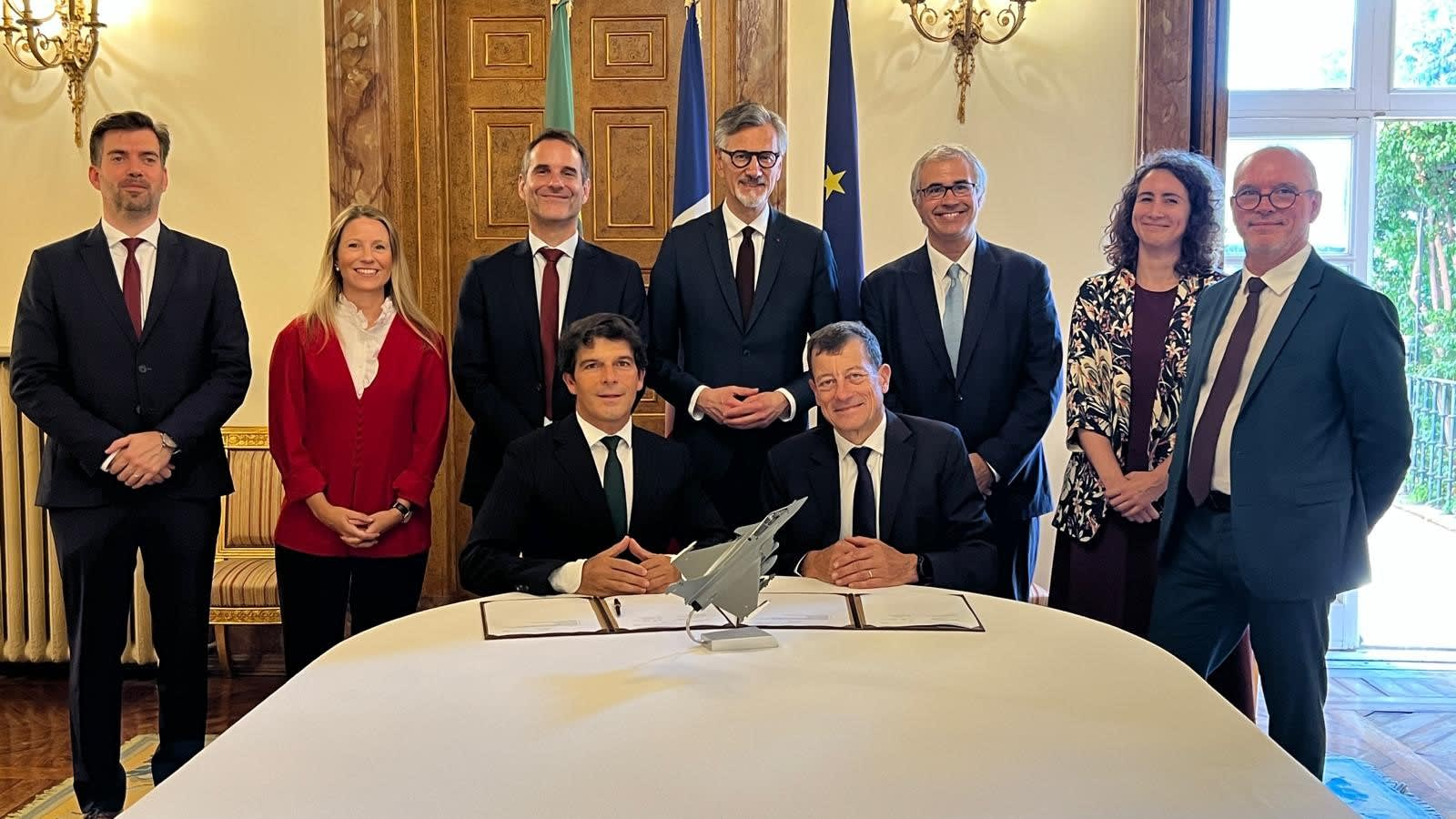
Dassault Aviation has signed a memorandum of understanding with AED Cluster Portugal to explore industrial cooperation around Rafale as Portugal considers the future replacement of its F-16 fighter fleet.
Dassault signed the agreement on behalf of the three principal Rafale industrial partners, including Thales and Safran. AED Cluster Portugal represents companies across the country’s aeronautics, space, and defence sectors. The memorandum follows Dassault’s formal submission of a Rafale proposal to the Portuguese government and Portuguese Air Force in July 2026.
The agreement does not award aircraft, establish a production volume, or guarantee Portuguese workshare. It creates a framework for examining where local companies could participate if Rafale progresses through the F-16 replacement process, allowing potential industrial arrangements to be assessed before an acquisition decision is made.
Portugal’s fighter force is built around the F-16M, operated from Monte Real and used for national air defence and NATO missions. The aircraft remain operationally active, but long-term force planning requires a successor capable of sustaining combat-air capability as the F-16 fleet ages.
Portugal has already developed domestic experience in fighter sustainment through the F-16 programme. Its fleet underwent a Mid-Life Update, and the country has supported maintenance, modification, and operational activity around the type rather than relying entirely on overseas contractors.
That background gives industrial participation greater substance than a simple local-content percentage. A new fighter fleet creates decades of work around maintenance, repair, software, mission data, training, component support, weapons integration, and supply management. The extent to which those activities can be carried out domestically affects both long-term programme cost and national control over fleet availability.
Dassault says the memorandum is intended to build on relationships already established by Rafale partners in Portugal. Thales and Safran broaden the possible cooperation beyond airframe support because they provide major elements of the aircraft’s sensor, avionics, propulsion, and equipment base.
Rafale’s industrial structure centres on Dassault as prime contractor and airframe integrator, Safran as supplier of the M88 engine, and Thales across major mission-system technologies. Portuguese businesses could therefore encounter several potential entry points in maintenance, manufacturing, engineering, or support, but each would carry qualification, security, quality, and configuration requirements.
Aerospace work cannot be reassigned solely through a commercial memorandum. Suppliers entering a combat-aircraft programme may need approved manufacturing processes, traceability, specialist inspection, cyber controls, airworthiness procedures, and reliable delivery performance before work can be placed with them.
The same constraints apply to sustainment. Maintenance or component overhaul affecting flight safety or mission-critical systems requires controlled technical data, trained personnel, approved tooling, and disciplined configuration management. Early industrial discussions give bidders and local companies time to establish whether those conditions can be met before a final work package is negotiated.
Dassault is also continuing to develop Rafale as an evolving combat system. The company recently flight-tested sovereign artificial-intelligence algorithms aboard the aircraft, while the operational platform combines electronically scanned radar, the SPECTRA electronic-warfare suite, multisensor data fusion, and a range of French and multinational weapons.
Those continuing upgrades affect the industrial discussion because support over a combat aircraft’s service life extends well beyond the configuration delivered on day one. Software standards, sensors, weapons, processors, communications, and electronic-warfare functions can all change during the programme, creating recurring engineering and qualification work.
Portugal will have to balance industrial participation against operational requirements, acquisition cost, delivery timing, interoperability, training, and long-term sustainment. Its F-16 fleet remains in service, giving the government scope to structure a replacement programme rather than buying against an immediate loss of capability.
The AED Cluster memorandum is therefore groundwork rather than an acquisition milestone. Dassault has placed Rafale into the Portuguese process and opened discussions about how local industry might participate if selected.
The substantive milestones remain Portugal’s procurement decision and any later definition of workshare, sustainment responsibilities, investment, or supplier qualification. Those steps will determine whether the memorandum develops into lasting Portuguese participation in the Rafale industrial base.