IN Brief:
- The Marine Corps will evaluate cargo unmanned aircraft during demonstrations in Huntsville, Alabama, from 25 January to 5 February 2027.
- Participants must demonstrate autonomous resupply missions involving 100lb and 150lb payloads, followed by unloaded return flights.
- Successful trials could support prototype agreements and subsequent production decisions under the military's unmanned logistics programme.
The US Naval Air Systems Command is inviting unmanned aircraft developers to demonstrate longer-range tactical cargo systems capable of delivering supplies to dispersed Marine Corps units. The Tactical Resupply Unmanned Aircraft System Increment II programme will evaluate autonomous aircraft against specified payload, range, flight-control, and operating requirements during demonstrations scheduled for early 2027.
The government plans to conduct the trials in Huntsville, Alabama, between 25 January and 5 February 2027. Its Air Warfare Program Management Office, operating within the Direct Reporting Portfolio Manager for Robotic and Autonomous Systems, is coordinating the activity. Applications close at 23:59 Eastern Standard Time on 30 November 2026, with selected participants expected to receive notification by 18 December.
TRUAS Increment II supports the Marine Corps Unmanned Logistics System – Air programme, which is intended to provide airborne distribution capacity where ground transport or crewed aviation cannot readily meet tactical resupply requirements. The focus is on equipment that smaller military units can operate in distributed environments, including locations with limited infrastructure and considerable separation between supply points.
The first mandatory demonstration requires an aircraft to transport a 100lb payload over 40 nautical miles, detach the load, and return to its original launch location without cargo. The second increases the outbound payload to at least 150lb but reduces the required delivery distance to ten nautical miles. Each aircraft must complete the respective outward and return flights without refuelling.
These missions test different relationships between payload mass and usable range. Carrying a heavier load increases the demands placed on propulsion and lift, while a longer flight requires sufficient fuel or stored energy for both the delivery leg and the return journey. The aircraft must also remain controllable after releasing its cargo, when the change in mass alters the conditions under which it is flying.
Both required missions involve autonomous flight, with a minimum transit speed of 50 knots. Aircraft must operate no higher than 1,000 feet above ground level during the trials and be capable of launching and recovering without catapults, arresting nets, cables, or other mechanical launch and recovery equipment. These conditions establish an operating environment that places considerable emphasis on the aircraft’s own propulsion, landing, and control arrangements.
The government expresses a preference for aircraft with a maximum gross take-off weight of approximately 350lb or less. That figure is an evaluation preference rather than an unconditional exclusion of heavier designs. The application assessment also considers the proposed propulsion and energy source, with heavy-fuel and hybrid configurations receiving favourable treatment under the published evaluation criteria.
Propulsion selection influences endurance, operating procedures, and the logistical support required by a deployed unit. Fuelled aircraft need appropriate storage and handling arrangements, while battery-powered and hybrid designs introduce different charging, replacement, and power-management requirements. The demonstration will assess whether a submitted aircraft can meet the prescribed mission rather than assume that one propulsion arrangement is suitable for every application.
Participants must demonstrate ground preparation and refuelling procedures, followed by up to five autonomous flights. Two flights are mandatory, while the government may authorise as many as three additional demonstrations to examine capabilities beyond the basic requirements. These supplementary activities allow suppliers to present alternative operating characteristics without changing the two principal cargo missions against which eligible systems will be assessed.
Airspace and range safety form part of the demonstration requirements. Each aircraft must carry a transponder with at least Mode 3/C capability, while applicants must provide lost-link and return-to-home procedures. Manufacturers must also supply information needed for frequency-spectrum authorisation and coordination of the aircraft’s command and control equipment. These arrangements allow the test organisers to manage unmanned flight activity within the designated environment.
Maintaining autonomous operation requires the aircraft to follow an approved route and respond appropriately when communication with its operators is interrupted. The relevant procedures must address how the aircraft behaves if a control link becomes unavailable, while the flight-control system must continue managing navigation and recovery within the authorised operating conditions. The programme will collect performance evidence during the demonstrations rather than rely solely on suppliers’ claimed specifications.
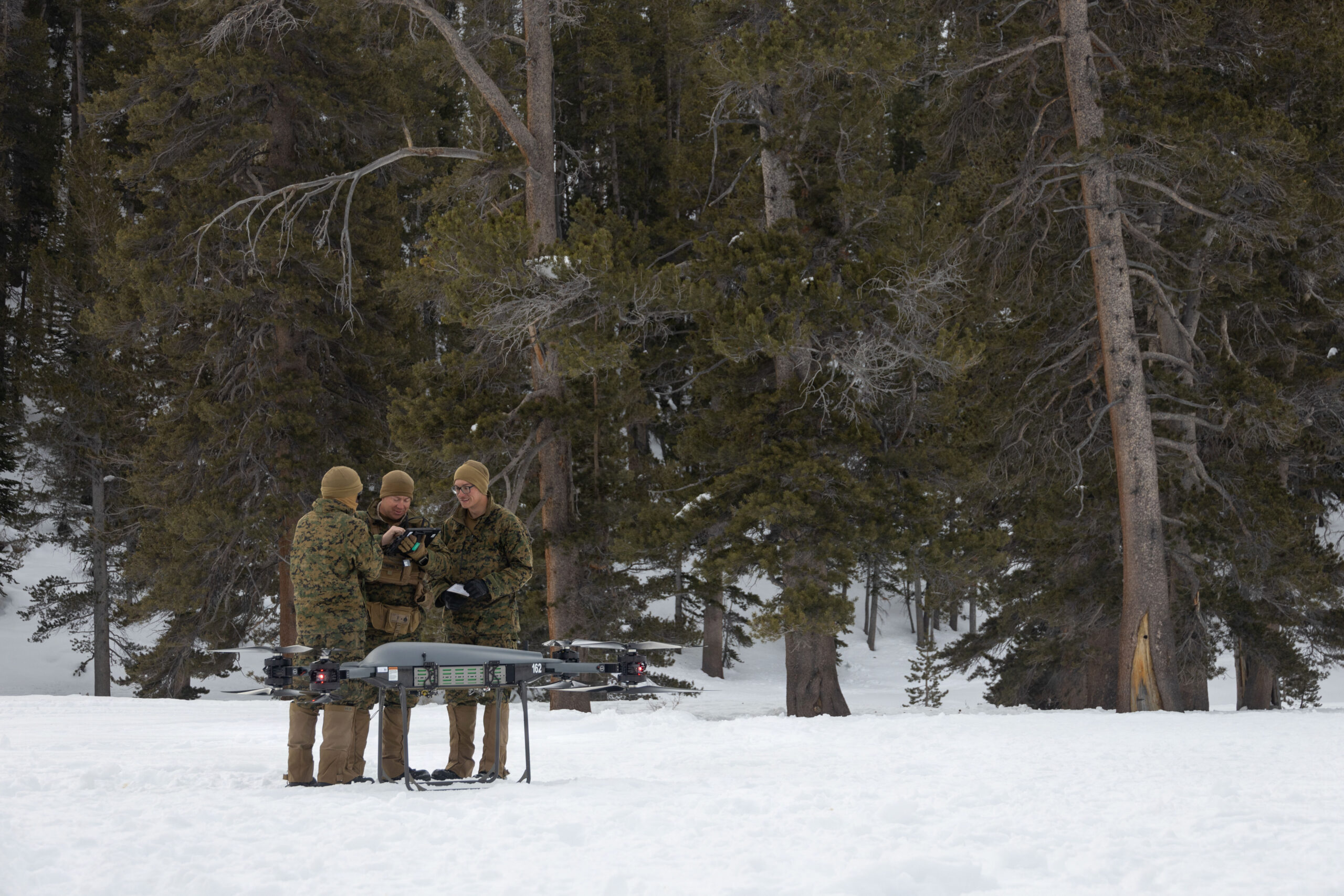
The Marine Corps already has experience with autonomous tactical resupply through the TRV-150 aircraft. Naval Air Systems Command identifies its existing configuration as capable of carrying up to 120lb over a comparatively short combat radius, using automated launch, waypoint navigation, landing, and cargo delivery. Increment II introduces substantially longer prescribed flights, while retaining the requirement to move supplies without continuous manual flight control.
The wider Unmanned Logistics System – Air programme also includes development of aircraft for heavier or longer-distance transportation. These efforts address different parts of military distribution, from small loads delivered directly to dispersed units to movements between ships and operating locations. The Increment II trials will determine which submitted designs can satisfy the specified combination of payload, range, autonomy, and operating constraints.
Participation is open to established manufacturers, smaller engineering businesses, and non-traditional defence suppliers. Applicants must provide a three-to-five-page technical white paper and the completed programme questionnaire. The government will assess aircraft maturity and the evidence supporting claimed performance, with applicants encouraged to address the published evaluation criteria before the selection decision.
Selection for the Huntsville demonstration does not constitute a contract award. Following the trials, the government may offer one or more Other Transaction prototype agreements, but it also reserves the right to make no awards. Successful completion of a prototype programme could subsequently provide a route to production, while flight data may inform other authorised military drone procurement evaluations.
The application deadline and January demonstration establish the next milestones for Increment II. Suppliers will be evaluated on observed aircraft performance and the suitability of their systems for military logistics, with subsequent prototype or production arrangements dependent on further government decisions.