
IN Brief:
- Protector RG Mk1 completed its first disclosed operational surveillance sorties in UK airspace during October.
- The aircraft supported Royal Navy monitoring operations with more than ten hours of intelligence coverage.
- Its maritime role combines long endurance, onboard sensors, remote operation, and integration with other airspace users.
The Royal Air Force has completed its first operational maritime surveillance sorties using Protector RG Mk1 in UK airspace, providing more than ten hours of intelligence coverage during Royal Navy operations in the English Channel. The remotely piloted aircraft supported monitoring of Russian naval movements while operating alongside other military and civilian air traffic.
Protector joined a wider sequence of maritime monitoring activities involving the Type 45 destroyer HMS Dauntless and the offshore patrol vessel HMS Tyne. During the first half of October, the ships monitored the Russian frigate Neustrashimy and accompanying vessels transiting waters close to the United Kingdom. Protector’s surveillance activity contributed an airborne observation capability to the Royal Navy’s existing surface and helicopter operations.
The aircraft conducted its maritime missions without weapons, concentrating on intelligence, surveillance, and reconnaissance. Its first disclosed operational activity in British airspace marks a further step in the RAF’s introduction of a remotely piloted aircraft designed to operate within the wider aviation environment. The aircraft had previously undertaken operational intelligence missions overseas, making the UK maritime task a new application of an established operational capability.
Protector is based on General Atomics Aeronautical Systems’ MQ-9B SkyGuardian aircraft, adapted for British military requirements. It replaces the RAF’s earlier MQ-9A Reaper capability with a more recent airframe, updated equipment, and an operating architecture developed around certification and integration with controlled airspace. The UK Military Aviation Authority awarded Protector its military type certificate in April 2025, establishing an important part of the aircraft’s entry into service.
The certification programme was designed to support operation in UK airspace without the geographical restrictions that applied to earlier remotely piloted military aircraft. Operating alongside other air traffic requires procedures and equipment supporting safe separation, communications with air traffic services, and compliance with the applicable operating rules. These requirements form part of the aircraft’s normal operating arrangements rather than a separate capability introduced specifically for the October missions.
Protector’s long endurance allows it to remain airborne for extended surveillance tasks. The RAF’s published technical specification identifies more than 40 hours of endurance and a maximum altitude of 50,000 feet, while its operational descriptions use the more conservative reference of over 30 hours and up to 40,000 feet. The October maritime task involved more than ten hours of surveillance coverage, without a disclosed maximum altitude or complete flight-duration profile for the individual sorties.
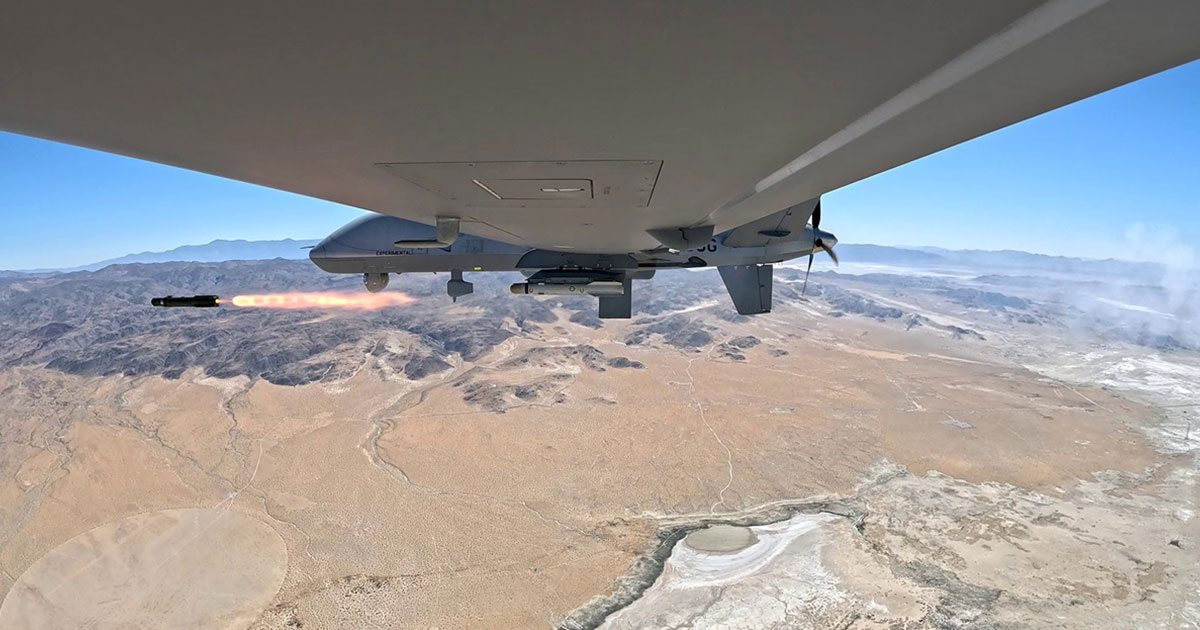
The aircraft uses a Honeywell TPE331-10T turboprop engine and has a wingspan of approximately 24 metres. Its design supports a range of sensors and communications equipment intended for intelligence gathering and precision strike missions. Although the aircraft is compatible with Brimstone 3A missiles and Paveway IV guided bombs, the reported English Channel operations were unarmed.
Protector’s published surveillance equipment includes an electro-optical and infrared targeting system, full-motion video, synthetic aperture radar, and ground moving-target identification functions. Optical equipment can provide detailed imagery where observation conditions permit, while radar offers a separate means of examining an area using reflected radio-frequency signals. The combination provides different methods of collecting information, with their effectiveness dependent on the task, target, and surrounding conditions.
During maritime surveillance, information gathered from an aircraft can complement the observations available to surface vessels. A ship’s sensors and watchkeeping personnel provide information from its position at sea, while an airborne system can observe from a different location and altitude. The resulting reports can contribute to a wider operating picture when passed through the appropriate communications and command arrangements.
The October missions demonstrated Protector’s ability to participate in that operating environment. Royal Navy ships continued their surface monitoring activities while the aircraft supplied additional intelligence coverage. The Ministry of Defence has not specified the number of Protector sorties, the sensors used against individual vessels, or the proportion of each transit observed by the aircraft.
Protector is remotely operated by personnel based at RAF Waddington in Lincolnshire. The RAF identifies a pilot, sensor operator, and mission intelligence coordinator as the aircraft’s crew. Flight control, sensor management, and intelligence handling are therefore distinct responsibilities, coordinated through the aircraft’s ground control and communication systems. This arrangement allows the aircraft to operate without an onboard crew while maintaining human control over flight and mission activities.
Communications links are central to the remotely piloted architecture because instructions and sensor information must move between the aircraft and its operators. Flight operations require dependable links and approved procedures for managing interruptions, while intelligence collection depends on transmitting or recording information in a form suitable for subsequent processing. The RAF has not published the detailed communications configuration used for the English Channel sorties.
The aircraft’s introduction into British service has progressed through several stages. The first Protector arrived at RAF Waddington in 2023 and completed its first flight in UK airspace that November. Subsequent testing and certification supported its entry into service in 2025, followed by the commencement of operational missions overseas in November of that year.
In June 2026, a Protector flew from RAF Waddington to RAF Akrotiri in Cyprus, covering more than 2,000 nautical miles during a journey lasting approximately 13.5 hours. The deployment involved flight through European airspace and provided further experience of operating the aircraft beyond its home station. The October maritime sorties followed that activity by applying the aircraft to surveillance missions close to the United Kingdom.
At the end of October, the RAF also recorded Protector’s first 1,000 operational flying hours. The accumulated activity includes intelligence missions supporting British personnel and allied operations overseas. This broader flying record provides context for the aircraft’s increasing operational use, while the English Channel mission establishes its first disclosed operational maritime surveillance activity in domestic airspace.
The Royal Navy and RAF are developing closer links between crewed and remotely operated platforms as maritime surveillance requirements expand. Protector’s ability to remain on station for extended periods provides an additional option alongside surface ships and maritime helicopters. Its use must be coordinated with existing naval command arrangements, the availability of trained operators, and the aircraft’s other operational commitments.
The October sorties establish a working example of Protector providing intelligence support to Royal Navy vessels while operating in British airspace. Further deployments will determine how routinely the RAF can allocate the aircraft to maritime tasks, how those missions are coordinated with other surveillance platforms, and how the capability develops as additional aircraft and equipment enter service.