IN Brief:
- Patria demonstrated coordinated surface and airborne unmanned systems at a Finnish Navy event in Upinniemi.
- A common mission management system connected the participating platforms, with remote control from two Finnish locations.
- Finland plans to establish an Unmanned Systems Company within its Coastal Brigade in early 2027.
Patria and the Finnish Defence Forces have demonstrated coordinated operations involving unmanned surface vessels and aircraft, using a common mission management system during a Finnish Navy event at Upinniemi on 5 November.
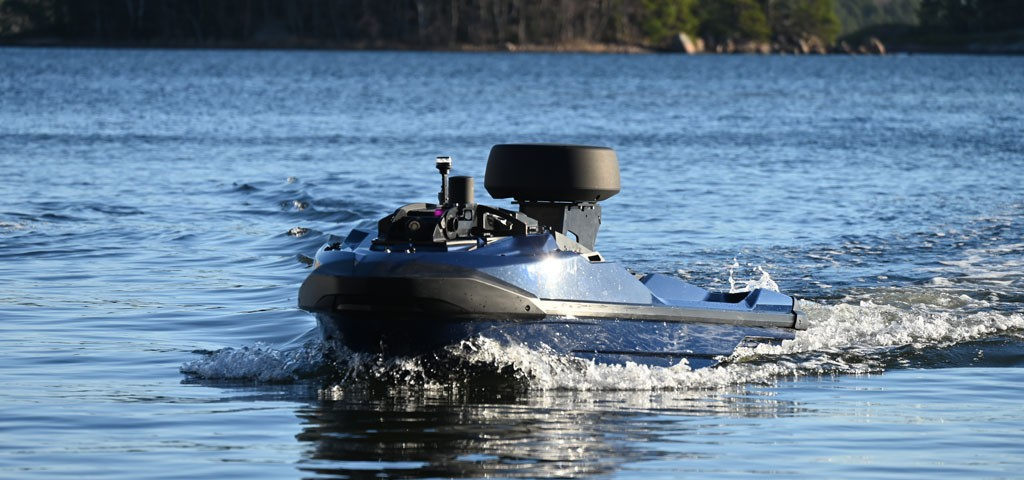
The demonstration brought together a surface vessel equipped with Patria’s autonomy kit, a lightweight fixed-wing unmanned aircraft, and a Patria ONE quadcopter launched from the aft deck of a Finnish Navy Jehu-class vessel. The participating systems completed an assigned mission while being remotely controlled from two locations in Finland.
The Finnish Navy also confirmed plans to establish an Unmanned Systems Company within its Coastal Brigade at the beginning of 2027, providing a dedicated organisational structure for developing and operating remotely controlled and autonomous capabilities.
Patria’s mission management system provided the common coordinating environment for the demonstration. Its multi-domain architecture is designed to connect different unmanned platforms, allowing their activities to be managed within a combined mission rather than requiring each system to operate independently.
Combining vessels and aircraft introduces different control requirements. Surface platforms must accommodate maritime navigation and changing conditions on the water, while fixed-wing and multirotor aircraft have distinct flight characteristics, endurance limits, and launch arrangements.
The demonstration established that the participating platforms could operate together under the mission management arrangement. Patria has not disclosed the mission duration, operating range, communications architecture, or individual platform performance measurements.
The surface vessel used Patria’s autonomy kit, which the company describes as suitable for rapid installation on sufficiently modern vessels. The equipment provides a means of adapting existing maritime platforms for unmanned operation, subject to the interfaces and technical characteristics of the host vessel.
Adapting a vessel requires the autonomy equipment to interact with its onboard systems. Steering, propulsion, navigation, and other platform functions must be accessible through suitable control interfaces, while the installed configuration must be tested against the requirements of the intended application.
Patria has not published a standard installation period or a list of certified vessels. Its description of the kit’s broad compatibility therefore establishes the intended integration approach rather than guaranteeing that every existing vessel can be converted without additional engineering.
The fixed-wing aircraft provided one airborne element of the combined mission, operating alongside the surface platform. A Patria ONE quadcopter supplied another, taking off from the aft deck of a Jehu-class vessel during the demonstration.
The shipboard launch is a distinct part of the engineering activity. Deploying an aircraft from a naval vessel introduces requirements associated with deck space, aircraft handling, the movement of the host platform, and communications between the aircraft and its operators.
The ONE’s multirotor configuration allows a different launch arrangement from that generally required by fixed-wing aircraft. The published account confirms the successful launch and participation in the mission but does not describe recovery procedures or the limits under which the quadcopter can operate from a moving vessel.
Patria describes surveillance, reconnaissance, and target acquisition among the possible applications for the integrated systems. These missions can involve collecting information from different platforms and making it available through the common mission management environment.
Surface and aerial sensors offer different viewing positions and operating characteristics. A maritime platform can remain in an area while an airborne system observes from above, although the quality and continuity of information depend on the equipment fitted and the conditions in which it operates.
The company also identifies a one-way operating mode in which an unmanned system can carry a warhead. That is a stated capability option, not confirmation that an armed engagement or live weapons activity formed part of the Upinniemi demonstration.
Remote control from two separate locations added a distributed element to the activity. Operators did not need to be positioned at a single control station to participate in managing the combined mission, although the company has not identified the communications links or network arrangements connecting the locations.
Distributed control requires information and instructions to pass between the mission management system, the participating platforms, and their operators. The published demonstration does not provide sufficient data to assess the arrangement’s performance during communications disruption, electronic interference, or loss of satellite navigation.
Likewise, describing the activity as a multi-domain swarm does not establish that every platform made all navigation and mission decisions without human intervention. Patria confirmed remote control and coordinated operation, but did not disclose the division of control between operators, onboard software, and the common management system.
The demonstration forms part of a longer development relationship between Patria and the Finnish Defence Forces. The company has been working on autonomous and unmanned technologies through its Defence and Weapon Systems business, alongside its established military platform and sustainment activities.
The Finnish Navy intends to integrate unmanned systems both through dedicated formations and within existing operational units. Rear Admiral Tuomas Tiilikainen, Commander of the Finnish Navy, identified combat vessels and intelligence organisations among the possible users of the technology.
The planned Coastal Brigade company provides a route for concentrating operational experience and training around the new equipment. Its establishment is scheduled for early 2027, although the announcement does not specify the number of platforms, personnel, or individual equipment contracts that will support the unit.
Patria’s industrial capabilities span protected mobility, weapons systems, and sustainment, providing manufacturing and integration expertise across several defence domains. The company is owned by the Finnish state, with a 50.1% holding, and Kongsberg Defence & Aerospace, which owns the remaining 49.9%.
The Finnish demonstration has established coordinated operation between unmanned maritime and airborne systems using Patria’s mission management technology. Further testing and the creation of the Coastal Brigade unit will determine how these capabilities are introduced into Finland’s established naval organisation.